


Botulinum toxin is often thought of as a quick, single treatment. In my practice I think of it a little differently: as one of the ways a result is looked after over time.
The aim is the same as with anything else I do. It is not a different face, but the one you had earlier, kept that way as far as it reasonably can be.
Why I think of it as maintenance
Even when a lift gives a clear result, that result does not last a lifetime. The way I put it to patients is that ten years on, they are still ahead of where they would have been without it. Keeping that advantage is what maintenance is for.
So after a procedure, I usually talk with patients about light maintenance once or twice a year, with treatments such as botulinum toxin.
Where wrinkles are deep, I also use botulinum toxin and filler alongside a thread lift, because a lift and a wrinkle are different problems.
One injection, three different purposes
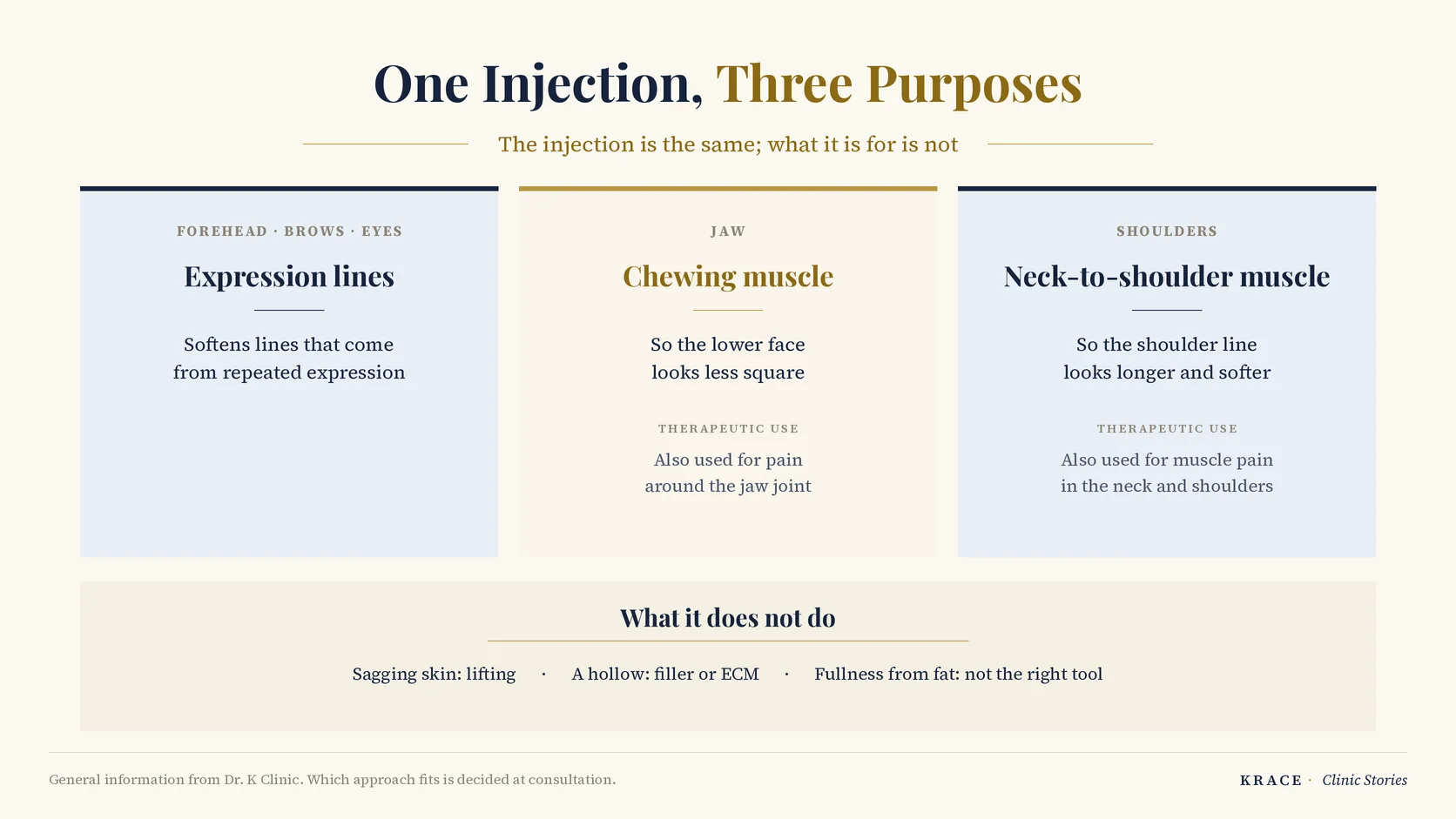
At Dr. K Clinic I use botulinum toxin in three areas, and the purpose is different in each.
On the forehead, between the brows and around the eyes, it softens lines that come from repeated expression. On the jaw, it is used on the chewing muscle, so the lower face looks less square. On the shoulders, it is used on the muscle that runs from the neck to the shoulder, so the line between them looks longer and softer.
The injection is the same. What changes is what I am trying to do with it, and that is why the question I start with is not “where do you want it?” but “what is bothering you?”
What it does not do
Botulinum toxin works on muscle. It does not lift skin that has sagged; that is a job for lifting. It does not fill a hollow; that is a job for filler or an ECM injectable. A lift and a wrinkle are different problems, and so are a wrinkle and a hollow. Much of a consultation is working out which of these a patient is actually looking at.
The jaw and the shoulders: when I use it
On the jaw, I use it where a well-developed chewing muscle makes the face look square. I also use it therapeutically, where there is pain around the jaw joint.
On the shoulders, I use it where the line of the shoulders looks raised. Here too there is a therapeutic use, for muscle pain in the neck and shoulders.
Where the fullness comes from fat or from sagging rather than from muscle, I do not actively suggest it. Some patients also ask about teeth grinding; in my experience it does not help with that.
How it works over time, and how often
On the jaw and the shoulders, the change happens in stages. About a week after the injection, the muscle has less strength and cannot contract as fully. After about a month, because the muscle has been working less, it begins to shrink, and that is when the slimming starts to show. It looks smallest at around three months.
From that point, strength slowly returns, usually around five to six months after the injection, and as the muscle starts working again it gradually becomes fuller. So in my practice the interval between injections is about six months, or five at the earliest.

The day of treatment
Bruising is uncommon, though a slight bruise occasionally appears. Flying the same day is fine, and other treatments can be done on the same day. For the day itself, I ask patients to avoid alcohol, smoking, saunas and swimming pools where they can.
Before any treatment, I ask about diabetes, high blood pressure, and any other ongoing condition, and about every medication and supplement a patient takes.
Risks to review before deciding
Every medical procedure carries risk, and those risks differ by treatment and by patient. Outcomes vary between individuals, and no result can be guaranteed in advance.
How the choice is made
At the first consultation I start with what is bothering the patient and the current state of the face. I then ask what has been done before, and check whether general health makes a procedure appropriate. I prefer to have that conversation in person, before anything is scheduled.
Dr. Wooin Kim, Medical Director, Dr. K Clinic
Seongnam, just outside Seoul, South Korea
This article is general information and is not a substitute for individual medical consultation.