

“Skin booster” is a single name for several different injections. At Dr. K Clinic I use four, and they do not all do the same thing. Which one I use depends on what a patient wants to change, not on which name is most familiar.
The aim is the same as with anything else I do. It is not a different face, but the skin you had earlier, returned to that condition as far as it reasonably can be.
What a skin booster does, and what it does not
Skin boosters work mainly on the condition of the skin itself. Most are not meant to lift the face, or to add volume in the way a filler does. The exception is the ECM type, which I also use where a small hollow needs filling, such as beneath the eye.
The four I use
A collagen-stimulating booster, which prompts the skin to produce collagen of its own. I use it where the skin has become thin and lost elasticity.
An ECM booster, made from extracellular matrix, the structural material of skin, derived from donated human tissue. I use it where an area has hollowed or lost elasticity.
A hydrating “water-glow” treatment. I use it for hydration and fine lines.
A polynucleotide (PN) booster. I use it for redness, elasticity, fine lines, and skin that is dry beneath the surface.

When I turn to something else
Where the main concern is sagging, I turn to lifting rather than a skin booster. Pigmentation, such as melasma and dark spots, I treat with laser. A skin booster is not the tool for either.
Sessions, and the days afterward
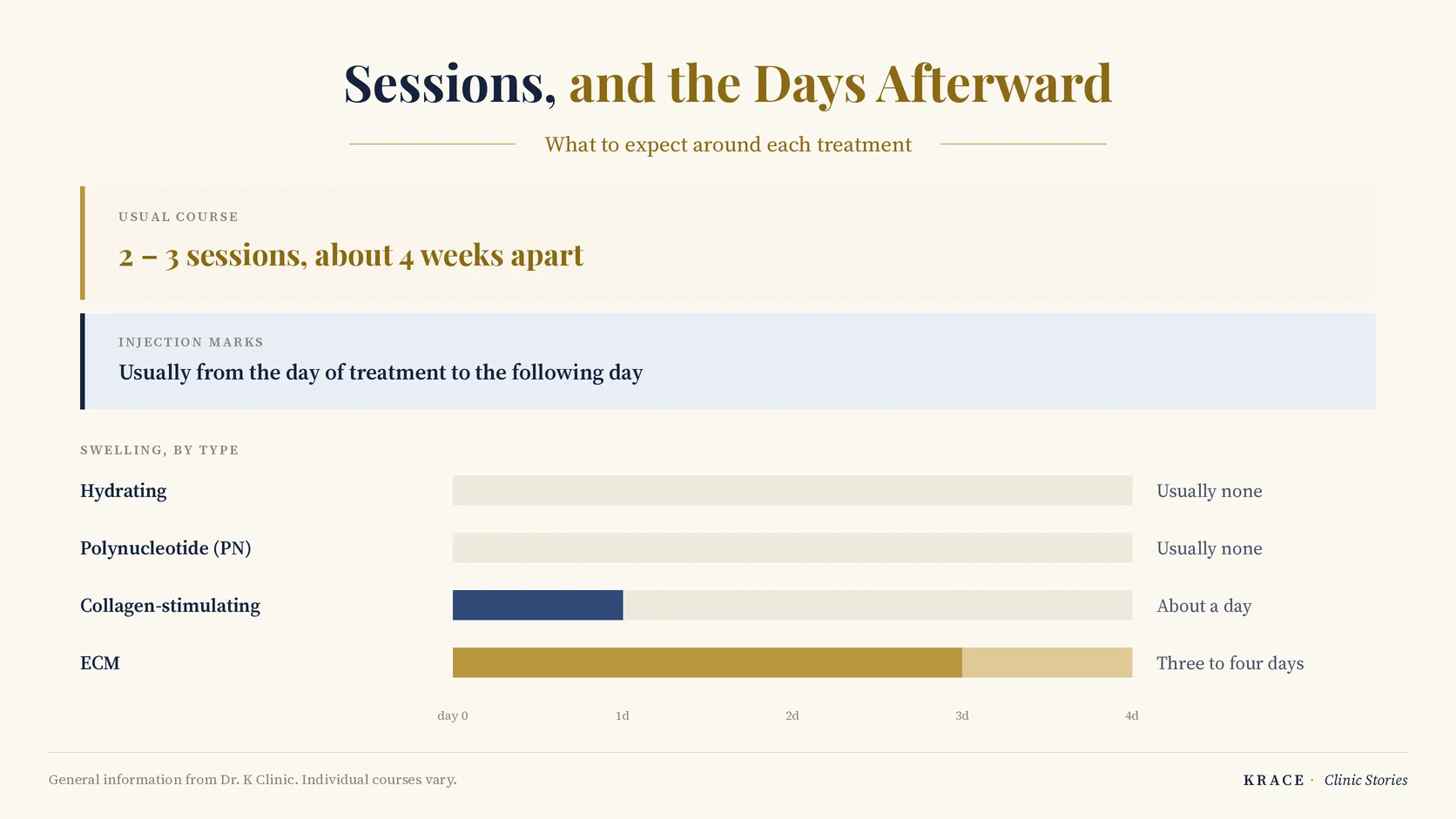
In my practice, skin boosters are usually given in two to three sessions, about four weeks apart.
Marks from the injections usually last from the day of treatment to the following day. Swelling depends on the type. The hydrating and PN types usually cause none. The collagen-stimulating type usually settles in about a day, and the ECM type in three to four days.
Before any treatment, I ask about diabetes, high blood pressure, and any other ongoing condition, and about every medication and supplement a patient takes. Several of them affect bleeding and bruising directly.
Risks to review before deciding
Every medical procedure carries risk, and those risks differ by treatment and by patient. Outcomes vary between individuals, and no result can be guaranteed in advance.
How the choice is made
At the first consultation I start with what is bothering the patient and the current state of the skin. I then ask what has been done before, and check whether general health makes a procedure appropriate. After that I explain which treatment would address what, so that the choice rests on what the skin needs rather than on a brand name.
I prefer to have that conversation in person, before anything is scheduled.
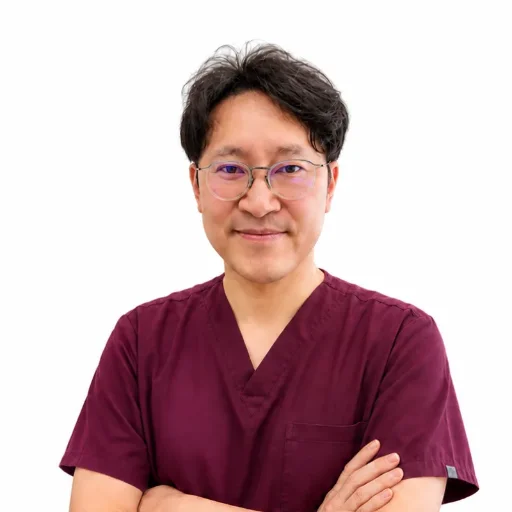
Dr. Wooin Kim, Medical Director, Dr. K Clinic
Seongnam, just outside Seoul, South Korea
This article is general information and is not a substitute for individual medical consultation.