

Official 2025 foreign-patient statistics, published by South Korea's Ministry of Health and Welfare in April 2026. Data checked November 7, 2026.
More than two million international patients received medical care in South Korea in 2025. But what kinds of care did they visit for? And what should someone planning a medical appointment in Korea take from those figures?
The official data tells a broader story than cosmetic surgery alone: dermatology leads the recorded specialty counts, but visitors also use internal medicine, health screening, and other services. This guide explains the numbers, the differences between countries, and the practical questions worth asking before making a booking request.
The Quick Answer
Dermatology represented 62.9% of Korea's recorded international-patient specialty count in 2025, followed by plastic surgery (11.2%), combined internal medicine (9.2%), and health screening centers (3.1%). Among the 2,011,822 international patients recorded that year, China, Japan, Taiwan, the United States, and Thailand were the five largest national-origin groups. Seoul accounted for 87.2% of patients recorded by region.
Important: Specialty shares are calculated from specialty-level records, not as shares of the 2,011,822 distinct patients. A person who used more than one specialty may appear in multiple categories. These statistics describe use, not treatment quality, individual results, or what care is right for you. Source: Ministry of Health and Welfare (MOHW), April 2026.
2025 snapshot | Official figure |
|---|---|
International patients | 2,011,822 |
Countries represented | 201 |
Dermatology share of specialty records | 62.9% |
Patients recorded in Seoul | 87.2% |
Patients using clinic-level institutions | 87.7% |
What changed in recent years?

Korea recorded 605,768 international patients in 2023, 1,170,467 in 2024, and 2,011,822 in 2025. This shows growth in recorded use after the pandemic. It does not mean every clinic has available appointments, that all treatments are less expensive, or that higher demand signals better clinical results. Source: Medical Korea annual data.
Which Medical Specialties Were Visited Most?
Figure 1. Share of reported specialty-level international patient records in 2025. Patients may be counted in more than one specialty. Source: MOHW, April 2026.
Dermatology: the largest category
The ministry reported approximately 1.31 million dermatology specialty records, representing 62.9% of reported specialty-level activity. That is far more than any other single category. However, the publication does not break this total into specific services such as acne consultations, laser treatments, or skin boosters. It would be misleading to label any individual procedure the country's “most popular” treatment based on this figure.
If you are exploring skin care in Korea, start with the questions that matter for your own appointment: what the initial consultation covers, whether a clinician will assess your skin and history, what additional costs may apply, and what aftercare is required. See our Korean skin treatment guide.
Plastic surgery: a separate specialty
Plastic surgery accounted for 11.2%, or approximately 233,000 specialty records. The category is significant but much smaller than dermatology. The data does not distinguish consultation-only visits from individual procedures, and it does not support conclusions about their suitability or outcomes. A licensed medical professional must assess personal medical questions.
Internal medicine and health screening: different purposes
Combined internal medicine specialties represented 9.2% of specialty records, while health screening centers represented 3.1%. These categories show that international medical care extends well beyond appearance-related visits.
An internal medicine visit may address an existing symptom or a particular health concern. A health screening program generally follows a defined set of tests and clinical review. They are not interchangeable services. Before selecting a screening package, confirm the included tests, preparation requirements, appointment length, physician review, and when results will be issued. Read our health checkup process guide.
Other fields also grew in 2025. For example, the ministry reported increases from 2024 of 79.0% for dentistry specialty records and 62.6% for obstetrics and gynecology records. Growth indicates changing utilization; it is not a clinical recommendation. Source: MOHW.
Where Do International Patients in Korea Come From?

Figure 2. Five largest national-origin groups in the 2025 official data. Source: Medical Korea / Korea Health Industry Development Institute (KHIDI).
The largest groups were China (618,973) and Japan (600,009). Together, they accounted for about 60.6% of the distinct-patient total. Taiwan (185,715) and the United States (173,363) followed, then Thailand (58,124). Source: Medical Korea.
The nationality figures show where patients were recorded as coming from—not what language any particular patient speaks, what they can afford, or why they sought care. Korea's international patient population is diverse, and service preferences should not be assumed from a passport.
How patterns differ by country
The overall specialty ranking reflects the mix of visitors from many countries. It does not describe everyone equally.
East Asia: China and Japan supplied the largest numbers of recorded patients. The ministry reported strong year-over-year growth in China and Taiwan, but growth alone does not identify an individual's treatment goals.
United States: The U.S. accounted for 173,363 patients, up 70.4% from 2024. Among U.S. specialty records, dermatology accounted for 44.3%, combined internal medicine 13.2%, and plastic surgery 9.3%. Compared with the overall specialty mix, internal medicine played a larger role in the U.S. group. These are specialty-record shares—not percentages of all U.S. individuals.
Southeast Asia: Thailand was fifth in total patient numbers; Singapore, Indonesia, and Malaysia were also included in the ministry's discussion of growing international patient volumes.
Other regions: The ministry's examples show variation beyond these major groups. For patients from Kazakhstan, combined internal medicine and health screening recorded more use than dermatology.
These differences are a reason to ask about each person's needs rather than assume that everyone visits Korea for the same kind of care. Source: MOHW, April 2026.
Why Do So Many International Patients Visit Seoul?

The ministry reported that 87.2% of international patients were recorded in Seoul in 2025. Busan followed with 3.8%, Gyeonggi Province with 2.7%, Jeju with 2.3%, and Incheon with 1.3%. It also reported 2,555 Seoul-based medical institutions registered to serve foreign patients, representing 62.5% of the national registered total.
Likewise, 87.7% of international patients used clinic-level medical institutions. This is an institutional classification, not a rating of quality. Different types of facilities serve different clinical needs, and the appropriate setting should be determined by the service required and the provider's clinical assessment.
If you are comparing options, begin with the exact institution and branch—not just a popular district. Check the address, registered status where applicable, appointment language, relevant services, and arrangements for records after the visit. Korea's Medical Korea registration system explains the registration framework.
What to Check Before Booking Medical Care in Korea
Planning ahead helps you compare the practical details of your visit, not just broad national trends.
Population-level statistics can help you understand the market; they cannot tell you what a particular appointment will cost or whether it will fit a short trip. Before requesting a booking, work through these questions:
Which medical service are you seeking? Describe your goal or question in plain language without selecting a procedure solely because it is popular.
Is the provider the right type of institution? Confirm its full name, branch, location, registration where applicable, and services offered. A doctor's assessment determines clinical suitability.
Does the timing fit your trip? Ask about consultation and test appointments, any preparation, recovery considerations where relevant, and whether another visit might be needed.
What language support is available? Check who will communicate during booking, consultation, payment, and follow-up. Do not assume interpreters or translated documents are included.
What is included in the price? Request written estimates covering consultation, tests, treatment, medication, interpretation, coordination, and follow-up where applicable. Ask about deposits, cancellation and rescheduling rules.
When and how will you receive records? For health screenings, confirm result timelines, whether English reports are available, and how questions will be addressed after you return home.
If you intend to use health or travel insurance, contact your insurer in advance. The official patient statistics do not contain coverage or reimbursement information. For a more detailed step-by-step overview, read our clinic booking guide for international visitors.
Planning a medical visit in Korea? Start your free KRACE Care Map to organize your interests, dates, and provider options in English.
Frequently Asked Questions
1. What medical specialties do international patients visit most in Korea?
In the official 2025 specialty-level data, dermatology led at 62.9%, followed by plastic surgery (11.2%), combined internal medicine (9.2%), and health screening centers (3.1%). A patient may appear in more than one specialty category. These are measures of recorded use, not recommendations for care.
2. Can international visitors book medical appointments in Korea?
Yes. International visitors can request appointments at Korean medical institutions, including outpatient clinics. Before booking, confirm the provider's details, available dates, language support, preliminary price, and cancellation terms. The medical institution decides whether to accept and confirm an appointment.
3. Do medical clinics in Korea offer English-language support?
Some do, including English-speaking staff, translated materials, or interpretation arrangements, but support differs by institution and appointment. Ask what language help will be available during the actual consultation and whether there is a separate charge.
4. How long does it take to receive health screening results in Korea?
There is no universal timeframe. Some results may be explained on the day of the visit, while others require laboratory processing, image interpretation, or further physician review. Confirm the schedule for complete reports, English translations, and any follow-up before choosing dates for a short trip.
5. Will my health or travel insurance cover medical care in Korea?
Coverage depends on your policy, provider, and reason for care. Elective services and routine screening may be excluded. Contact your insurer before booking and ask the provider what itemized receipts or other paperwork can be provided. Do not assume an overseas claim will be reimbursed.
How KRACE Helps You Plan Your Care
Your care in Korea, thoughtfully planned.
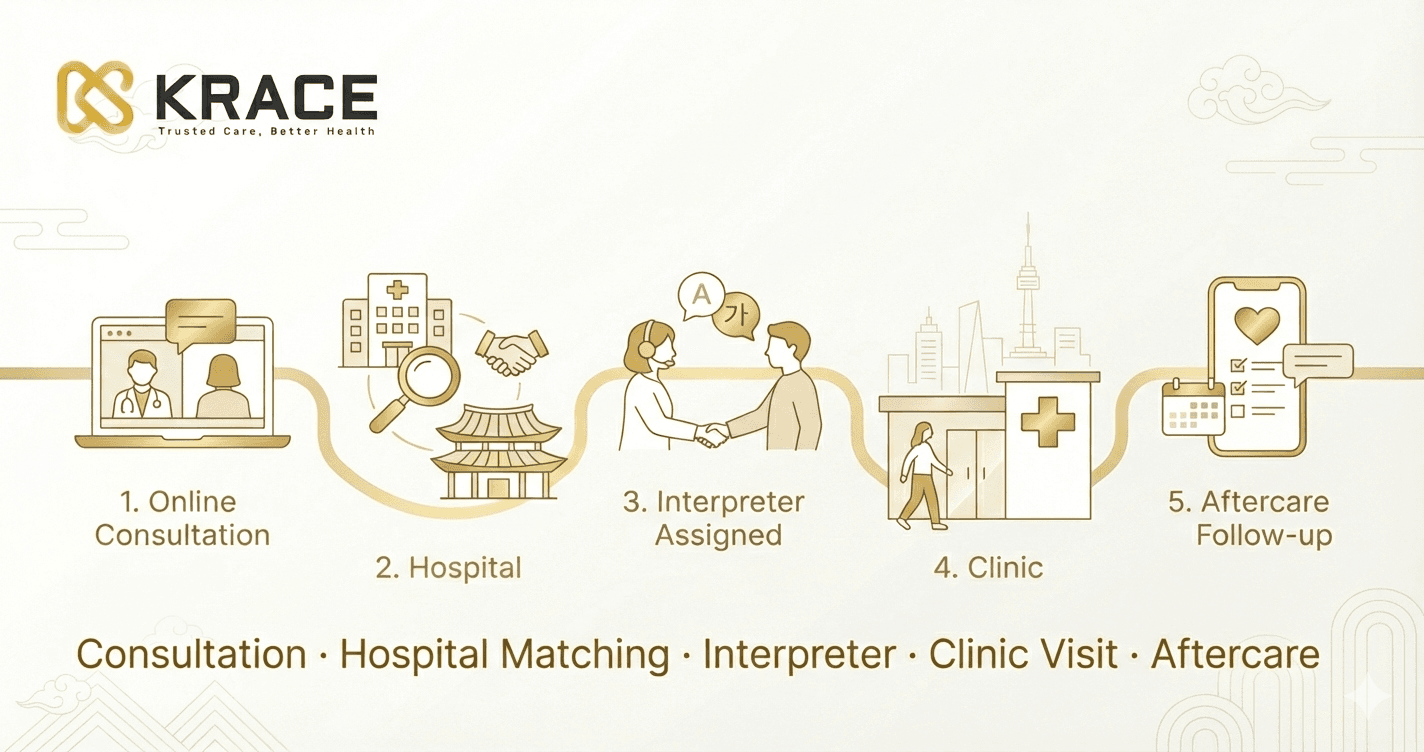
KRACE helps international visitors turn their care interests and travel dates into a practical plan. Instead of relying on a generic list of clinics, you can begin with a free Care Map and explore provider information, booking requests, appointment communication, and coordination around your time in Korea.
KRACE supports the logistics and communication of medical visits. You choose your provider; licensed medical professionals decide which services are clinically appropriate and deliver the care. The availability and scope of language support, reports, and after-visit coordination depend on the provider and the services confirmed for your booking.
Free to start · About 2 minutes to begin · Provider confirmation required for appointments.
You might also like

What KRACE Does (and What We Don't)
KRACE healthcare coordination helps international visitors compare Korean providers, arrange appointments, and manage communication in English. Learn what is included, how fees work, and where medical decisions stay with licensed clinicians.
blog.kracecare.com

How to Choose the Right Korean Clinic: A Practical Guide
Imagine this: back home, you wait weeks—sometimes months—for a specialist appointment, only to spend 10 minutes in the consultation room. Now imagine landing in Seoul and getting a full consultation, diagnostics, and a treatment plan within 24–48 hours. That’s not an exception. It’s the norm in Korea. But here’s the reality most guides skip: while Korea is fast and affordable, choosing the right clinic as a foreigner can feel overwhelming. Different systems, unclear pricing, and language gaps ca
blog.kracecare.com

Korean Skin Treatment Guide: What Foreign Visitors Should Know Before Booking in Korea
If you have ever looked at before-and-after photos from Seoul and wondered whether glass skin Korea is just marketing, here is the honest answer: the glow is usually not coming from a 10-step bathroom shelf alone. In Korea, skincare is often a mix of daily habits, clinic-based maintenance, and fast access to dermatology-led treatments that many visitors find easier to book, faster to receive, and more affordable than back home. Korea’s medical-wellness ecosystem has also scaled quickly: in 2024,
blog.kracecare.com
Sources & Methodology
This article summarizes official data for calendar year 2025, released in April 2026. Distinct international patients and specialty-level records are different measures. Someone using more than one specialty may be represented more than once in the specialty figures. The data cannot establish clinical outcomes, individual provider performance, prices, insurance coverage, or real-time appointment availability.
Ministry of Health and Welfare — 2025 International Patient Statistics, April 24, 2026. Primary source for specialty, country-pattern, institution-type and regional shares.
Medical Korea / KHIDI — Global Patient Data, accessed November 7, 2026. Source for annual totals and exact counts for the five leading national-origin groups.
Medical Korea — Registration System, accessed November 7, 2026. Registration context for institutions serving foreign patients.