

Double eyelid revision in Korea can feel emotionally loaded. You may be comparing your results to social media photos, wondering if your crease is too high, too thick, uneven, or simply not what you imagined. Before chasing another surgery, the better first question is not “Which clinic should I go to?” but “Are my goals realistic for my anatomy, healing stage, and revision history?”
Why Double Eyelid Revision Feels So Difficult
Double eyelid surgery is small in surface area but high in emotional impact. A few millimeters can change how open, soft, heavy, or “done” the eyes look.
In the Reddit-style discussion shared with us, several themes came up: hesitation to name a surgeon publicly, worry about a thick or “sausage-like” crease, asymmetry between both eyes, interest in a lower and thinner crease, and uncertainty about whether another revision would actually help.
That kind of conversation is common because eyelid revision is rarely just about “fixing a line.” It may involve scar tissue, skin thickness, fat volume, ptosis, brow position, healing time, and personal expectations.
The American Society of Plastic Surgeons lists possible eyelid surgery risks such as swelling, bruising, dry eyes, difficulty closing the eyes, infection, asymmetry, and possible need for revision surgery. That does not mean complications are inevitable, but it does mean revision should be approached carefully, not impulsively.
On the Ground
In Seoul consultations, the most useful patients are not the ones who bring 20 perfect “after” photos. They are the ones who can explain what bothers them now, what they want to avoid, and what trade-offs they can accept. A good revision conversation is usually slower, more technical, and less glamorous than social media makes it look.

What Counts as a “Realistic” Revision Goal?
A realistic revision goal is specific, anatomy-aware, and flexible.
For example, “I want a lower crease” is clearer than “I want prettier eyes.” “I want the right crease to look closer to the left, but I understand perfect symmetry may not be possible” is more realistic than “I want both eyes to become identical.”
Most revision goals fall into a few categories:
Concern | What patients often notice | Why it needs careful review |
|---|---|---|
High crease | The eyelid fold looks too tall or dramatic | Lowering a crease can be harder if scar tissue or skin shortage exists |
Thick or puffy fold | The lid looks heavy or “sausage-like” | Swelling, fat, muscle, scar tissue, or fixation technique may all play a role |
Asymmetry | One side looks higher, rounder, or heavier | Natural facial asymmetry and healing differences matter |
Hidden or weak crease | The fold fades or does not hold | Skin type, eyelid structure, and technique may affect durability |
Ptosis-like look | Eyes look sleepy or unevenly open | May involve eyelid-lifting function, not just crease design |
Multiple prior revisions | Results become less predictable | Scar tissue and limited tissue mobility can reduce options |
The key point: the same visible concern can have different causes. A thick crease two months after surgery may be swelling. A thick crease after one year may involve scar tissue, fixation depth, excess tissue, or design mismatch.
When You May Be Too Early to Judge
One of the biggest mistakes after double eyelid surgery is judging the final result too soon.
Early healing can include swelling, bruising, irritation, dry eyes, and discomfort, according to the American Society of Plastic Surgeons. Patients are also advised to ask their own surgeon what to expect during their individual recovery timeline.
The American Academy of Ophthalmology notes that after upper eyelid blepharoplasty, discomfort and swelling are expected, even though many patients can resume normal activities relatively quickly.
For cosmetic double eyelid surgery, the visible crease can continue changing for months. The early fold may look higher, thicker, tighter, or less natural than it will later become.
You may be too early to judge if:
You are still within the first few months after primary surgery.
Swelling changes throughout the day.
The crease looks worse in the morning and softer later.
Your scar is still red, firm, or raised.
Your surgeon has not yet cleared you for revision evaluation.
Your concern is improving month by month, even slowly.
This does not mean you should ignore concerns. It means your next step may be documentation and follow-up, not immediate revision.

When a Revision Consultation Makes Sense
A revision consultation may make sense when the result has stabilized enough for a surgeon to assess the underlying issue.
Common reasons to seek a second opinion include persistent asymmetry, a crease that remains much higher than desired, functional discomfort, difficulty closing the eye, visible scarring, a fold that does not match the agreed plan, or emotional distress that is not improving with time.
However, a consultation is not the same as committing to surgery.
A strong revision consultation should answer these questions:
Question to ask | Why it matters |
|---|---|
Is this still swelling, or is it likely structural? | Prevents unnecessary early revision |
What tissue factors limit my options? | Helps set realistic expectations |
Can the crease be lowered safely? | Lowering may be more complex than raising |
Is ptosis correction involved? | Eye-opening function may affect appearance |
What result is unlikely for me? | A good surgeon should discuss limits |
What happens if I do nothing now? | Sometimes waiting is the safest option |
What is the revision plan if asymmetry remains? | Revision may improve, not perfect, the result |
A cautious surgeon may tell you to wait. That can feel frustrating, but it is not always a bad sign. For revision DES, timing can be part of safety.
The Emotional Trap: Chasing a Perfect Crease
The attached Reddit discussion shows something important: people often feel relief when they learn they are not alone. One commenter described wanting a flatter, subtler appearance and waiting until the six-month mark. Another mentioned multiple revision experiences.
That emotional pattern is real. After cosmetic surgery, people may stare at their results every day, compare themselves to strangers online, and feel trapped between regret and hope.
This is where “goal realism” becomes more than a medical question.
Before revision, ask yourself:
Do I dislike the result in real life, or mainly in close-up photos?
Has anyone neutral noticed the issue, or only me?
Am I asking for a small correction or a completely different eye shape?
Am I trying to return to my old eyes, or create a new ideal?
Would I be satisfied with improvement, not perfection?
Have I received at least one conservative opinion?
A revision may be appropriate. But repeated revisions can also create a cycle where each surgery solves one concern while creating another.
Korea Can Be a Good Option, But It Is Not Magic
Korea has deep experience with eyelid procedures, especially in Seoul’s aesthetic districts. Many international visitors consider Korea because clinics may have high case volume, detailed consultation systems, and familiarity with Asian eyelid anatomy.
Korea’s broader medical tourism market has also grown quickly. Government-reported figures show foreign patient visits rose from 610,000 in 2023 to 1.17 million in 2024 and 2.01 million in 2025.
But popularity does not remove risk. A busy clinic is not automatically the right clinic for your case. A famous doctor is not automatically the right doctor for revision. A low price is not automatically a good deal.
Korean law also distinguishes registered medical institutions and foreign patient attraction systems. The Act on Supporting Overseas Expansion of Medical Services and Attraction of International Patients sets requirements for institutions intending to attract international patients.
For international visitors, this matters because revision surgery requires more than an appointment. You need clear communication, medical document handling, realistic scheduling, post-care planning, and a way to ask questions after leaving Korea.
How to Choose a Clinic for Double Eyelid Revision in Korea
For revision DES, do not choose based only on before-and-after photos.
Photos are useful, but they rarely show the full story: how long after surgery the photo was taken, whether the case was primary or revision, how much swelling remained, what the patient’s starting anatomy was, and whether the result matches your own eyelid type.
Use this clinic-check framework instead:
Selection factor | What to check |
|---|---|
Revision experience | Does the surgeon regularly handle revision DES, not just primary DES? |
Case similarity | Do they show cases similar to your concern: high crease, thick fold, asymmetry, ptosis, scar? |
Consultation detail | Do they explain why your current result looks the way it does? |
Limits | Do they clearly say what may not be possible? |
Safety | Do they discuss dry eye, closure, scarring, and asymmetry risks? |
Communication | Can you ask detailed questions in English before and after the visit? |
Aftercare | Is there a plan for stitch removal, swelling checks, urgent concerns, and remote follow-up? |
Documentation | Are quotes, consent forms, and surgery plans clear before payment? |
KOIHA describes its role as supporting healthcare institutions in improving medical service quality and patient safety through accreditation programs. Accreditation is useful, but for aesthetic revision, it should be only one trust signal among many.
Should You Share Your Surgeon’s Name Online?
In the attached discussion, the original poster preferred not to name the surgeon publicly and instead moved that conversation to private messages.
That choice is understandable. Public surgeon-name threads can quickly become emotional, accusatory, or clinic-focused instead of goal-focused. They may also expose a patient to pressure, harassment, or legal concerns depending on the country and platform.
For your own decision-making, it is usually more useful to collect:
Timeline after surgery
Before photos
Current photos in neutral lighting
Surgical method used
Whether ptosis correction was done
Whether incision or non-incision technique was used
Symptoms such as dryness, tightness, pain, or closure difficulty
Your original goal and current concern
Any follow-up notes from the original clinic
A good second-opinion surgeon needs medical context more than internet drama.
Price: Why We Are Not Listing a Fixed Revision Cost
Prices vary by clinic and package — request a direct quote for accuracy.
For this article, we are not publishing a fixed price table for double eyelid revision in Korea because publicly available prices are inconsistent, often commercial, and may not separate primary surgery from revision complexity. Revision DES pricing can change significantly depending on scar tissue, ptosis correction, anesthesia, surgeon level, included aftercare, and whether the case requires lowering, releasing, or reconstructing the crease.
For a safer quote, request an itemized estimate that includes:
Quote item | Ask directly |
|---|---|
Consultation fee | Is it included or separate? |
Surgeon fee | Is the named surgeon performing the full procedure? |
Anesthesia | Local, sedation, or general? |
Revision complexity | Is the quote for simple revision or complex correction? |
Medication | Are prescriptions included? |
Stitches and follow-up | Are removal and checkups included? |
Emergency contact | Who responds after hours? |
Tax refund | Is VAT refund applicable, and what documents are needed? |
Cancellation policy | What is refundable if the plan changes? |
A low quote without a clear surgical plan is not a bargain. For revision, the quality of explanation matters as much as the number.
A Practical Timeline for International Visitors
Double eyelid revision should not be planned like a casual beauty appointment between shopping days.
A practical timeline may look like this:
Stage | What to do |
|---|---|
3–6 months before travel | Gather photos, surgery history, concerns, and medical notes |
2–3 months before travel | Request clinic screening and check whether you are ready for revision |
4–8 weeks before travel | Shortlist clinics, compare plans, confirm language support |
2–3 weeks before travel | Confirm quote, schedule, medications, travel buffer, and post-care |
In Korea | Attend consultation, avoid rushing into same-day decisions when possible |
After surgery | Stay long enough for early checks and stitch removal if required |
After returning home | Continue remote follow-up and watch for urgent symptoms |
Build in recovery time. Even if daily activities resume quickly, visible swelling and bruising may affect your comfort, photos, and travel schedule.
When to Stop Chasing Revisions
This is the hardest part.
You may need to stop chasing revision, at least temporarily, if multiple surgeons say your desired result is not technically safe, if your eyelid function could be compromised, if you are still healing, if your expectations depend on perfect symmetry, or if each consultation leaves you more anxious rather than clearer.
Stopping does not mean giving up. It may mean pausing until your tissues settle, getting a mental reset, or seeking a more balanced opinion.
A good revision decision should feel grounded. Not euphoric. Not desperate. Grounded.
How KRACE Can Help
KRACE does not diagnose, treat, or perform surgery. Medical services are provided by independent licensed healthcare providers in Korea.
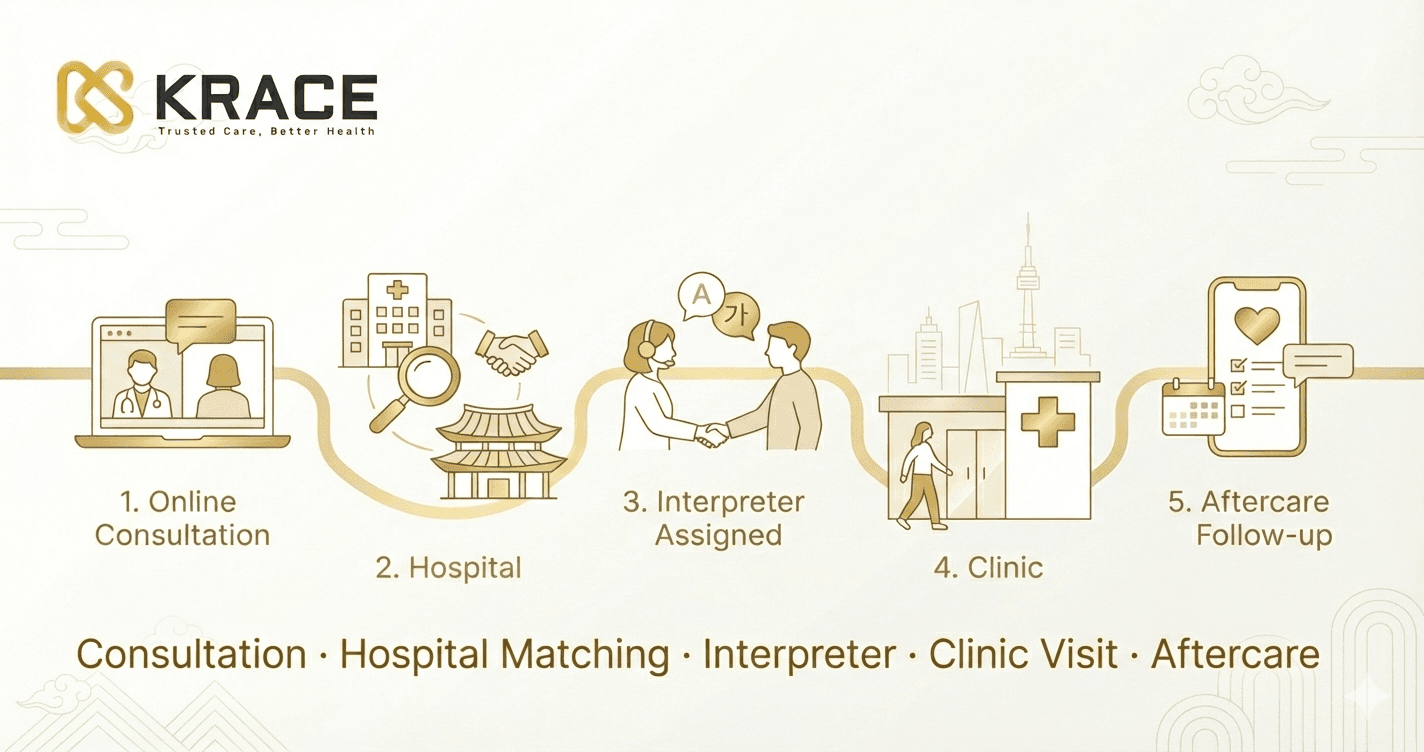
What KRACE can help with is the coordination layer: preparing your case summary, organizing clinic questions, helping you compare consultation responses, checking whether your goals are being understood in English, arranging booking support, and planning post-care communication.
For revision DES, that coordination can matter because the real issue is not only “Which surgeon is famous?” It is whether the clinic understands your goal, explains the limits, and gives you a plan you can evaluate calmly.
Frequently Asked Questions
These answers cover common questions about double eyelid revision in Korea, including timing, clinic selection, pricing, and travel planning.
How long should I wait before double eyelid revision in Korea?
Can a high double eyelid crease be lowered?
Is double eyelid revision more difficult than primary surgery?
How much does double eyelid revision cost in Korea?
Can KRACE choose the best surgeon for my revision?
You Might Also Like

How to Choose the Right Korean Clinic: A Practical Guide
Imagine this: back home, you wait weeks—sometimes months—for a specialist appointment, only to spend 10 minutes in the consultation room. Now imagine landing in Seoul and getting a full consultation, diagnostics, and a treatment plan within 24–48 hours. That’s not an exception. It’s the norm in Korea. But here’s the reality most guides skip: while Korea is fast and affordable, choosing the right clinic as a foreigner can feel overwhelming. Different systems, unclear pricing, and language gaps ca
blog.kracecare.com

How to Book a Clinic in Korea as a Foreigner
Imagine this: back home, you wait two to six weeks just to see a doctor—longer for anything specialized. Now picture landing in Seoul and getting a consultation, diagnosis, and treatment plan within a single day. That’s not a travel hack. It’s how the Korean medical system works. But here’s the catch: while care is fast and accessible, figuring out how to actually book a clinic in Korea as a foreigner isn’t always straightforward. Different systems, language gaps, and unclear pricing can make it
blog.kracecare.com

K-beauty Treatment Korea: What Actually Works 2026 Guide for Foreigners
So what’s actually behind that “glass skin” look—and how do you access it without getting overwhelmed? Why K-beauty Treatments in Korea Feel Different Korean skincare isn’t just about products—it’s a system. And that system starts in clinics, not stores. Unlike many countries where dermatology is treated as a medical necessity only, Korean dermatology blends medical care with beauty optimization. That means you don’t wait months for treatment—you walk in, get assessed, and often start treatment
blog.kracecare.com