
You finally get health insurance — and then realize you still have to pay thousands before it even kicks in.
That’s the reality for millions of people on high-deductible health plans (HDHPs). Even with tools like Health Savings Accounts (HSAs), many still delay care — not because they want to, but because the system makes it feel expensive to act early.
So the real question isn’t just how insurance works.
It’s this:
Why does healthcare still feel expensive — even when you’re doing everything right?
What Is an HDHP? (Simple Explanation)
A high-deductible health plan (HDHP) is a type of insurance with lower monthly premiums but higher out-of-pocket costs before coverage begins.
For 2026, typical thresholds:
- Individual: approx. $1,600+ deductible
- Family: approx. $3,200+ deductible
In practice, this means:
- You pay for most care upfront
- Even basic visits can feel expensive back home
- Many people delay preventive care
👉 This creates a gap between having insurance and actually using it.
How HSAs Work (And Why Most People Use Them Wrong)
A Health Savings Account (HSA) allows you to:
- Contribute pre-tax money
- Grow it tax-free
- Spend it tax-free on medical expenses
👉 Often called a “triple tax advantage” account.
But according to recent reporting (NPR, 2026), many people:
- Use it like a checking account
- Don’t invest the funds
- Miss long-term strategy benefits
A smarter approach:
- Pay smaller costs out-of-pocket
- Let HSA funds grow
- Use later for major expenses
👉 In theory, this offsets high deductibles.
👉 In reality, many people still feel cost pressure.
Why Healthcare Still Feels Expensive in the US
Even when optimized, the system still has friction.
Typical out-of-pocket costs:
- Specialist visit: approx. $150–400 (U.S. average range)
- MRI / imaging: approx. $1,000–3,000
- Preventive screenings: often delayed due to cost
According to OECD health data (2024–2025), the U.S. spends significantly more per capita on healthcare than other developed countries — yet access and timing remain inconsistent.
👉 The result:
- People delay care
- Small issues become bigger problems
- Long-term costs increase
Korea vs US Healthcare: Cost and Access
Short answer:
For preventive care and diagnostics, Korea is often faster and more predictable — and in many cases, still costs less than a U.S. deductible.
| Category | U.S. (HDHP context) | Korea |
|---|---|---|
| Access speed | Often delayed | Same-day / next-day |
| Specialist visit | High out-of-pocket | Lower direct payment |
| Preventive care | Often skipped | Routine |
| Pricing clarity | Complex | Transparent |
👉 According to Korea Health Industry Development Institute (2025), over 1.17 million international patients visited Korea — the highest on record.
On the Ground (Seoul Logistics)
If you actually go through the process in Seoul, here’s what it looks like:
- Most clinics are in Gangnam
- Subway: approx. $1–2 per ride
- Clinics are clustered within short travel distances
- English coordinators are commonly available
Navigation tip:
Use Naver Map — it’s significantly more accurate than Google Maps in Korea.
👉 The experience is designed for efficiency, not waiting.
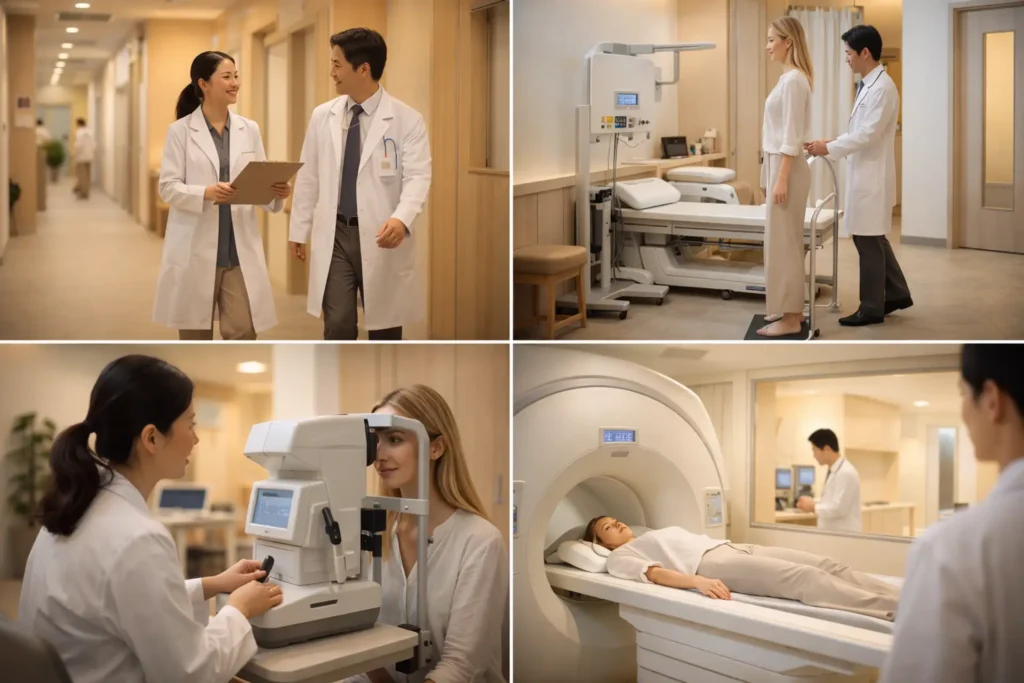
What a Health Checkup in Korea Actually Feels Like

Here’s a typical scenario:
You walk into a clinic at 9 AM.
- Blood tests
- Imaging
- Specialist consultation
Everything happens in sequence — often within a few hours.
By early afternoon:
- You’ve completed multiple tests
- Results are explained the same day
- Follow-up options are clear
👉 This “compressed care model” is one of the biggest differences.
If you want a full breakdown of the process:
👉 https://blog.kracecare.com/korean-health-checkups-guide/
When It Makes Sense to Consider Care Abroad
Let’s be realistic — this isn’t for everyone.
It makes sense if:
- You have a high deductible you haven’t met
- You need multiple tests (bundled value matters)
- You want faster access
- You’re already planning a trip to Korea
It doesn’t make sense if:
- You need emergency care
- Your insurance fully covers local services
- You require long-term follow-up locally
👉 The decision depends on your situation — not just cost.
Is It Safe to Get Medical Care in Korea?

Safety is usually the first concern — and a valid one.
In Korea:
- Government-certified systems regulate providers
- Many hospitals have international accreditation
- Clinics serving international patients provide English support
👉 Korea consistently ranks among the safest countries globally.
If you’re choosing a clinic:
👉 https://blog.kracecare.com/choose-korean-clinic-guide/
The Bigger Insight
This isn’t just about HSAs.
It’s about a deeper issue:
👉 Even when people use the system correctly,
👉 healthcare can still feel financially inefficient.
That’s why more people are:
- Comparing global options
- Looking for faster, clearer care
- Combining travel + healthcare decisions
You Might Also Like
- https://blog.kracecare.com/korean-health-checkups-guide/
- https://blog.kracecare.com/choose-korean-clinic-guide/
- https://blog.kracecare.com/korea-fast-medical-care/
What to Do Next
If you’re navigating a high deductible and unsure what to do:
Start by comparing real options — not just insurance plans.
Frequently Asked Questions
What is a high-deductible health plan (HDHP)?
How does an HSA work with an HDHP?
Why does healthcare still feel expensive even with insurance?
Why do some people consider Korea for preventive care or health checkups?
Is it safe to get medical care in Korea as an international visitor?

Medical Tourism · Korea
Planning a visit to Korea?
- ✓ Trusted Korean clinics
- ✓ English consultation support
- ✓ Guidance for international patients