

Patients describe this area in a few familiar ways. It looks puffy. Something seems to bulge. It looks like dark circles, or simply tired, no matter how much they sleep.
Under-eye fat repositioning is one of the procedures I perform most often. It is also one where the decision depends on a few specific things that cannot be seen in the mirror, and where the right answer is sometimes a different approach, or none at all.
This is how I think about who it suits, who it does not, and what it can and cannot change.

Who it suits
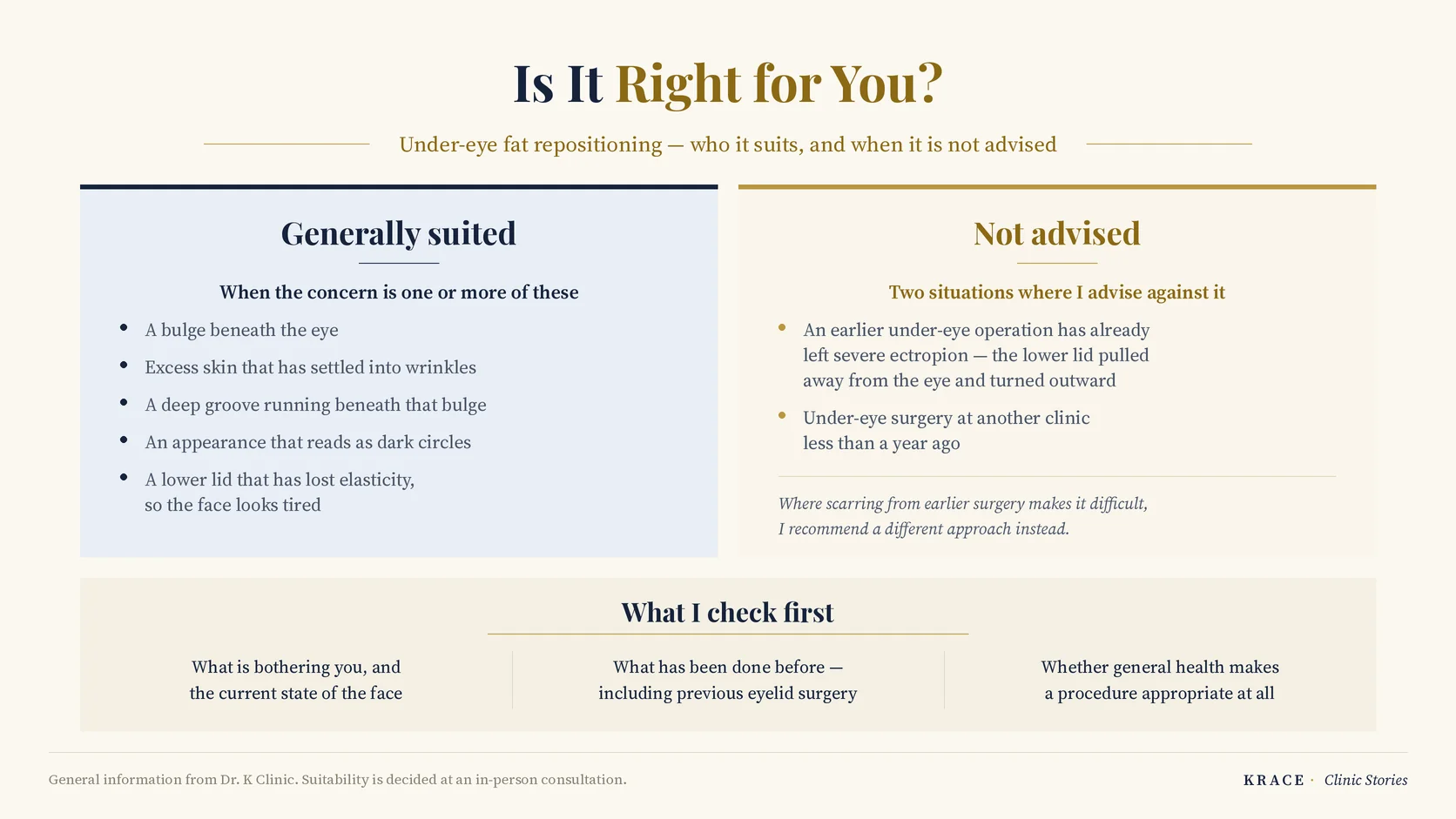
It is generally suited to people whose concern under the eyes is one or more of the following:
a bulge beneath the eye
excess skin that has settled into wrinkles
a deep groove running beneath that bulge
an appearance that reads as dark circles
a lower lid that has lost elasticity, so the face looks tired
Who I would not recommend it for
Before any operation on the lower lid, I check how much elasticity the lid has, using what is called a snapback test. I also ask about previous eyelid surgery specifically, rather than as part of a general medical history. What has already been done to a lid changes what can sensibly be done to it next.
Two situations lead me to advise against it. The first is where an earlier under-eye operation has already left severe ectropion, in which the lower lid has pulled away from the eye and turned outward. The second is where a patient had under-eye surgery at another clinic less than a year ago.
More generally, where scarring from earlier surgery or repeated revisions makes the operation a patient is asking for difficult, I recommend a different approach rather than proceeding with the original plan.
What it changes, and what it does not
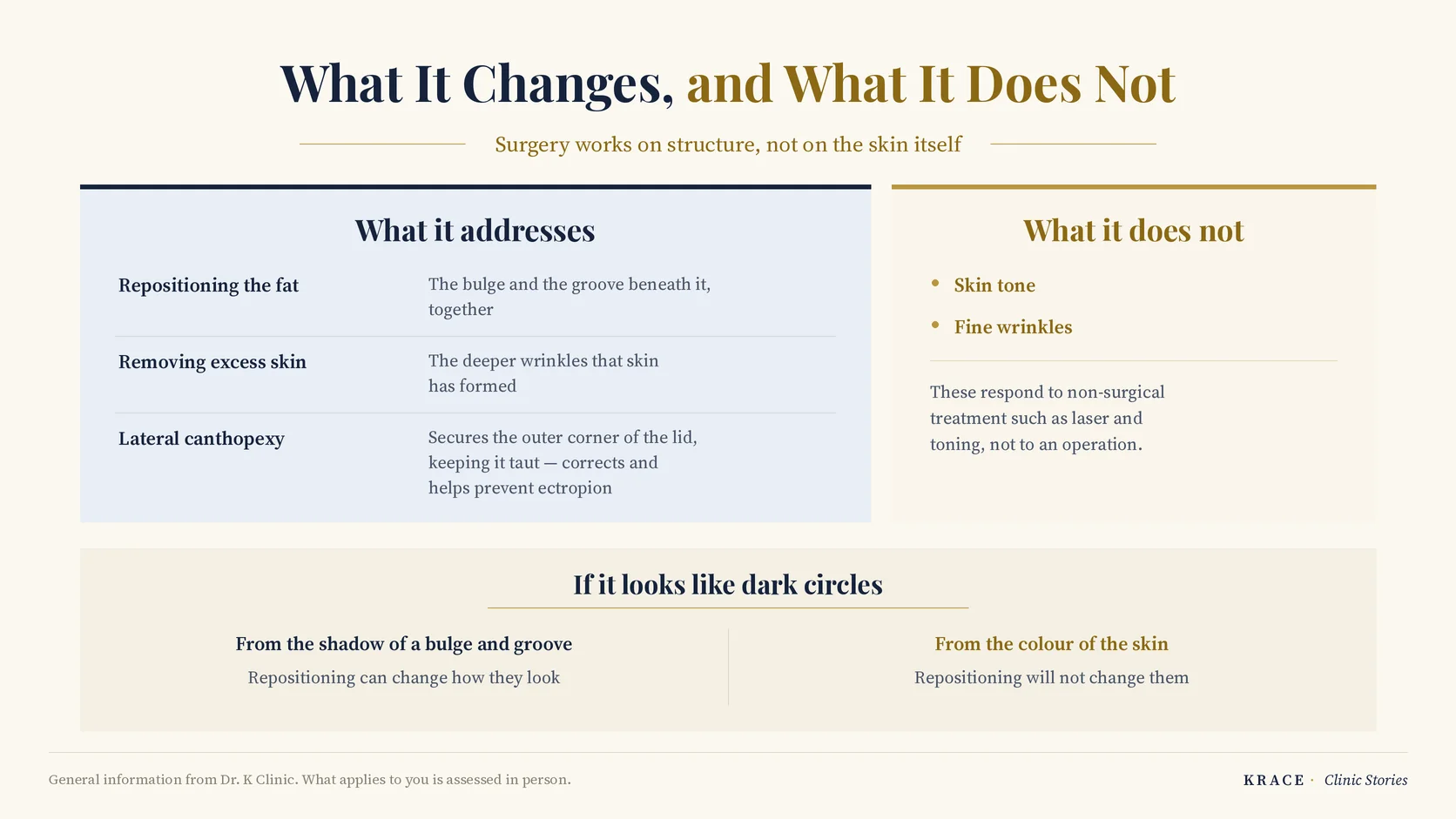
Repositioning the fat addresses two things together: the bulge itself, and the groove beneath it. Where excess skin has formed wrinkles, removing that skin addresses the deeper wrinkles. And where the lower lid needs support, securing its outer corner — a step called lateral canthopexy — keeps the lid taut, which both corrects ectropion and helps prevent it.
What surgery does not change is the skin itself. Skin tone and fine wrinkles respond to non-surgical treatment such as laser and toning, not to an operation. So when dark circles come from the shadow of a bulge and the groove beneath it, repositioning can change how they look. When they come from the colour of the skin, it will not.
What I am working toward is not a different face. It is the one you had earlier, returned as far as it reasonably can be. Around the eyes that matters more than anywhere else, because this is the part of a face people read first.
What I check first
At the first consultation I start with what is bothering you and the current state of your face. I then ask what has been done before, and I check whether your general health makes a procedure appropriate at all.
Before scheduling, tell us about diabetes, high blood pressure, and any other ongoing condition, along with a full list of current medications and supplements. Several of them affect bleeding and healing directly.
Risks to review before deciding
The complication I explain to every patient considering this operation is ectropion. To guard against it, I perform a snapback test beforehand and, where it is needed, recommend lateral canthopexy as part of the plan.
Every surgical treatment carries risk, and those risks differ by procedure and by patient. Outcomes vary between individuals, and no result can be guaranteed in advance.

Choosing who performs it
Eyelid surgery is a field where results differ considerably from one doctor to another. I would rather patients chose on that basis than on advertising or price: ask how the procedure will be done in your case, what it is expected to correct, and to see comparable cases the clinic has treated, before deciding.
That conversation should take place in person, with the physician who would perform the procedure, before anything is scheduled.