

If you are searching for a clinic in Korea as an international visitor, the safest choice is not always the most famous clinic, the lowest starting price, or the most dramatic before-and-after photo.
This guide explains the key Korean clinic red flags to check before you pay a deposit, book a procedure, or travel for care — including unclear doctor identity, vague pricing, pressure to pay, weak English support, and missing aftercare.
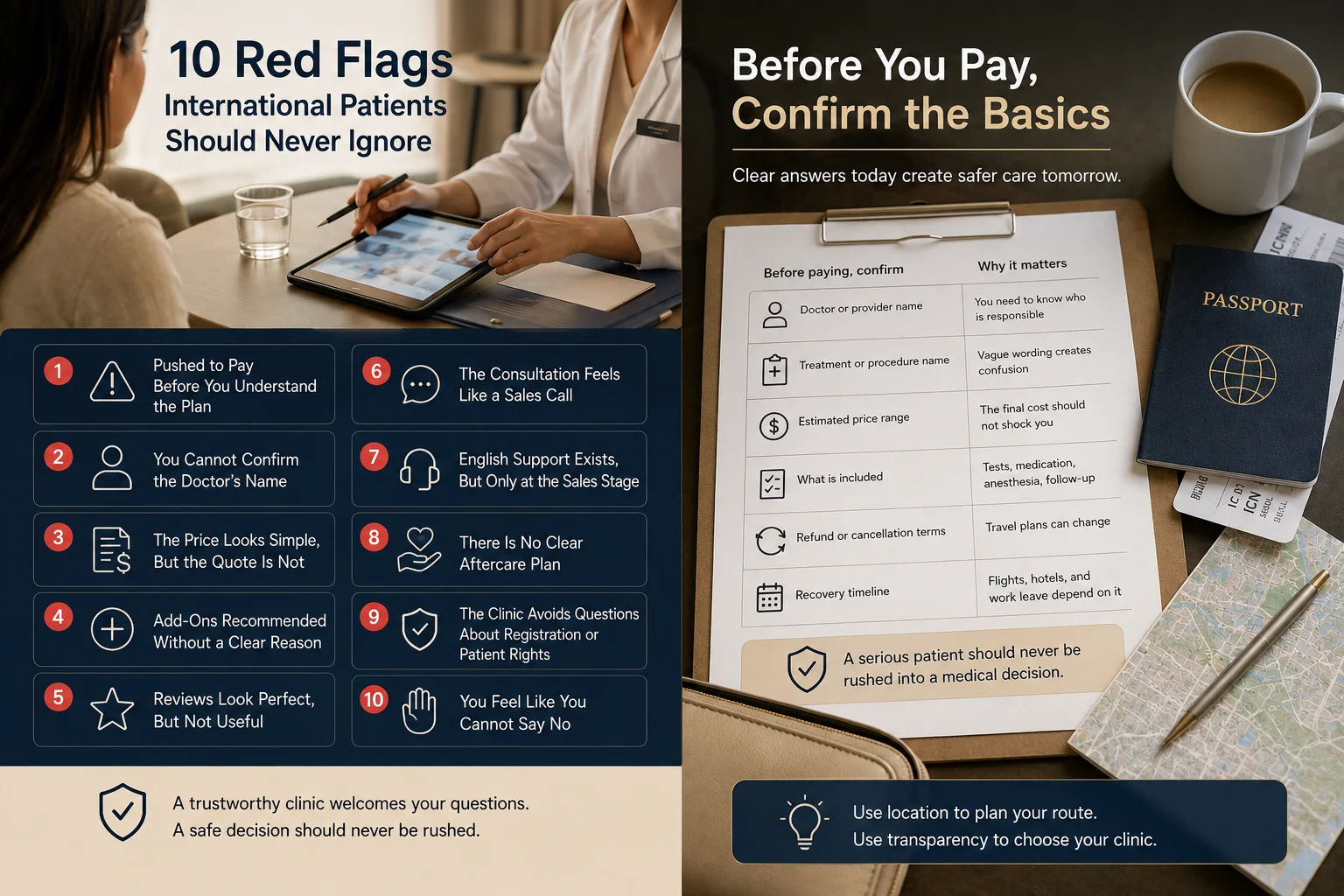
Quick Checklist: 10 Korean Clinic Red Flags Before Booking
Before booking, answer these questions:
Question | Yes / No |
|---|---|
Do I know the doctor or provider name? | |
Do I understand the exact treatment plan? | |
Did the clinic explain why this treatment fits me? | |
Did I receive an estimated quote in writing? | |
Do I know what is included and excluded? | |
Are add-ons clearly explained? | |
Do I understand the cancellation or refund terms? | |
Is language support available at important steps? | |
Is aftercare explained before payment? | |
Do I feel free to compare other clinics? |
If several answers are “no,” pause. Ask again. Compare another clinic. A trustworthy provider will respect that.
Planning a clinic visit in Korea can feel exciting at first. You see clean clinic interiors, dramatic before-and-after photos, quick replies in English, and prices that may look lower than back home.
Then the harder part starts.
Which clinic is actually right for you?
Which reviews can you trust?
Why does one clinic quote one price, while another recommends extra treatments?
And how do you know whether a clinic is prepared to support an international patient after the appointment?
This guide is not a blacklist.
It is a practical red-flag checklist for international visitors considering medical, aesthetic, dental, dermatology, checkup, or wellness care in Korea — especially if you are comparing clinics online before paying a deposit or booking an appointment.
Korea Is Easier to Research Than Ever. That Is Also the Problem.
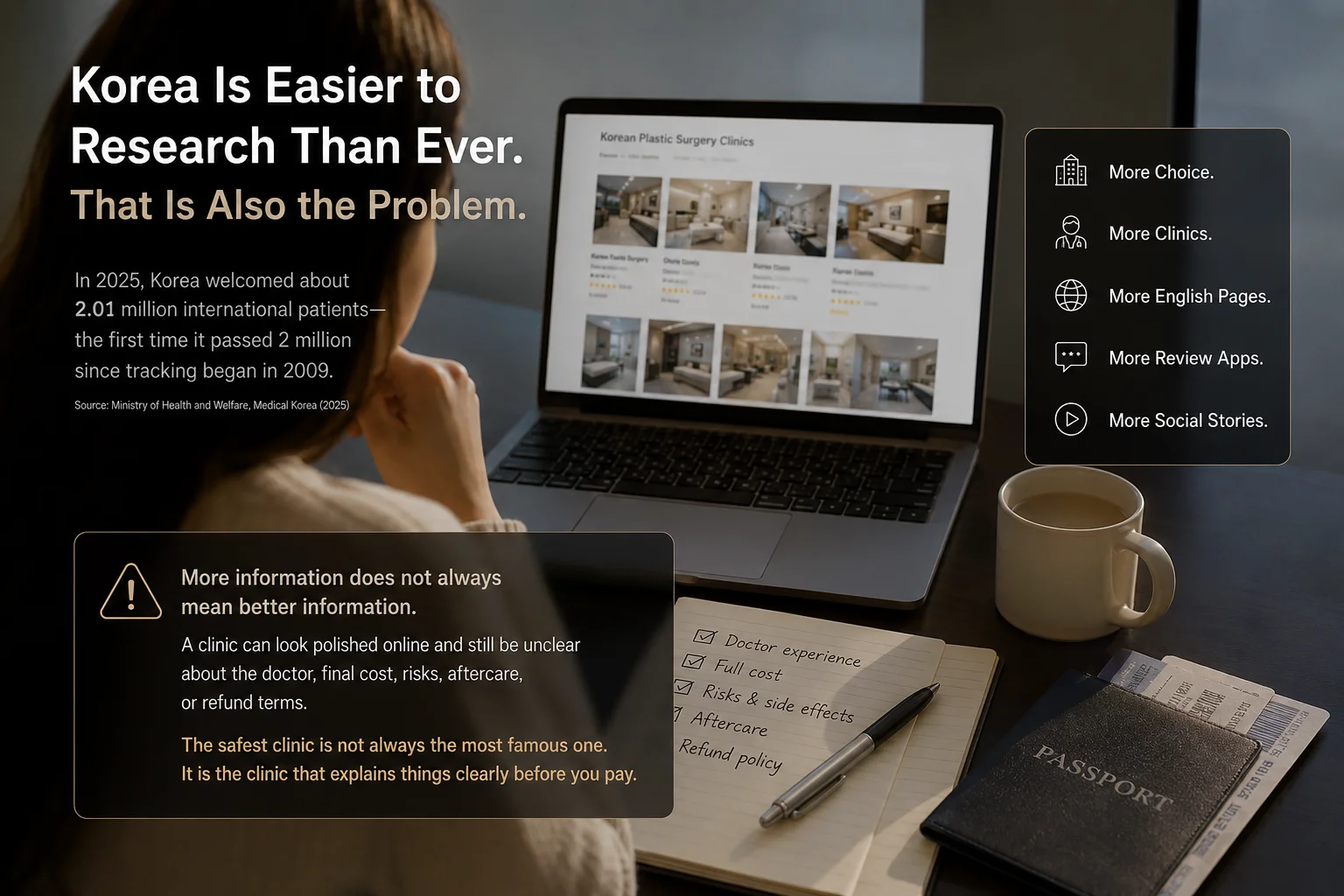
Korea has become one of Asia’s most visible medical travel destinations. In 2024, Korea received about 1.17 million international patients from 202 countries, according to the Ministry of Health and Welfare and Medical Korea. In 2025, the number reached about 2.01 million, marking the first time Korea passed 2 million international patients since tracking began in 2009.
That growth means more choice.
More clinics.
More English pages.
More review apps.
More YouTube videos.
More TikTok “Korea glow-up” stories.
But more information does not always mean better information.
A clinic can look polished online and still be unclear about the doctor, final cost, risks, aftercare, or refund terms.
For international visitors, the safest clinic is not always the most famous one.
It is the clinic that explains things clearly before you pay.
On the Ground: Seoul Is Convenient, But Location Is Not a Credential
Many international visitors start their search in Seoul, especially around Gangnam, Sinsa, Apgujeong, Seocho, Myeongdong, Hongdae, and central Seoul.
That makes sense.
You can compare several clinics in a short trip. You can stay near subway lines. You can combine consultations with shopping, skincare, food, or travel.
But a popular clinic district is not proof of quality.
A famous neighborhood can help with logistics.
It should not replace due diligence.
Use location to plan your route.
Use transparency to choose your clinic.
Red Flag 1: The Clinic Pushes You to Pay Before You Understand the Plan
A deposit is not always suspicious.
Some clinics use deposits to hold consultation slots, surgery dates, or limited appointment times.
The problem is pressure.
Be careful if you hear:
“Today only.”
“You need to pay now.”
“This doctor gets fully booked.”
“We can explain the details later.”
“Everyone chooses this package.”
Before paying anything, ask for the basics in writing.
You should know:
Before paying, confirm | Why it matters |
|---|---|
Doctor or provider name | You need to know who is responsible |
Treatment or procedure name | Vague wording creates confusion |
Estimated price range | The final cost should not shock you |
What is included | Tests, medication, anesthesia, follow-up |
Refund or cancellation terms | Travel plans can change |
Recovery timeline | Flights, hotels, and work leave depend on it |
A trustworthy clinic will not be offended by careful questions.
A serious patient should never be rushed into a medical decision.
Red Flag 2: You Cannot Confirm the Doctor’s Name
This is one of the most important checks.
A clinic brand is not the same as a doctor.
You should know who will actually treat you.
For surgery, dental implants, eye procedures, dermatology lasers, injections, women’s health, or any treatment involving sedation or recovery, ask directly:
“Who will perform my treatment?”
“Will the same doctor attend my consultation and procedure?”
“Will another doctor, assistant, or staff member perform any part of it?”
“What is the doctor’s specialty or relevant experience?”
This matters because your outcome depends on the person providing care, not only the clinic’s Instagram account.
International patients usually feel safer when the provider’s identity is clear before the appointment.
Red Flag 3: The Price Looks Simple, But the Quote Is Not
Medical pricing can vary.
That is normal.
Your final cost may depend on anatomy, treatment scope, sedation, anesthesia, lab tests, imaging, materials, revision history, or aftercare.
But vague pricing is different.
A low starting price can become stressful if the clinic later adds unexpected items without clear explanation.
Common areas of confusion include:
anesthesia fees
medication
lab tests
imaging
implants or materials
extra laser shots or sessions
deswelling care
follow-up visits
compression garments or supplies
revision or touch-up policy
Do not only ask, “How much is it?”
Ask:
“Is this the full estimated cost?”
“What is included?”
“What is not included?”
“Which items are optional?”
“Which items are medically necessary?”
“Can the price change after an in-person exam?”
“Can I receive this quote in writing?”
Under Korea’s law on international patient attraction, registered medical institutions and agencies must help international patients understand key matters such as treatment method, possible side effects, estimated medical cost, and dispute procedures.
That is not just legal language.
It is the foundation of trust.
Red Flag 4: Add-Ons Are Recommended Without a Clear Reason
Add-ons are not always bad.
Sometimes a clinic recommends an additional treatment because it genuinely fits your condition or goal.
The red flag is when the explanation feels sales-driven.
For example:
You ask about one skin treatment, but the clinic recommends a full package.
You ask about eyelids, but several extra procedures are added.
You ask about dental work, but the plan expands before you understand the first issue.
You ask about a health checkup, but premium tests are added without context.
A good clinic should explain the difference between:
medically necessary
recommended but optional
cosmetic preference
convenience-based
package-based
not needed right now
Use this question:
“What happens if I do not do this add-on?”
The answer tells you a lot.
If the clinic can explain the trade-off calmly, that is a good sign.
If the clinic makes you feel foolish or scared, slow down.
Red Flag 5: Reviews Look Perfect, But Not Useful
Reviews are helpful.
But reviews are not proof.
International visitors often research through Reddit, blogs, YouTube, TikTok, Instagram, Google, Naver, and clinic apps.
That is smart.
But every platform has limits.
A review may not tell you:
whether the patient received a discount
whether the photo was edited
whether the result is early swelling or long-term healing
whether the patient had similar anatomy
whether the same doctor treated them
whether complications were handled well
whether the clinic asked for a positive review
Before-and-after photos can also be misleading.
Lighting, angle, makeup, facial expression, camera distance, and timing can change the impression.
Instead of looking for one dramatic result, look for patterns.
Ask the clinic:
“Can you show cases similar to mine?”
“Are these early results or long-term results?”
“What kind of result is realistic for me?”
“What are the limits?”
A clinic that explains limits is often more trustworthy than one that promises perfection.
Red Flag 6: The Consultation Feels Like a Sales Call
A consultation should feel like an evaluation.
Not a checkout page.
The clinic should ask about your health, goals, medication, allergies, past procedures, healing history, travel dates, and recovery time.
For aesthetic treatments, the clinic should also ask what style you want.
Some patients want a noticeable transformation.
Some want a subtle change.
Some want a Korean beauty look.
Some want to keep their original features and simply look fresher.
None of these goals are wrong.
The problem is when the clinic pushes one standard look or one standard package.
A strong consultation should include:
what is possible
what is not realistic
what risks exist
what alternatives exist
what recovery looks like
what aftercare is needed
what the patient should decide slowly
The best answer is not always “yes.”
Sometimes the safest answer is:
“That may not be right for you.”
Red Flag 7: English Support Exists, But Only at the Sales Stage
This is a common issue.
A clinic may reply quickly in English before booking.
But after payment, the English support becomes weaker.
That is a problem.
International patients need clear communication at every stage:
consultation
consent
payment
preparation
procedure day
medication instructions
aftercare
emergency contact
medical records
follow-up after returning home
For simple skincare, basic English support may be enough.
For surgery, sedation, dental implants, eye care, women’s health, or complex treatment, language support becomes part of patient safety.
Ask:
“Will English support be available on the procedure day?”
“Will I receive aftercare instructions in English?”
“Who do I contact if I have a concern after I leave Korea?”
“Can I request an English summary of my visit?”
For international visitors, this matters deeply. English support should not stop at advertising or booking. It should also help you understand preparation, consent, medication instructions, aftercare, and follow-up when details matter.
Red Flag 8: There Is No Clear Aftercare Plan
Aftercare is where many international visitors feel most vulnerable.
You may be in Korea for only a few days.
You may fly home before swelling, bruising, lab results, wound healing, dental adjustment, or treatment response is fully complete.
That means you need a plan before the appointment.
Ask:
“When is the first follow-up?”
“How many follow-ups are included?”
“What symptoms are normal?”
“What symptoms are urgent?”
“What should I do after I return home?”
“Can I send photos or messages later?”
“Can I get records for my doctor back home?”
“What happens if I need additional care?”
This is important for plastic surgery.
It is also important for dermatology, dental care, health checkups, eye care, women’s health, Korean medicine, and chronic condition follow-up.
A clinic that does not explain aftercare clearly is not ready for international patients.
Red Flag 9: The Clinic Avoids Questions About Registration or Patient Rights
International visitors do not need to become legal experts.
But they should know that Korea has a formal system around international patient attraction.
The relevant Korean law is designed to help international patients receive safe and quality healthcare services, and registered institutions must follow specific obligations.
Before booking, it is reasonable to ask:
“Are you registered to receive international patients?”
“Can I receive the treatment plan and estimated cost?”
“Can I request my medical records?”
“What is your complaint or dispute process?”
“Who is responsible for follow-up communication?”
Registration is important, but international visitors should also look for clear documents, clear pricing, provider transparency, aftercare, and communication.
Patients need to see that the clinic understands what international care requires.
Clear documents.
Clear pricing.
Clear provider identity.
Clear aftercare.
Clear communication.
That is what makes international patients feel safe.
Red Flag 10: You Feel Like You Cannot Say No
This may be the most practical red flag.
A good clinic lets you think.
A risky clinic makes you feel trapped.
You should feel free to:
compare other clinics
ask more questions
decline add-ons
bring an interpreter
request written information
delay your decision
cancel if the plan does not feel right
If the clinic makes you feel guilty, rushed, embarrassed, or afraid to ask questions, take that seriously.
Medical decisions should not feel like a flash sale.
What International Visitors Should Look For Instead
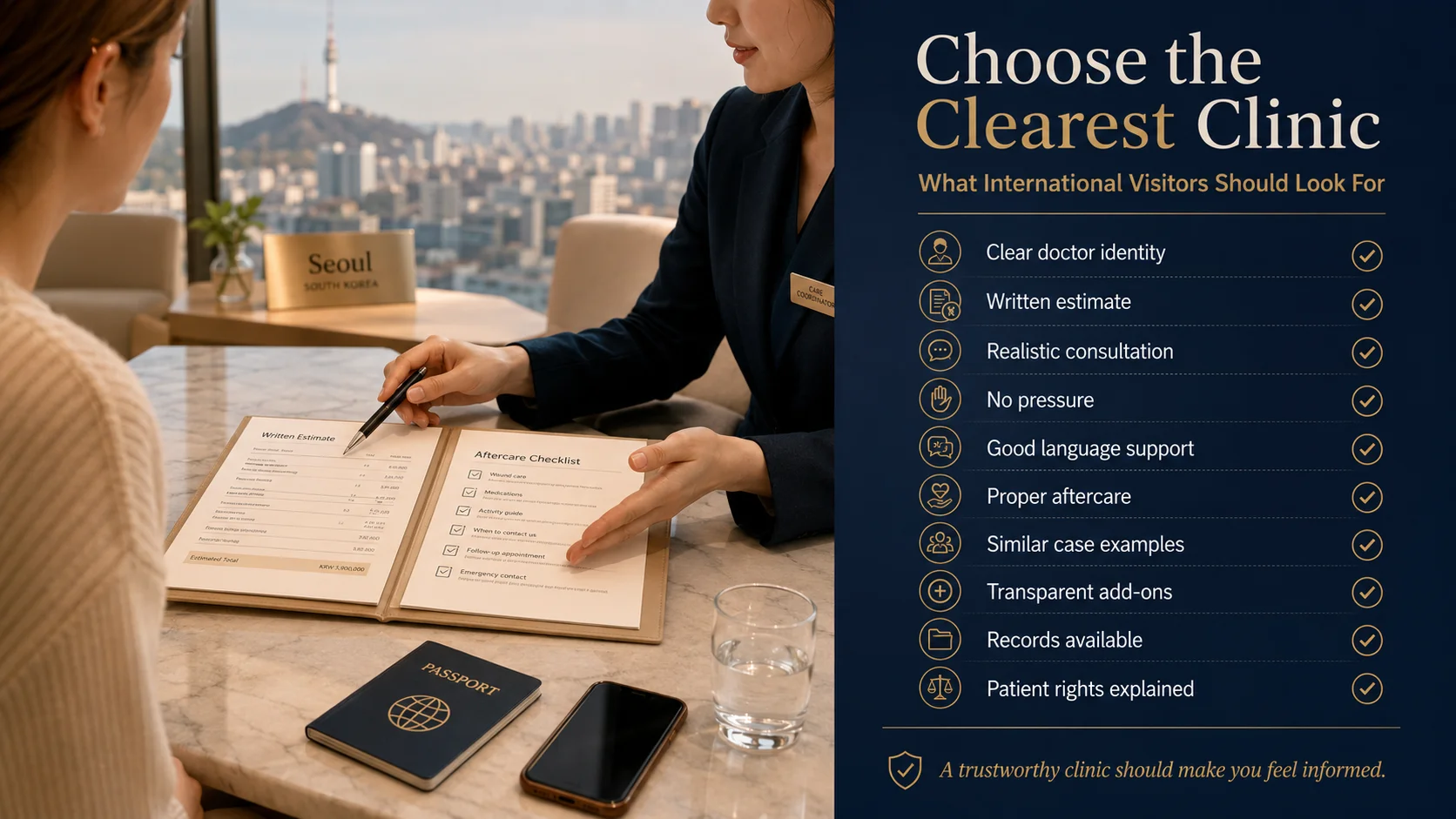
The goal is not to find a perfect clinic.
The goal is to find a clear clinic.
Look for these trust signals:
Trust signal | What it looks like |
|---|---|
Clear doctor identity | You know who is treating you |
Written estimate | Costs and inclusions are explained |
Realistic consultation | Risks and limits are discussed |
No pressure | You can compare before booking |
Good language support | Key instructions are understood |
Proper aftercare | Follow-up steps are clear |
Similar case examples | Results match your situation |
Transparent add-ons | Optional vs necessary is explained |
Records available | You can request summaries or documents |
Patient rights explained | Refunds, complaints, and disputes are not hidden |
A trustworthy clinic may still be busy.
It may still be expensive.
It may not have the flashiest marketing.
But it should make you feel informed.
Why This Matters for International Visitors
International patients are not only choosing a treatment. They are also managing uncertainty around language, pricing, recovery, medical records, and follow-up after returning home.
That is why a trustworthy clinic should explain key details clearly before you pay — including who will treat you, what the treatment plan includes, what the estimated cost covers, what aftercare is available, and how you can get support if questions come up later.
If a clinic communicates clearly before booking, it is usually a stronger sign that they are prepared to support international patients responsibly throughout the full care journey.
Final Takeaway: Do Not Choose the Loudest Clinic. Choose the Clearest One.
Korea has many skilled doctors, advanced clinics, and strong medical travel infrastructure.
But international visitors still need to be careful.
The biggest risk is not always choosing a “bad” clinic.
It is choosing too quickly without enough clarity.
Do not rely only on a review app.
Do not rely only on influencer photos.
Do not rely only on a low starting price.
Do not rely only on a famous district.
Choose the clinic that tells you:
who will treat you,
what they recommend,
why they recommend it,
what it may cost,
what could go wrong,
how recovery works,
and who will support you after the visit.
That is what real trust looks like.
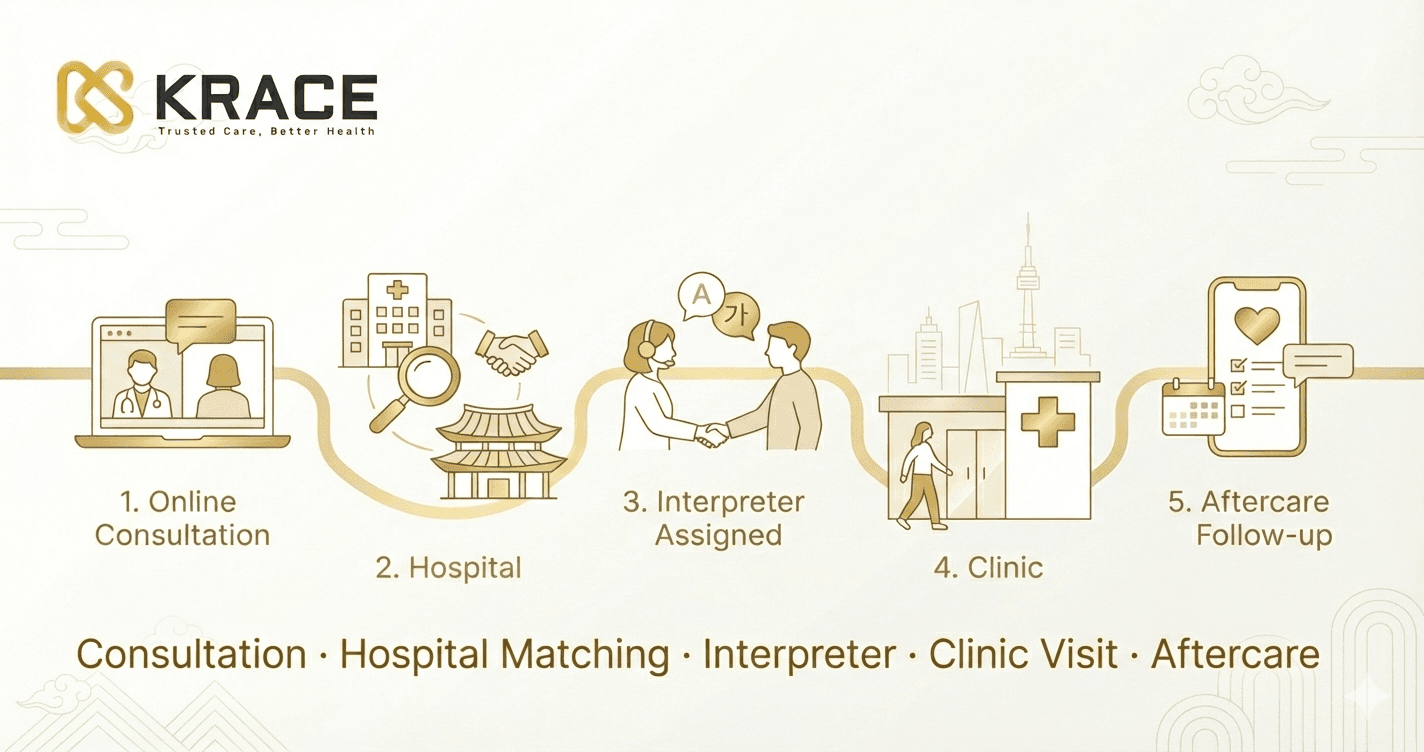
KRACE helps international visitors compare clinic options, coordinate booking, support communication, and organize post-visit follow-up in Korea. KRACE does not provide medical care, diagnosis, or treatment. Medical services are provided by independent licensed healthcare providers.
Start with a free consultation →
Frequently Asked Questions
These answers cover common questions about Korea clinic red flags, Korean clinic checklists, pricing clarity, language support, and aftercare for international visitors.
What are the biggest red flags when booking a clinic in Korea?
Should I trust Korean clinic reviews on apps or social media?
Is it normal for a Korean clinic quote to change after consultation?
Do international patients need English support at Korean clinics?
What should I ask before paying a deposit to a Korean clinic?
You Might Also Like

How to Choose the Right Korean Clinic: A Practical Guide
Imagine this: back home, you wait weeks—sometimes months—for a specialist appointment, only to spend 10 minutes in the consultation room. Now imagine landing in Seoul and getting a full consultation, diagnostics, and a treatment plan within 24–48 hours. That’s not an exception. It’s the norm in Korea. But here’s the reality most guides skip: while Korea is fast and affordable, choosing the right clinic as a foreigner can feel overwhelming. Different systems, unclear pricing, and language gaps ca
blog.kracecare.com

How to Book a Clinic in Korea as a Foreigner
Imagine this: back home, you wait two to six weeks just to see a doctor—longer for anything specialized. Now picture landing in Seoul and getting a consultation, diagnosis, and treatment plan within a single day. That’s not a travel hack. It’s how the Korean medical system works. But here’s the catch: while care is fast and accessible, figuring out how to actually book a clinic in Korea as a foreigner isn’t always straightforward. Different systems, language gaps, and unclear pricing can make it
blog.kracecare.com