

Search for experiences with Korean healthcare and you will find two very different stories. One describes fast access, convenient testing, and efficient clinics. The other describes short consultations, unfamiliar hospital rules, and language friction. Both can be true. Korea’s healthcare system handles an unusually high volume of outpatient care, and understanding that structure helps explain both what works well and what can surprise an international visitor.
Part 1: What Often Works Well
Korean healthcare can feel unusually accessible at clinic level, especially compared with systems where primary-care gatekeeping or long appointment waits are common.
On the Ground
Do not assume “fast access” means every clinic is walk-in or every specialist is immediately available. Before visiting, confirm whether an appointment is needed, whether the physician can communicate in English or an interpreter is available, and whether tests or follow-up visits require separate scheduling.
Clinic-Level Access Can Be Very Fast
Korea records one of the highest levels of outpatient medical use in the OECD.
In 2023, Korea recorded 18 in-person doctor consultations per person, compared with an OECD average of 6.5. The OECD also notes that most patients in Korea can receive primary medical care on the same day, sometimes without an appointment, and links the high volume partly to short consultation times. (OECD, Health at a Glance 2025)
For an international visitor, the important point is not that every clinic works the same way. It is that Korea has a dense outpatient system where clinic-level access can often happen with fewer administrative steps than visitors may be used to back home.
If you want a closer look at how local clinics work, see our primary care in Korea guide.
Testing Can Be Organized Around a Single Visit
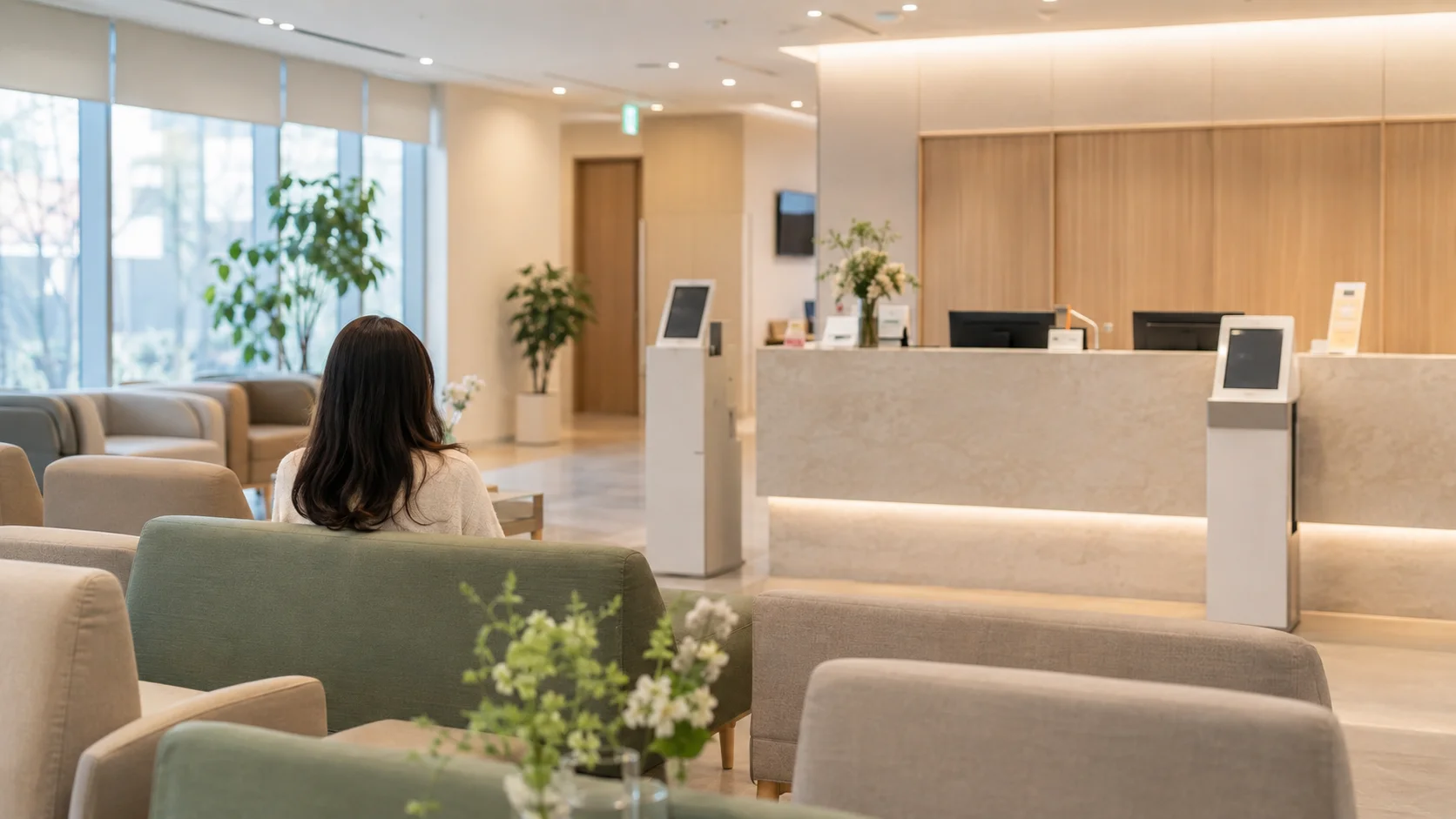
Another noticeable difference is how clinics and screening centers may organize multiple services around one scheduled visit.
Health screenings, laboratory work, imaging, consultation, or other tests may sometimes be coordinated within the same facility or appointment sequence. The exact timing depends on the provider, the type of testing, and whether additional examinations are needed.
That can feel very different from a system where referrals, imaging centers, laboratories, and specialist appointments are spread across separate providers.
The useful question is not simply, “Can Korea do this quickly?” Ask instead:
Which tests are included in the appointment?
Which results are available the same day?
Which reports take longer?
Is another consultation needed to discuss the results?
Will I still be in Korea when that happens?
For a deeper look at speed and scheduling, see why medical care can feel faster in Korea.
Korea Has a Registration System for International-Patient Providers
Korea also operates a formal registration system for medical institutions serving international patients.
Medical Korea states that registered medical institutions have been required since 2016 to maintain medical malpractice liability insurance. The registration system provides a verifiable administrative baseline for international-patient services. (Medical Korea)
But registration is not the same as a quality ranking or accreditation.
A registered institution should not automatically be interpreted as the “best” clinic, nor does registration tell you whether a particular provider is appropriate for your medical needs. It is one item to verify alongside physician credentials, the provider’s service scope, communication support, written estimates, and follow-up process.
Part 2: What Often Surprises International Visitors
The same system that allows high patient throughput also creates some of the experiences visitors find unexpected.
Doctor Consultations Can Be Brief
This may be the biggest adjustment for someone coming from a system where a routine physician appointment is scheduled for a longer block of time.
OECD data explicitly identifies short consultation times as one factor allowing Korean doctors to handle a very high volume of outpatient visits. Korea also has the highest estimated number of in-person consultations per doctor among OECD countries in the latest dataset.
Brief does not automatically mean poor care.
For a straightforward visit, a focused consultation may work efficiently. The potential mismatch comes when an international visitor expects a long conversation covering extensive history, multiple questions, treatment alternatives, travel timing, and follow-up arrangements.
Before an appointment:
write down your questions;
put the most important ones first;
bring relevant records;
confirm whether interpretation is available;
tell the clinic if you want consultation before making a treatment decision.
For appointments involving a significant decision, it can also be useful to ask in advance how the consultation is scheduled and whether additional discussion can be arranged if necessary.
Tertiary-Hospital Referral Rules Are Easy to Misunderstand
Korea’s healthcare system uses different levels of medical institutions, and referral rules are particularly important for people enrolled in Korean National Health Insurance.
The National Health Insurance Service explains that clinics, hospitals, and general hospitals generally fall within the first phase of the health-benefit delivery system, while tertiary hospitals are the second phase. To receive second-phase health-insurance benefits at a tertiary hospital, a referral slip is generally required, subject to specific exceptions. (NHIS)
This distinction matters because visitors often hear “you need a referral for a major Korean hospital” without hearing the insurance context.
For an international visitor without Korean National Health Insurance, do not assume either that a referral is always required or that you can simply walk into any tertiary hospital. Appointment, documentation, international-patient-center, and payment policies can differ by institution.
If you are unsure which type of provider to contact, KRACE can help explain provider categories and booking requirements, but the medical appropriateness of a particular level of care must be determined by a licensed healthcare professional.
For provider-selection questions, read how to choose a Korean clinic.
“English-Speaking” Can Mean Different Things
A clinic website saying “English available” does not always tell you what will happen inside the consultation room.
It could mean:
reception staff can handle basic scheduling;
an international coordinator is available;
an interpreter can join the visit;
or the physician conducts the consultation directly in English.
Those are very different experiences.
Before booking, ask a specific question:
Will the physician speak with me directly in English, or will an interpreter or coordinator be present?
Also confirm whether English support covers only the appointment or extends to consent forms, estimates, results, medication information, and follow-up communication.
Medical Records May Require Advance Planning
The record that works inside a Korean medical institution is not automatically the record your clinician back home will need.
If you expect to continue care after returning home, ask before departure:
Which reports can be provided in English?
When will final reports be ready?
Can imaging files be provided in a format another provider can use?
Can medication information include generic names?
Is there a document or translation fee?
How are later results delivered?
Do not wait until you are home to discover that an important document requires a separate request.
This is especially important when results will be completed after your trip. A report being delivered electronically is not the same as having a healthcare professional interpret its clinical meaning.
Payment Is Usually Something to Clarify Before You Arrive
It is tempting to describe Korean healthcare simply as “cheap,” but that is not a useful rule for international patients.
Prices can vary by clinic, hospital level, service, insurance status, international-patient arrangements, tests, medication, and optional add-ons. One university hospital’s payment policy should not be treated as a national price standard.
Instead, before booking ask for:
consultation fee;
expected tests;
treatment or procedure fee, if applicable;
medication costs;
interpretation or documentation fees;
deposit requirements;
cancellation or refund terms;
what may create additional charges.
For larger services, ask for a written estimate before committing.
Prices vary by clinic and service — request a direct quote for accuracy.
Recent Hospital Disruptions Have Eased — but Availability Still Varies
By late 2025, Korea had formally ended the highest-level healthcare crisis alert as resident staffing and hospital activity recovered. However, regional and essential-care capacity remains an active policy issue.
International visitors may still encounter older articles describing the 2024–2025 trainee-doctor dispute as though it represents the entire Korean medical system today.
That period caused major disruption in parts of hospital care. By September 2025, the Ministry of Health and Welfare reported that the resident workforce had recovered to about 76.2% of its March 2024 reference level, though recovery varied by specialty and region.
The issue should not be treated as fully resolved, either. In June 2026, the Ministry of Health and Welfare continued to describe regional and essential-care capacity as an active policy challenge and announced further measures to strengthen national university hospitals and regional medical systems. (MOHW, June 2026)
For routine planned care, the practical lesson is simple: verify current availability with the actual provider rather than relying on a news story from 2024 or assuming every part of the Korean healthcare system is operating under the same conditions.

Part 3: Why the System Feels This Way
Many of the contrasts above come from the same underlying pattern.
Korea handles a very high volume of outpatient medical care. OECD data shows 18 in-person consultations per person in 2023 and the highest estimated consultation load per doctor among OECD countries.
That structure can create clear advantages:
Access can be fast.
Patients often face fewer steps before reaching clinic-level care.
Testing can be tightly coordinated.
Services may be organized within the same facility or visit sequence.
The process can feel efficient.
Registration, testing, consultation, and payment may move quickly once you understand the workflow.
But the same structure can produce friction for someone new to it:
Consultations may feel short.
There may be less time for background explanation.
Local assumptions are built into the process.
A Korean patient may already understand hospital tiers, referral documents, payment desks, and how to request records.
Language changes the experience.
An efficient process becomes much harder to navigate if you cannot understand the forms, questions, or next steps.
The biggest difference for an international visitor is often not the medical technology. It is system literacy.

What to Take From This Before Using Healthcare in Korea
You do not need to become an expert in the Korean medical system before your trip.
You do need to confirm a few things that local patients may take for granted.
1. Confirm the Actual Appointment Process
Do not rely only on “walk-ins welcome” or “international patients accepted.”
Ask whether the specific physician or service requires an appointment and what documents you need.
2. Know What Language Support Means
Confirm whether English support applies to the physician consultation, not only reception or booking.
If interpretation will be used, ask whether it must be reserved in advance.
3. Understand the Provider Type
A clinic, hospital, general hospital, and tertiary hospital are not interchangeable categories.
Learn the booking and referral requirements, but leave decisions about medical appropriateness to qualified healthcare professionals.
4. Put Documentation on the Checklist
Ask about English reports, imaging, medication names, results timing, and follow-up before the final day of your trip.
5. Ask for Costs in Writing When Possible
Do not assume one clinic’s price represents the Korean market.
Confirm what the estimate includes and what may be billed separately.
Where KRACE Fits
Most of the friction described in this guide is not about diagnosing a condition.
It is about navigating a system built for people who already understand how it works.
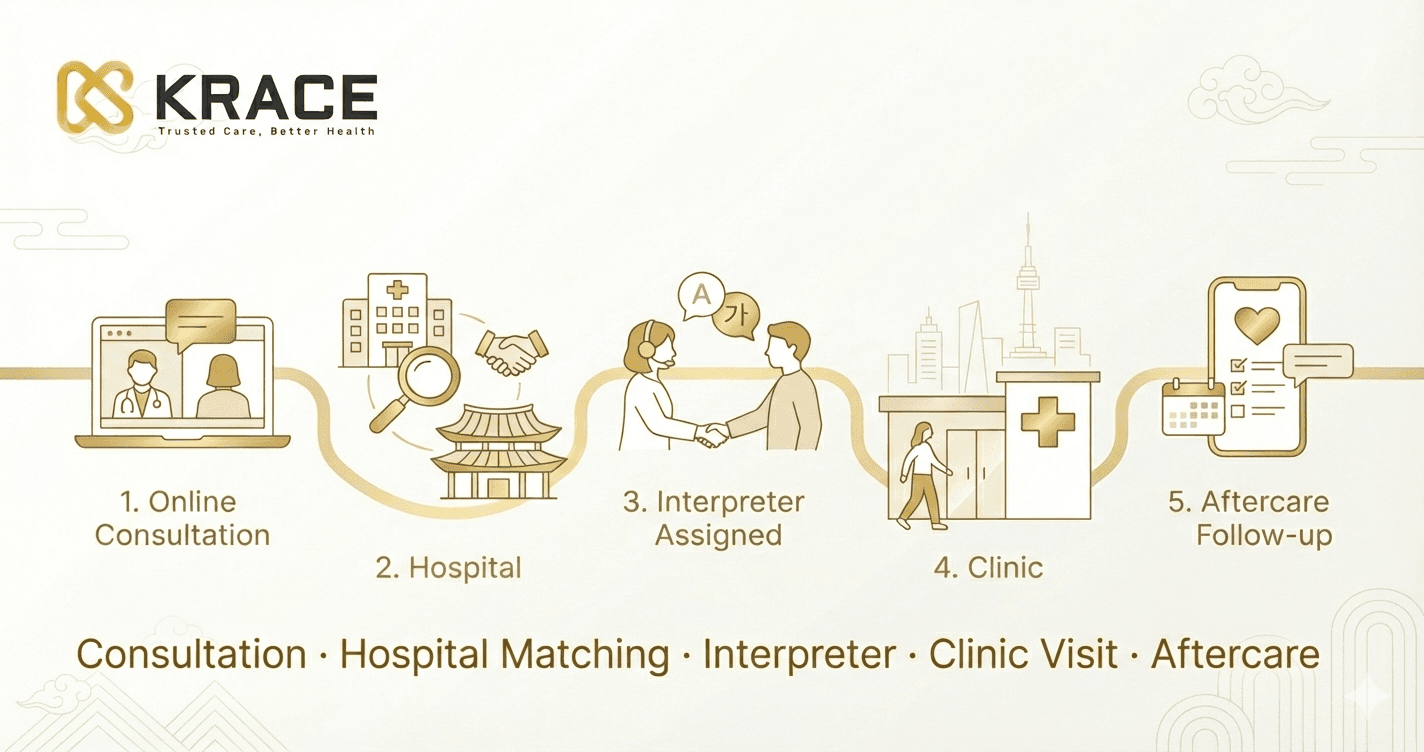
KRACE supports international visitors with clinic matching based on stated needs and provider information, booking coordination, communication, travel and appointment logistics, clinic-provided documentation requests, and post-care coordination.
KRACE can also help confirm practical information such as:
provider availability;
appointment requirements;
stated English-language support;
interpretation arrangements;
clinic-provided estimates;
documentation options;
travel-date compatibility;
follow-up logistics.
KRACE does not determine which treatment is medically appropriate, decide which level of hospital a patient clinically requires, diagnose symptoms, interpret test results, or replace a licensed healthcare professional.
Know the System Before You Step Into It
Korean healthcare can feel fast, convenient, rushed, unfamiliar, or all four at once.
Understanding the structure helps explain why.
Before booking, focus less on whether Korean healthcare is simply “better” or “cheaper” than care back home. Ask a more useful set of questions: Can this provider handle what I need? How will communication work? What happens during the visit? What records will I receive? And what happens after I leave?
Start with a free consultation →
You Might Also Like

Why More Travelers Are Choosing Korea for Primary Care
Imagine needing a health checkup but facing a three-month wait back home. Now picture landing in Seoul, booking a clinic visit within days, completing lab tests the same morning, and getting results before the week ends. For many international visitors, that’s not hypothetical — it’s exactly how healthcare works in Korea, especially for those seeking primary care Korea. Across North America, Europe, and Australia, rising costs and long wait times are pushing travelers to look abroad for care. Ko
blog.kracecare.com

How to Choose the Right Korean Clinic: A Practical Guide
Imagine this: back home, you wait weeks—sometimes months—for a specialist appointment, only to spend 10 minutes in the consultation room. Now imagine landing in Seoul and getting a full consultation, diagnostics, and a treatment plan within 24–48 hours. That’s not an exception. It’s the norm in Korea. But here’s the reality most guides skip: while Korea is fast and affordable, choosing the right clinic as a foreigner can feel overwhelming. Different systems, unclear pricing, and language gaps ca
blog.kracecare.com

How to Book a Clinic in Korea as a Foreigner
Some outpatient clinics in Korea offer same-day or short-notice appointments, but availability, pricing, and language support vary. This guide explains how international visitors can compare clinics, confirm costs, and arrange an appointment with confidence.
blog.kracecare.com
Frequently Asked Questions
Can an international visitor see a doctor in Korea without a referral?
Usually, yes for clinic-level care, but tertiary hospitals have different rules. Korean National Health Insurance generally requires a referral slip to receive second-phase benefits at a tertiary hospital, with specified exceptions. International visitors without Korean insurance should confirm the hospital's own appointment, referral, documentation, and international-patient requirements before visiting.
How long are doctor consultations in Korea?
Consultation length varies by provider and visit type, but brief outpatient consultations are common in Korea. OECD data identifies short consultation times as one factor behind Korea's high volume of doctor visits. If you have several questions, need interpretation, or are making an important medical decision, prepare your priorities in advance and ask how the clinic schedules the consultation.
Can I see an English-speaking doctor in Korea?
English-language support varies by medical institution. A clinic may have English-speaking reception staff, an international coordinator, an interpreter, or a physician who communicates directly in English. These are different services. Before booking, ask specifically who will communicate with you during the medical consultation and whether language support also covers forms, results, medication information, and follow-up.
Can I get my Korean medical records in English?
Availability varies by medical institution and document type. Ask whether consultation summaries, test reports, imaging files or reports, medication information, and other relevant records can be provided in English. Also confirm how long preparation takes, whether fees apply, and which file formats are available if another healthcare professional will need the records after you return home.
Can KRACE decide which treatment or level of hospital I medically need?
No. KRACE can support provider matching based on your stated needs and available provider information, booking, communication, documentation requests, and logistics. KRACE does not determine medical appropriateness, diagnose symptoms, recommend treatment, interpret results, or decide which level of hospital a patient clinically requires. Medical decisions must come from an independent licensed healthcare professional.