

Patients arrive with two sentences they have already decided are both true. They are not ready for surgery. And they have heard that threads do not work.
Both deserve a straight answer. A thread lift is not a smaller version of an operation, and it is not a lesser one either. It is a different tool. Whether it works has less to do with threads in general than with whether it was the right tool for that particular face.
What a thread actually does
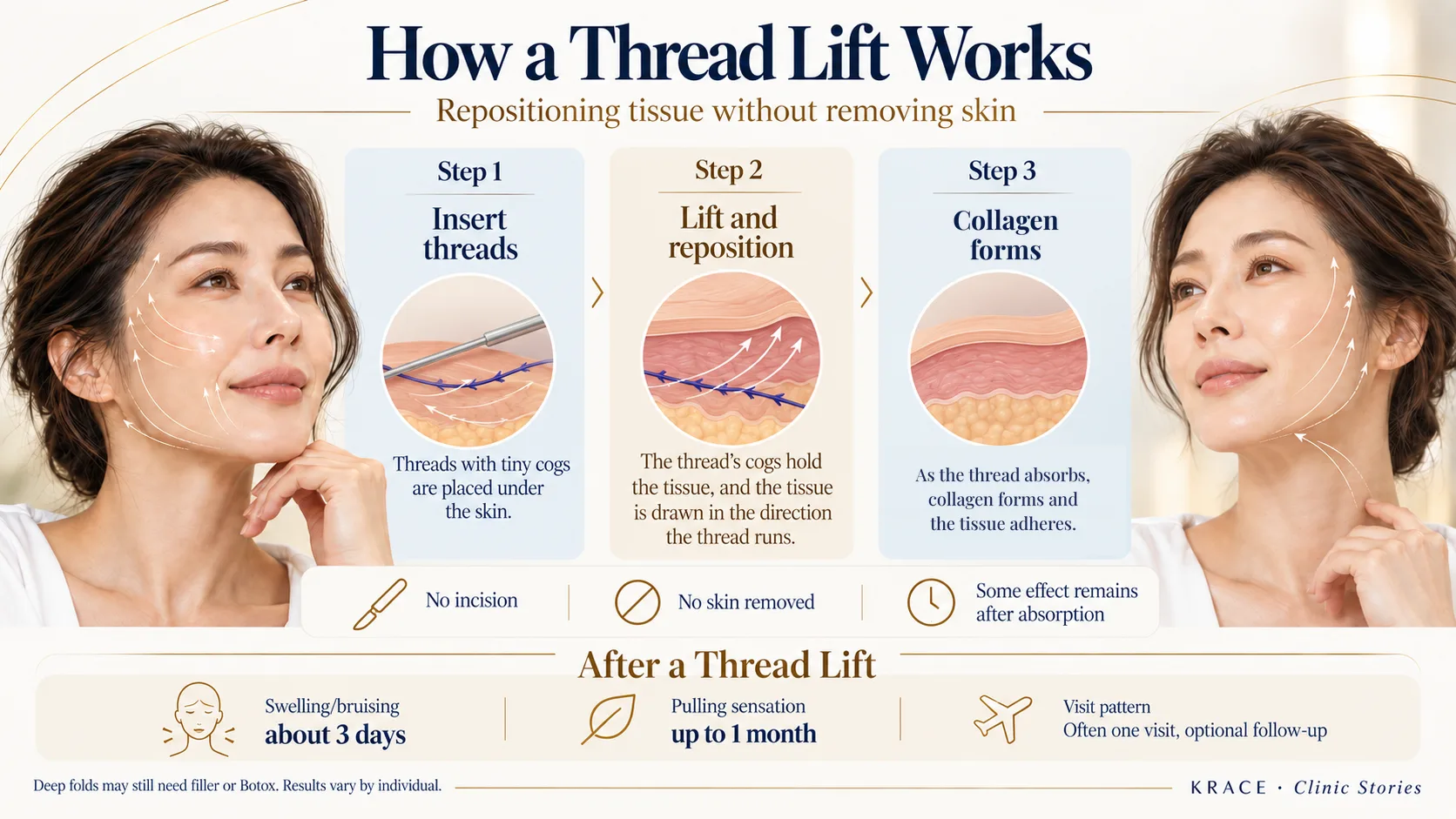
A thread lift repositions tissue using absorbable sutures placed along several paths beneath the skin. There is no incision and no skin is removed. The thread engages the tissue, and the tissue is drawn in the direction the thread runs.
That last part matters more than most patients expect. A thread does not tighten in every direction at once. It moves tissue along a line. Which line, and how many of them, is the decision being made.
Why direction matters more than count
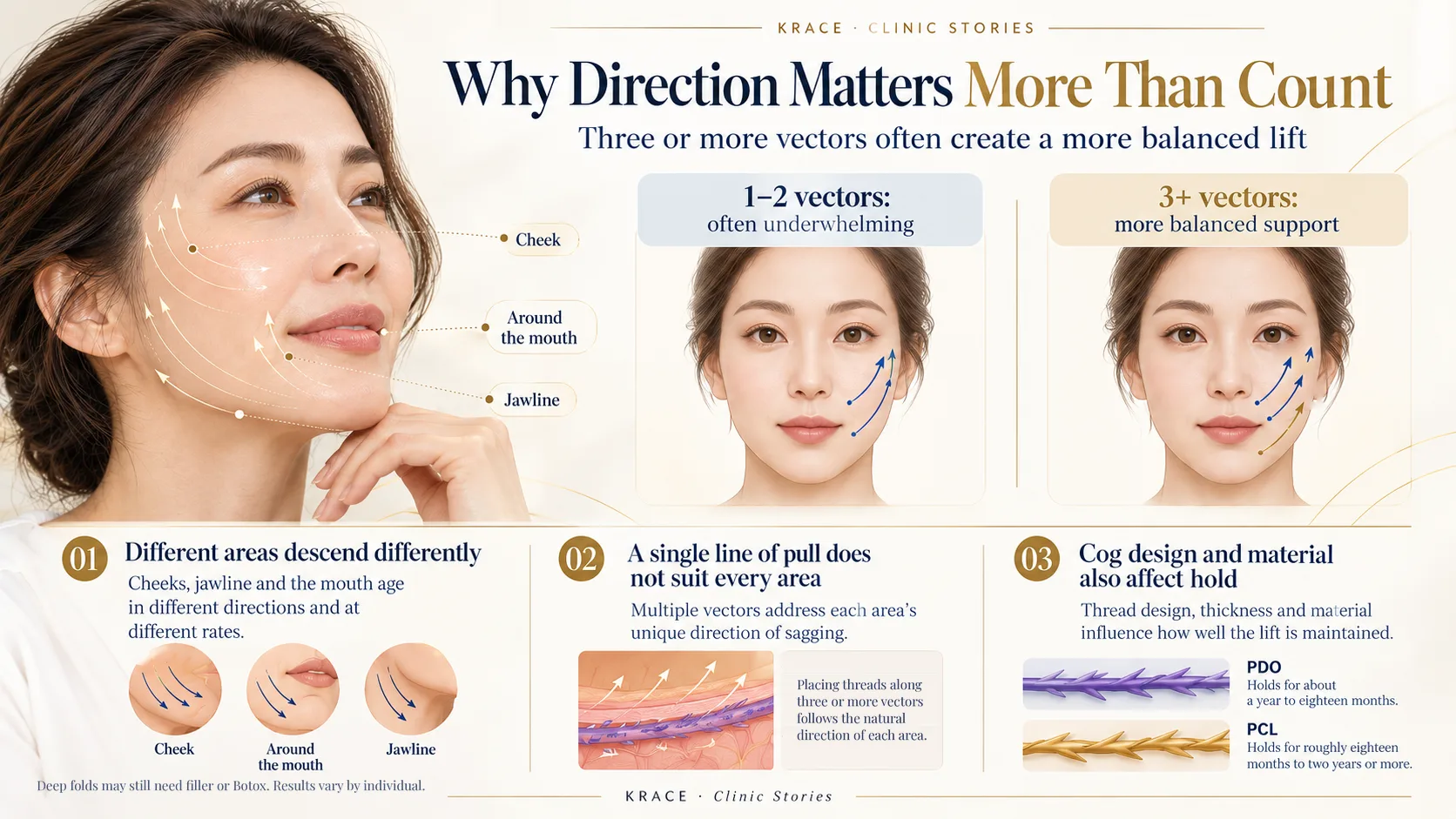
I place threads along three or more vectors rather than pulling everything in one direction. The cheek, the jawline, and the area around the mouth do not descend the same way, and a single line of pull that suits one of them will not suit the others.
Where only one or two vectors have been used, the result is frequently underwhelming. For any single point I am trying to lift, pulling from three or more directions is what brings the result to a level patients are satisfied with.
Direction is not the only variable. The shape of the cogs along the thread, the material — PDO or PCL — and whether those cogs run in two directions or in several all change how securely the thread holds the tissue it has engaged. These are chosen together rather than one at a time.
When a patient tells me threads elsewhere did nothing for them, this is usually where the explanation is found.
What remains after the thread is gone
Patients reasonably ask what happens when an absorbable thread absorbs. If it disappears, does the effect disappear with it?
Not entirely. As the thread breaks down, collagen forms along the path it took and the surrounding tissue adheres to that path. Some effect remains after the thread itself is gone. It is not the full initial result, and I would not describe it as permanent, but the face does not return to where it started.
This is the part I would rather explain carefully than overstate. A patient who understands what persists and what does not tends to be satisfied with what they actually get.
PDO and PCL hold for different lengths of time
The material determines the timeline. PDO threads are generally described as holding for about a year to eighteen months. PCL threads for roughly eighteen months to two years or more.
I use both, chosen according to what a given area needs rather than applying one material to the whole face, and only genuine threads supplied by the manufacturer. In medical travel the question of whether a product is genuine is a reasonable one to ask, and patients are entitled to a direct answer.
Who this suits, and who it does not
The question I answer first is how much loose skin there is.
Where a great deal of skin remains and has descended, that skin has to be removed, and a facelift is the operation for it. Threads do not take skin away. Using them in that situation produces something that does not match what the patient came in for.
Where there is not a great deal of excess skin but the face has descended, a thread lift is what I recommend.
For a patient who is not ready to consider surgery — and there are many, for reasons that have nothing to do with cost — threads offer a way to work on descent without an operation.

Deep folds usually need something else as well
Lifting and filling are different problems. A fold that has become fixed in the skin will still be visible after the surrounding tissue has been repositioned, because the fold itself was never a matter of position.
A heavier thread will improve a deep nasolabial fold on its own. For a result better than that, I generally suggest filler or botulinum toxin at the same time, and satisfaction is considerably higher with the combination. Which of the two, and how much, depends on the fold and is decided at examination.
Maintenance is part of the plan, not a failure of it
Whether a patient has threads or surgery, I advise maintaining the result with minor treatment such as botulinum toxin once or twice a year rather than expecting a single procedure to hold everything indefinitely.
This is not an upsell. A face that has been lifted goes on aging. Planning for that from the beginning produces a better ten-year outcome than treating each new change as a new problem.
For patients traveling from abroad
The clinic is in Seongnam, just outside Seoul. There is no skin excision and no incision, so the recovery is short. Most patients are back to ordinary activity the following day.
Swelling is the main visible effect and generally settles within about three days. A tight sensation along the threads can persist for around a month. That is expected and is not a sign that something has gone wrong.
One visit is usually enough. A follow-up at about a month is available for anyone who wants it, but it is not required. For a patient traveling from abroad, that is the practical difference between this and surgery.
Before scheduling, tell us about diabetes, high blood pressure, and any other ongoing condition, along with a full list of current medications and supplements. Some of these affect bleeding and healing directly.
Risks to review before deciding
A thread lift is a medical procedure. Swelling, bruising, tenderness, and a tight sensation are common in the early period. Dimpling or irregularity of the skin surface can occur, as can asymmetry between the two sides. A thread may become palpable or visible, may move from where it was placed, and in some cases requires removal. Infection, bleeding, and pain along the thread path are possible.
No result can be guaranteed in advance, and outcomes vary between individuals. That is a conversation to have in person with the physician who will perform the procedure, before anything is decided.