

In consultation, before anything else, most people ask the same three things: How much will actually change? How long will it last? How long until I look normal again?
The second question deserves the longest answer, and it is the one where answers vary most between clinics. Two people can have what is called the same facelift, done in the same year, and be in very different places five years later.
The difference usually comes down to which layer of the face was addressed.
Skin is not the only layer that sags
It is an easy assumption to make. The face looks loose, so the fix must be to remove loose skin and pull the rest tighter.
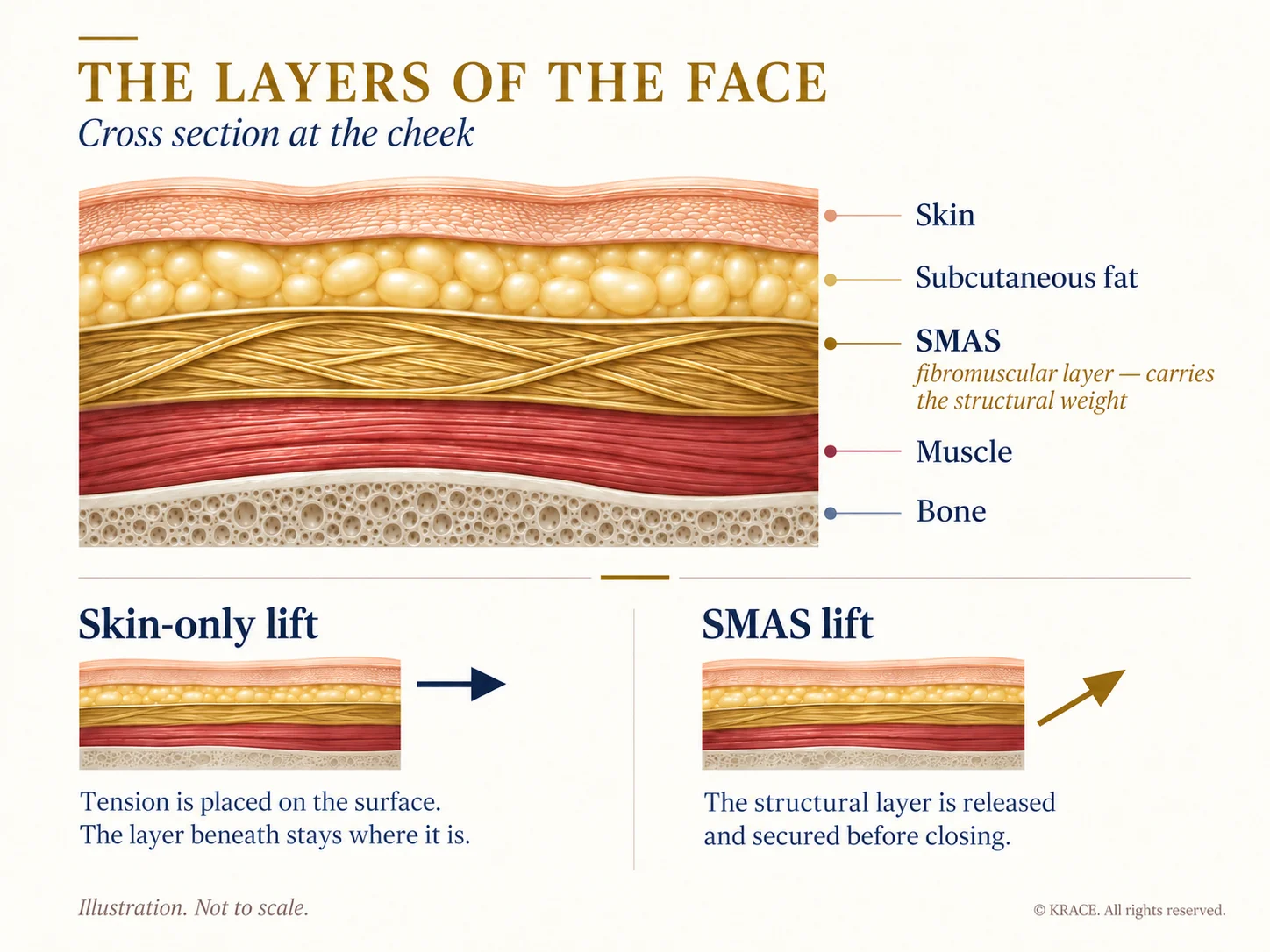
But the face is not a single sheet. Underneath the skin sits a fibromuscular layer that surgeons call the SMAS. This deeper layer carries the structural weight of the cheek and jawline. Over time it loosens and descends, and the skin follows it down. The sagging you see is the symptom; much of the cause sits underneath it.
This matters because skin has limited holding power. Pull it tight over a foundation that has not been repositioned, and it will do what skin does — gradually relax back toward where it was. The initial result can look good. It often does. The question is what remains after the tissue settles.
Skin-only lift and SMAS facelift: two operations, one name
A skin-only lift removes excess skin and closes under tension. It is a shorter surgery with a faster recovery, and for the right patient it can be a reasonable choice.
A deeper lift works on the SMAS itself. In my operations the excess skin is removed first. The SMAS is then released in front of the ear, elevated as a flap, and secured behind the ear. The remaining skin is drawn across and sutured.
Skin is pulled and closed in both operations. The difference is not whether the skin is pulled — it is whether anything underneath was moved before it was.
Both may be described to a patient as a facelift.
What revision facelift consultations tend to look like
In my experience, roughly a third to 40 percent of the patients who come to this clinic are here for revision — correcting surgery or treatment performed somewhere else.
A recurring pattern: the result looked reasonable at first, did not hold the way they expected, and the patient is left wondering what went wrong. Often they tell me the previous procedure focused mainly on tightening skin. Where operative records exist, I would rather read them than guess.
Revision is more difficult than a first operation. Scar tissue has formed, the tissue planes are less distinct, and the layers have adhered to one another. Separating them safely demands more technical skill than the original operation did. It is worth understanding the difference before the first surgery rather than after.
Where facelift incisions go, and what each one does
This is one of the questions patients ask most often, and the answer is more useful than a number of centimeters.
I divide the operation into three zones.
Scalp to just above the ear. This addresses the area around the eyes and the midcheek grooves.
In front of the ear. This addresses the nasolabial folds and the lines at the corners of the mouth.
Behind the ear. This addresses the jawline and the neck.
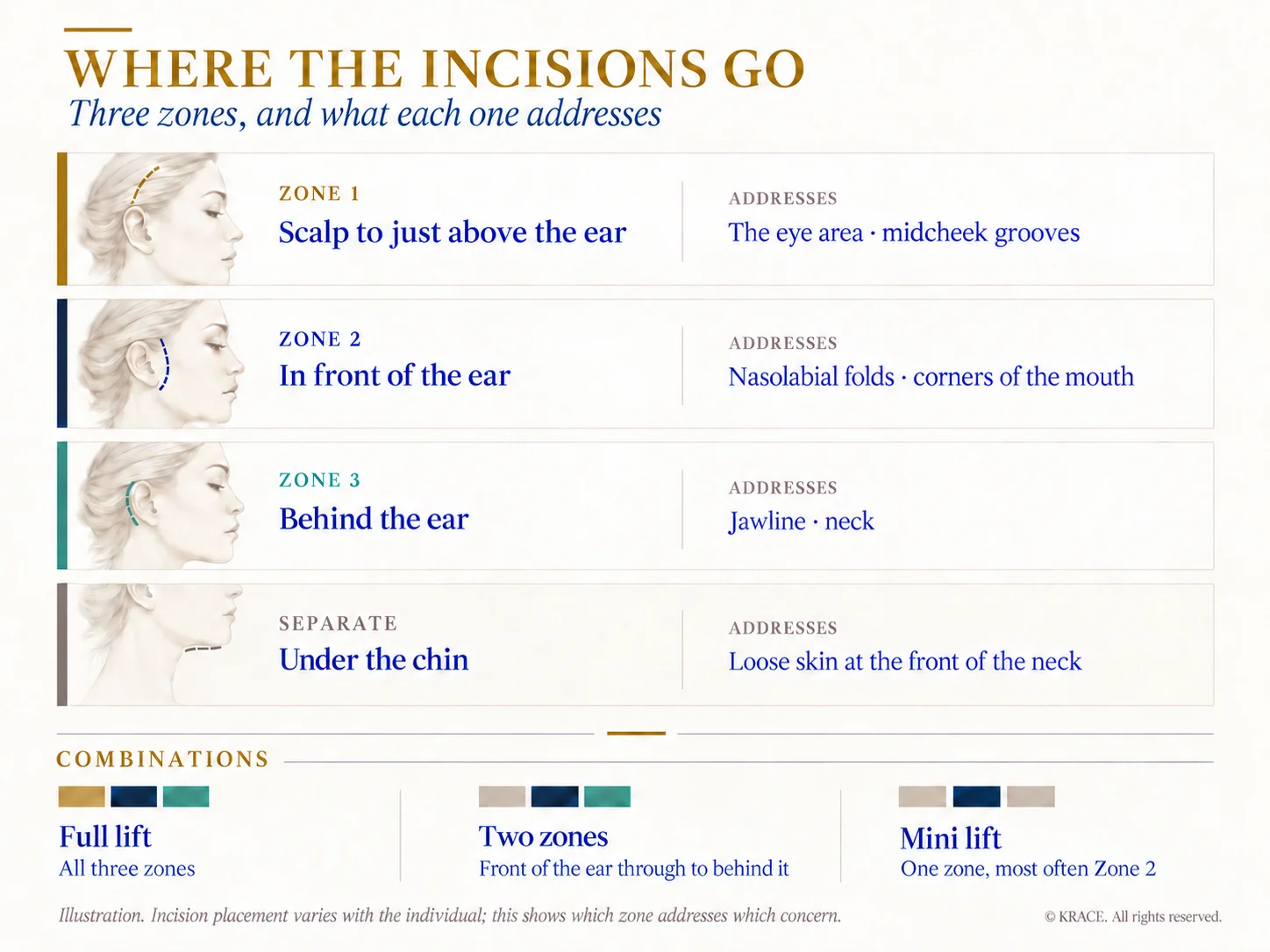
A full facelift uses all three. Lifting only one zone — most commonly the one in front of the ear — is what I call a mini lift. Someone concerned with the nasolabial folds, mouth corners, jawline and neck, but not the eye area, may have two zones instead: from in front of the ear through to behind it.
Loose skin under the chin and along the front of the neck is a separate problem, handled through an incision beneath the chin where the excess skin is removed directly.
Knowing which incision belongs to which concern tells you whether the plan actually matches what you came in for.
How long a facelift lasts: a realistic frame
Here is the honest version, and it is what patients are told in consultation.
A facelift does not stop aging. It sets the starting point back. Ten years from now the face will have continued to change — but it will be further ahead than it would have been without the surgery.
That framing tends to be more useful than a number of years, because the number depends on tissue quality, age at surgery, weight change, sun exposure, and genetics. Most patients are also advised to maintain results with periodic minor treatments once or twice a year rather than expecting the surgery to hold everything on its own.
Where thread lifts fit
Threads are a different tool, not a smaller version of the same one.
A thread lift repositions tissue using absorbable sutures placed along multiple vectors, without the larger incisions or skin excision that surgery requires. As the threads absorb, collagen forms along their path and the tissue adheres, so some effect remains after the thread itself is gone.
How long that lasts depends on the material. PDO threads are generally described as holding for about a year to eighteen months; PCL threads for roughly eighteen months to two years or more. I use both, chosen according to what a given area needs, and only genuine threads supplied by the manufacturer.
For patients with mild to moderate laxity, or for those not ready to consider surgery, threads can be an appropriate step. For significant descent of the cheek and jawline, they are unlikely to substitute for a structural lift. Deep static folds often need direct volume support as well, which is why threads are sometimes combined with filler or botulinum toxin rather than used alone.
Facelift recovery for patients traveling to Korea
The clinic is in Seongnam, just outside Seoul. Recovery to a presentable appearance is generally around one week, sometimes extending to two depending on the individual and the extent of surgery.
A return visit is required for wound care and suture removal, so travel plans need to account for more than the surgery date alone. Anyone considering surgery abroad should also disclose their full medical history in advance — particularly diabetes, hypertension, and any current medications, including supplements.
Choosing a clinic: what price and advertising do not tell you
One last thought, offered as a practical matter rather than a sales point.
Advertising volume is not a proxy for surgical judgment, and price does not tell you which technique is planned or whether that technique suits your anatomy.
The more useful questions are specific ones. Which layer will be addressed? Which incisions, and what does each one treat? What is realistic for my particular tissue? And what will this not fix? A surgeon who answers those directly is giving you more to work with than any advertisement can.
Facelift risks to review before deciding
A facelift is surgery. The risks include bleeding, infection, scarring, changes in skin sensation, problems with wound healing, nerve injury, and complications related to anesthesia.
Which of these matter most depends on the individual — general health, and what has been done to the face before. That is a conversation to have in person with the surgeon who will actually operate, before anything is decided.