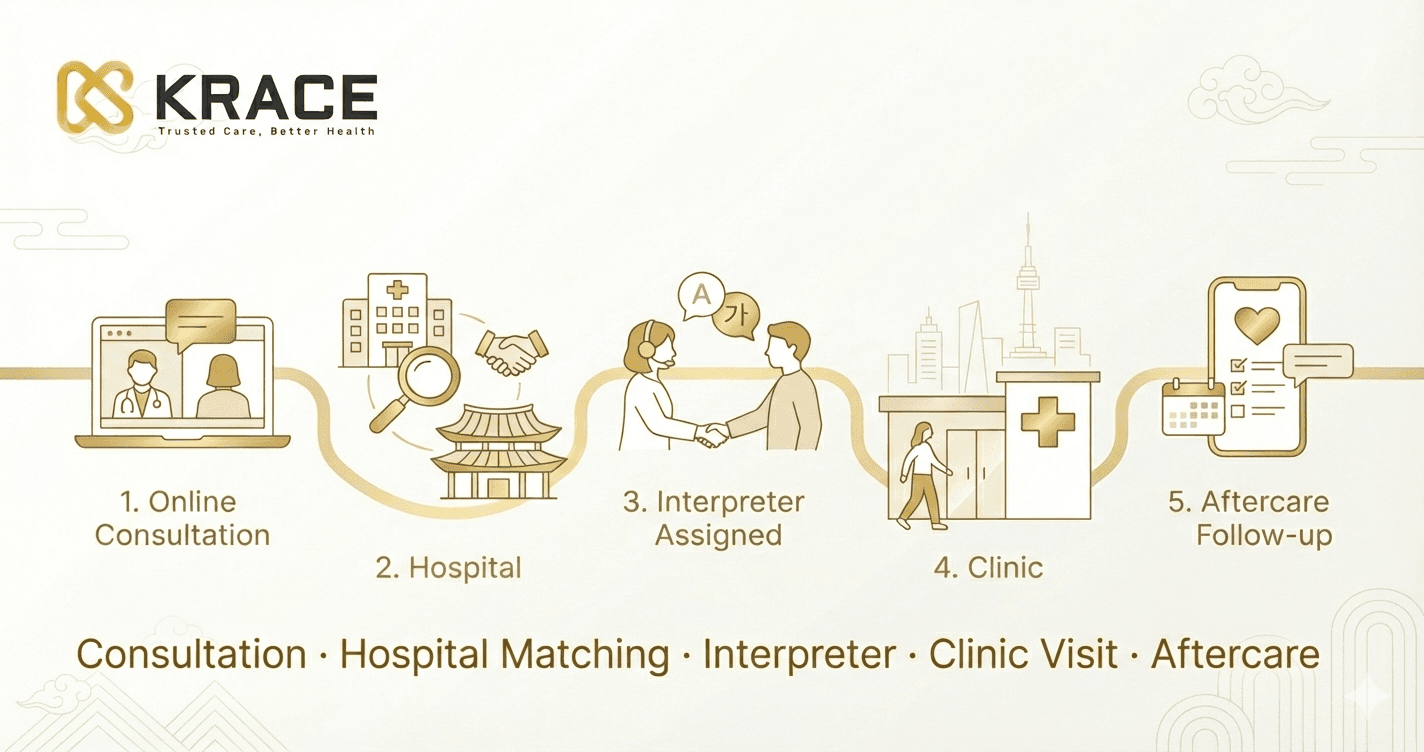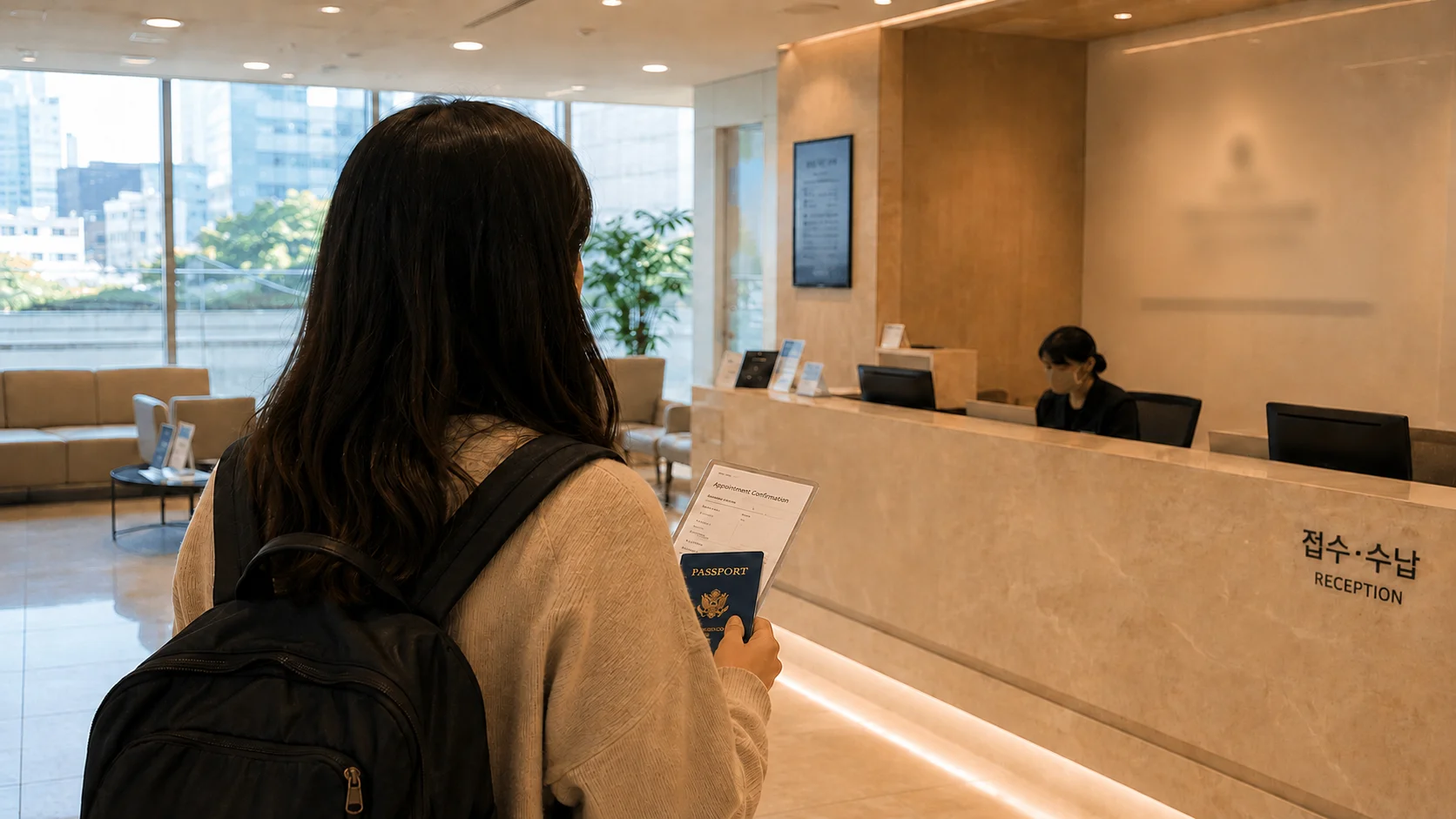

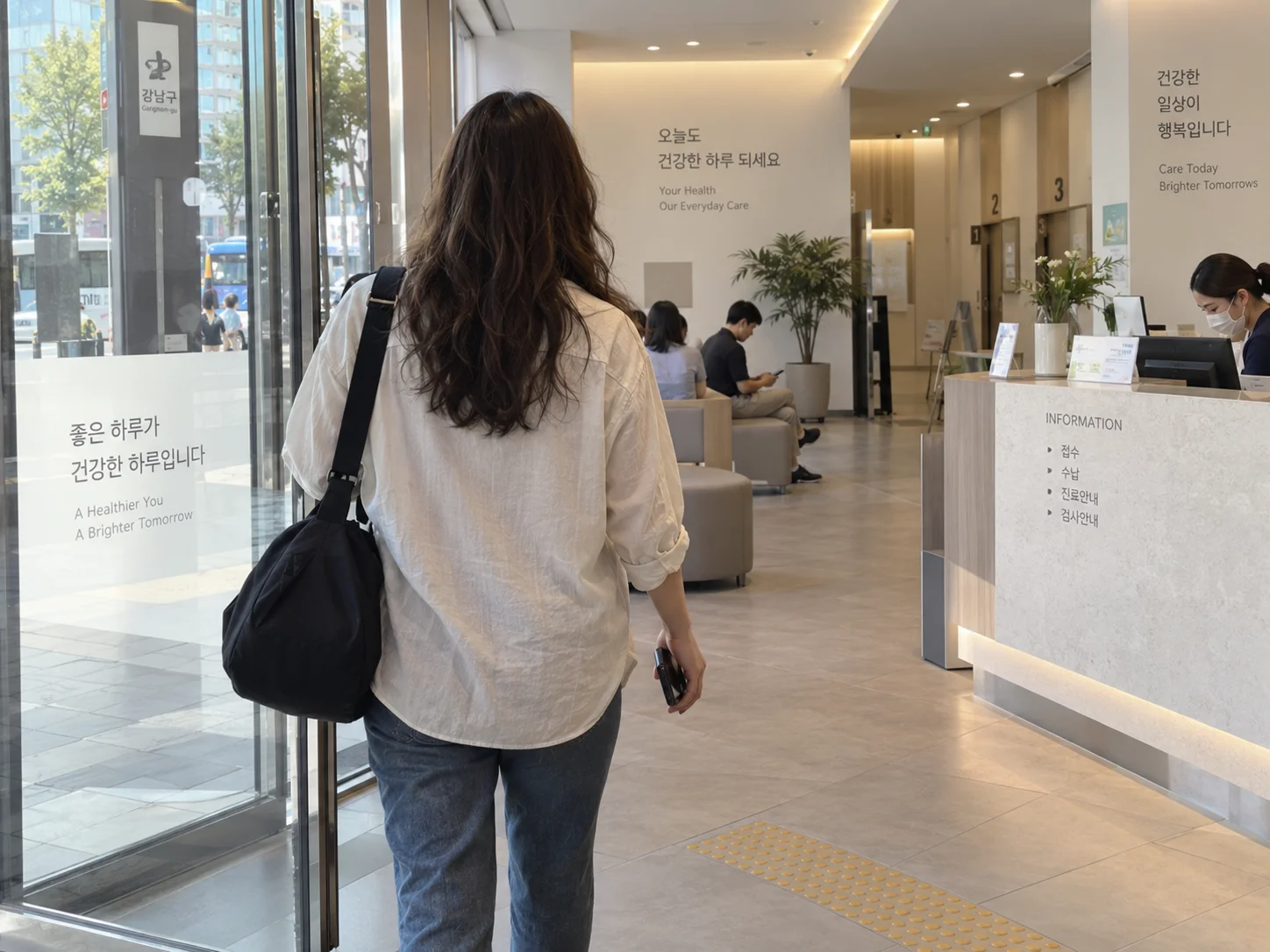
You have the appointment confirmation, the clinic address, and maybe a folder of medical records. But the question that often creates the most anxiety is much simpler: What actually happens when you walk into a Korean clinic? For an international visitor, the experience can feel surprisingly efficient—but the details around registration, language support, testing, payment, and follow-up still require some preparation.
Before You Arrive: The Visit Starts Before the Clinic Door
A smooth clinic visit usually begins before you leave your hotel.
Confirm the exact clinic name, branch, floor, appointment time, doctor or department, and what identification or medical records the clinic wants you to bring. Do not rely only on a map search result: large medical buildings may contain several unrelated clinics, while some brands operate multiple branches.
If you are visiting a provider that actively serves international patients, Korea has a formal registration system for medical institutions attracting foreign patients. Registered institutions can be searched through Medical Korea, and Korea’s official government guidance says registration requirements include malpractice liability coverage for foreign patients.
You can also review international-patient information through Medical Korea’s medical institution directory, which lists information such as specialty, interpretation languages, international patient contacts, and selected support services for individual providers.
On the Ground
Save the clinic name and address in Korean before leaving your hotel, especially if you plan to take a taxi. Keep your appointment confirmation and any ID or records the clinic specifically requested in one folder. If language support has been arranged, confirm whether the interpreter meets you at reception, joins remotely, or is provided by the clinic.
If you are still choosing a provider, read How to Choose a Korean Clinic before booking.
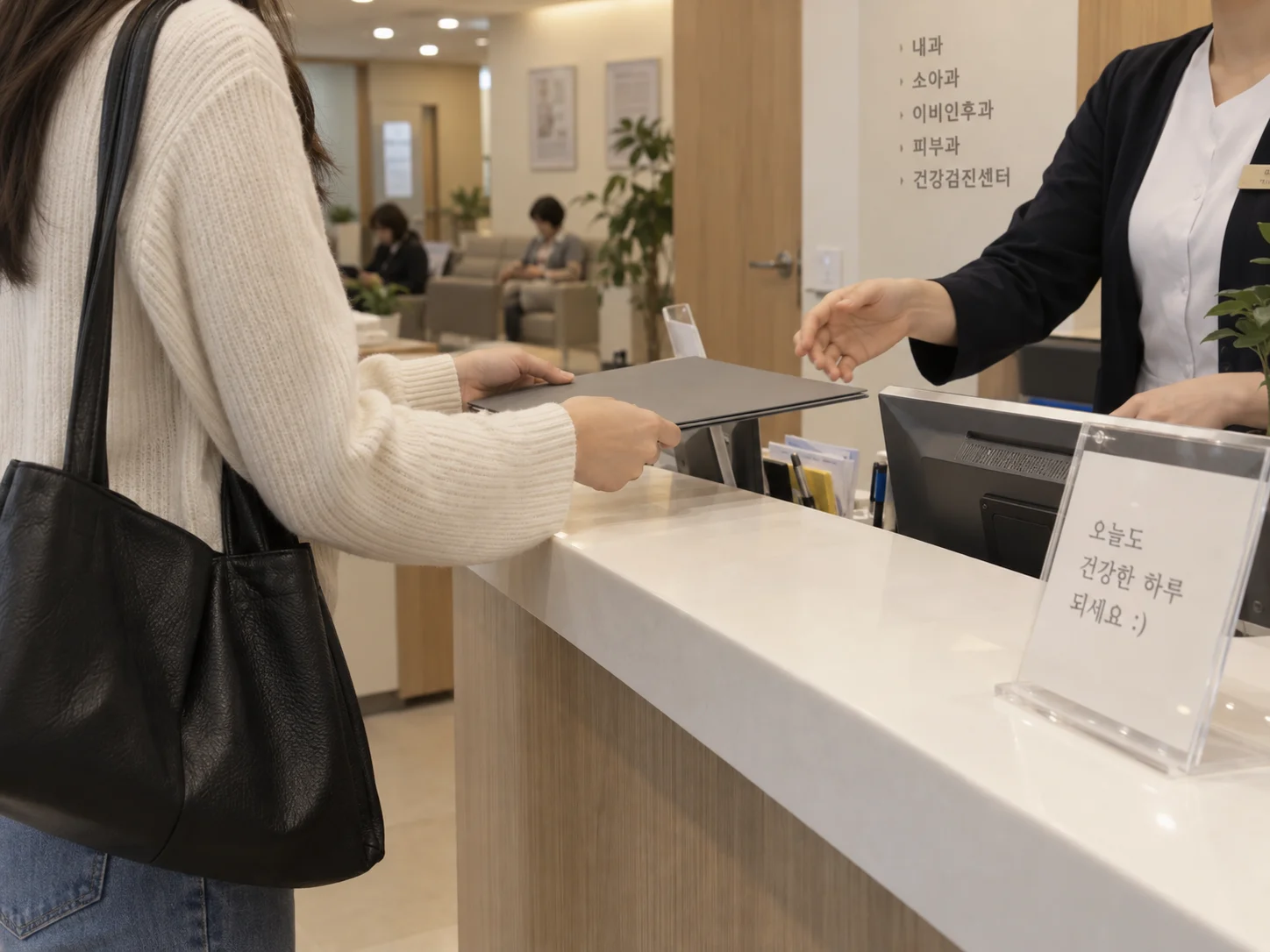
What Happens When You Walk In?
For many outpatient visits, the first stop is a reception desk rather than the doctor.
Staff may confirm your appointment, identity, contact details, and reason for visiting. Depending on the clinic, you may also complete a questionnaire covering symptoms, medical history, medications, allergies, or your goals for the appointment.
This is where the experience starts to vary considerably.
A small neighborhood clinic may have one reception area and a short path from check-in to the consultation room. A health screening center may move you between several stations, while a larger hospital can involve a dedicated international healthcare center, registration desk, billing desk, and multiple departments.
There is no single “Korean clinic experience,” so the practical question is not whether the process is fast in general. It is whether your particular clinic has explained its process before you arrive.
How Much Waiting Should You Expect?
Korea is often associated with quick access to outpatient healthcare, but an appointment time should not be treated as a guaranteed start time.
A previous patient may need longer with the doctor. Registration can take additional time, or the provider may determine that tests are needed before the consultation can continue.
For that reason, avoid placing another time-sensitive activity immediately after the appointment.
If you are planning sightseeing, a restaurant reservation, airport transfer, or train journey on the same day, leave a buffer. Your medical visit should drive that part of the schedule—not the other way around.
This becomes particularly important for tests and health screenings, where fasting requirements, imaging, laboratory work, or results consultations can extend the visit.
For a more detailed workflow, see Korea Health Checkup Steps.
The Consultation: Doctor, Coordinator, and Interpreter Are Different Roles
One of the most important things to understand as an international patient is who is actually communicating with you.
An English-speaking coordinator may help with registration, scheduling, payment, and logistics. An interpreter may facilitate communication between you and the clinician. The doctor is responsible for clinical assessment and medical decisions.
These roles should not be treated as interchangeable.
Before the appointment, ask:
Will the doctor speak English directly?
Will a medical interpreter be present?
Is interpretation in person, by phone, or by video?
Who should you contact for non-medical questions after the visit?
Who should you contact for clinical follow-up?
Official Seoul medical-tourism services provide multilingual consultation, reservation guidance, and medical-tourism coordination, which illustrates how language and logistics can be supported separately from the clinical consultation itself.
English support also varies significantly by provider. Medical Korea profiles list interpretation languages individually rather than assuming that every clinic offers the same level of support.
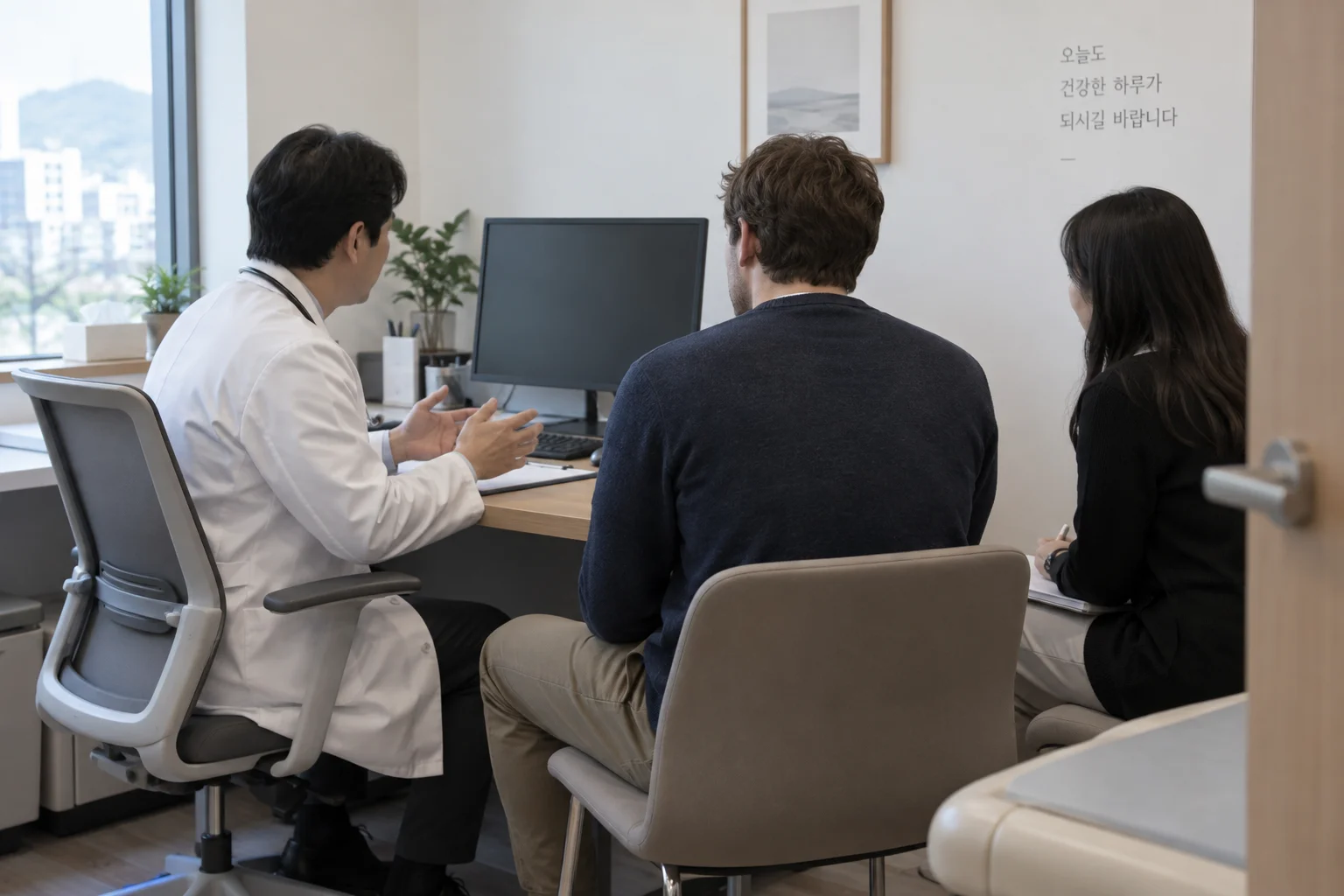
What Does the Doctor Visit Feel Like?
The consultation itself may feel more direct than some visitors expect.
The clinician may first review your reason for visiting, relevant history, prior records, and any testing available. If more information is needed, the provider may discuss additional examination or testing before determining next steps.
This is where preparation helps.
Write down your main questions before arriving. If you take regular medications or have relevant previous records, ask the clinic in advance which information would be useful and whether translation is needed.
Do not assume that bringing every medical record you have will make the consultation more efficient. A focused set of relevant documents is generally easier to coordinate than a large unsorted archive.
KRACE can help transmit information requested by the clinic and coordinate communication. KRACE does not determine which test or treatment is medically appropriate, interpret results, or make clinical recommendations.
What Happens If the Doctor Wants Tests?
This depends almost entirely on the provider.
Some clinics have laboratory testing, imaging, or other diagnostic services within the same facility. Others may require a separate appointment, another floor, another facility, or a return visit.
Before agreeing to additional testing, practical questions include:
Where will the test take place?
Can it be done today?
How long will it take?
What will it cost?
When will results be available?
Is a separate doctor consultation required for the results?
Will I still be in Korea when those results are ready?
The last question matters more to an international patient than it might to a local resident.
A result that takes several days may arrive after you have already left Seoul. That does not necessarily create a problem, but the delivery and follow-up process should be agreed on before departure.
Do Not Confuse Speed With Certainty
One attractive part of using healthcare during a Korea trip can be the possibility of arranging several steps within a relatively compact schedule.
But faster logistics do not mean every clinical question can be answered immediately.
Laboratory turnaround times differ. Imaging may require review. A doctor may request another visit, or the appropriate next step may depend on findings that were not available when you first walked in.
This is why KRACE content should not promise “same-day diagnosis,” “instant results,” or a complete treatment plan within a fixed number of hours.
The more useful promise is operational:
know where to go, what is scheduled, what is included, and what happens next.
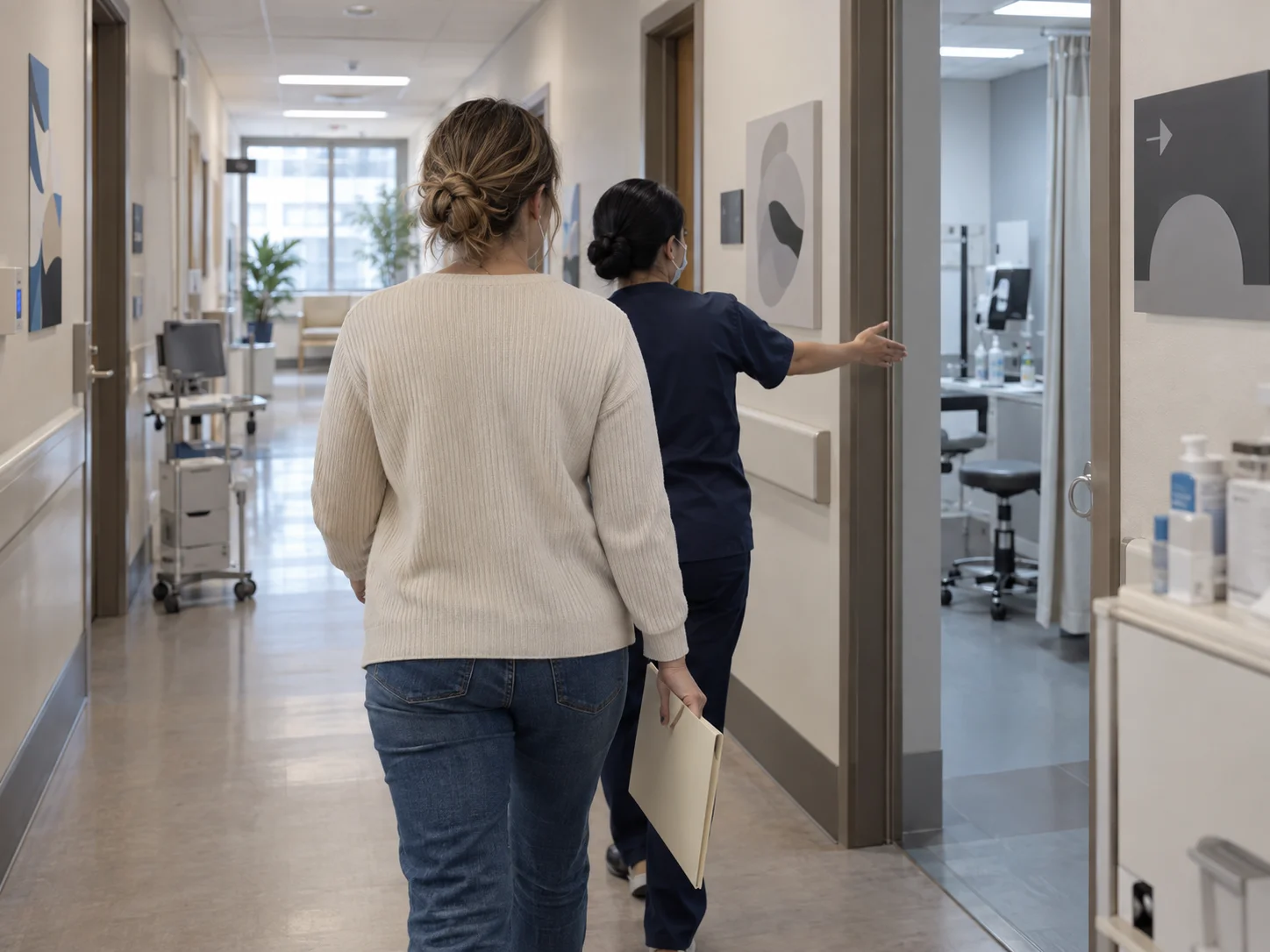
What Happens at Payment?
Payment is another point where international visitors should avoid assumptions.
Payment methods vary by medical institution. Medical Korea’s official institution profiles show that some providers explicitly accept international credit cards or other payment methods, but this information is listed provider by provider rather than as a universal rule.
Before treatment or testing, ask for a written estimate whenever possible.
Confirm separately:
consultation fee
tests or imaging
procedure or treatment fees
medication
interpretation, if charged separately
medical certificates or translated records
follow-up consultations
any optional add-ons
Do not use one clinic’s online price as a Korean market average. Final costs can depend on what the clinician finds, which tests are required, and what services are ultimately provided.
Prices vary by clinic and package — request a direct quote for accuracy.
What If You Receive a Prescription?
If the clinician issues a prescription, do not leave without understanding the practical next step.
Ask where it can be filled, whether you need to visit a separate pharmacy, and whether the medication instructions are available in a language you understand. If you plan to fly home soon, also ask the treating provider any relevant questions about continuing prescribed medication after travel.
KRACE can help with communication and logistics around clinic-provided instructions, but it does not advise on medication use or modify a prescription.
Before You Leave, Stop at the Desk One More Time
The end of the medical consultation is not necessarily the end of the visit.
Before leaving, confirm whether payment is complete, whether another appointment has been scheduled, when results will be available, and where any documents will be sent.
Useful questions include:
“Is there anything else I need to do today?”
“When will my results be available?”
“Do I need another appointment before I leave Korea?”
“Who should I contact after I return home?”
KHIDI’s guidance for patients considering medical services abroad specifically advises patients to consider post-treatment care after returning home as part of the decision process.
This is why follow-up belongs in the original booking conversation, not just at the end of the trip.
For more detail, read our guide to What Happens After Treatment in Korea? as part of your pre-travel planning.
What Feels Different as an International Patient?
The medicine is only one part of the experience.
An international visitor is simultaneously dealing with a healthcare system, a different language, an unfamiliar neighborhood, a travel schedule, foreign payment methods, and the question of what happens after flying home.
That creates several additional decision points:
Local healthcare question | International patient question |
|---|---|
When is my appointment? | Can it fit safely into my travel schedule? |
What does the doctor need? | Should I translate my records first? |
Where is the clinic? | Can I find the correct branch and floor? |
How much is the visit? | What is included and can I use my payment method? |
When are results ready? | Will I still be in Korea? |
Do I need follow-up? | Can follow-up continue after I fly home? |
This is where good coordination can make the experience feel much less uncertain without interfering with clinical decisions.
What If You Need Help While You Are in Seoul?
International-patient support exists outside individual clinics as well.
The Seoul Medical Tour Help Desk provides information on medical institutions, reservation guidance, and multilingual coordination for medical tourists. Seoul’s official traveler-assistance information also directs people to 119 for medical emergencies.
That distinction matters.
A coordinator or tourism support center can help solve a logistics problem. A medical emergency requires appropriate emergency services.
So, What Does a Good Clinic Visit Actually Feel Like?
Probably less dramatic than you imagined.
You know where you are going. Reception is expecting you. Someone explains the next step. You know who is translating, if anyone. The doctor has the information requested in advance.
If testing is added, you understand why the schedule is changing and what the additional cost will be. Before leaving, you know whether there is another visit, when records or results will arrive, and who handles follow-up.
That is a much better measure of an international-patient experience than whether the lobby looks luxurious or whether the clinic has thousands of social-media followers.
The goal is not to remove every uncertainty from healthcare.
It is to remove the avoidable uncertainty around accessing it in another country.
Planning Your First Korean Clinic Visit?
If you already know what type of care you are looking for but are unsure which clinic fits your needs, how the booking process works, or how to organize the appointment around your Korea trip, KRACE can help coordinate the practical steps.
KRACE supports clinic matching, booking, communication, travel-related logistics, and post-care coordination with independent licensed providers.
Start with a free consultation →
You Might Also Like

How to Choose the Right Korean Clinic: A Practical Guide
Imagine this: back home, you wait weeks—sometimes months—for a specialist appointment, only to spend 10 minutes in the consultation room. Now imagine landing in Seoul and getting a full consultation, diagnostics, and a treatment plan within 24–48 hours. That’s not an exception. It’s the norm in Korea. But here’s the reality most guides skip: while Korea is fast and affordable, choosing the right clinic as a foreigner can feel overwhelming. Different systems, unclear pricing, and language gaps ca
blog.kracecare.com

How to Book a Clinic in Korea as a Foreigner
Some outpatient clinics in Korea offer same-day or short-notice appointments, but availability, pricing, and language support vary. This guide explains how international visitors can compare clinics, confirm costs, and arrange an appointment with confidence.
blog.kracecare.com
Frequently Asked Questions
Practical answers to common questions international visitors may have before visiting a clinic in Korea.
What should I bring to a Korean clinic appointment?
Bring the identification and medical records requested by the clinic, along with your appointment confirmation. Save the clinic name, branch, floor, and address in Korean if possible.
If you take regular medications or have previous test results, ask the clinic in advance which records are actually needed and whether translation is required.
Do Korean clinic doctors speak English?
Some do, but English support should not be assumed. A clinic may have an English-speaking doctor, interpreter, international coordinator, or only limited foreign-language assistance.
Medical Korea lists interpretation languages for individual providers. Before your appointment, ask specifically who will communicate with you during the actual medical consultation.
How long should I allow for a Korean clinic visit?
There is no reliable universal duration. Registration, waiting, consultation, testing, imaging, payment, or an additional provider discussion can extend the visit.
Ask the clinic for an estimated schedule, but leave buffer time before tours, trains, restaurant reservations, airport transfers, or flights because the appointment may change depending on what happens during the visit.
Can I use an international credit card at a Korean clinic?
Some providers accept international credit cards, but payment policies vary by institution. International card acceptance should not be assumed for every clinic.
Confirm your card type, estimated cost, deposit requirements, and any alternative payment methods directly with the clinic before your appointment.
What should I get from the clinic before leaving?
Confirm any next appointment, expected result date, payment receipt, prescriptions or instructions, and any records or test results the clinic will provide.
If you will return home soon, ask whether further in-person review is expected, how results will be delivered, and who you should contact for follow-up after leaving Korea.