
You have heard good things about medical care in Korea—perhaps from a friend, a relative, or someone you follow online. Then you start searching, and every clinic seems to have a polished website, glowing reviews, and a long list of treatments.
How do you tell a well-run clinic from a well-marketed one?
The answer is not to look for one perfect review or one “best clinic” list. It is to check a series of practical facts: government registration, the doctor’s credentials, communication support, pricing clarity, and what happens after you return home.
Why a Polished Website Is Not Enough
Korea recorded approximately 2.01 million international patients in 2025, the first year the annual figure passed two million. Visitors came from 201 countries, with the United States ranking among the largest source markets. A growing market creates more choices, but it also makes careful verification more important.
A clinic can invest heavily in English marketing without offering the right specialist, a clear estimate, or dependable follow-up. On the other hand, an experienced outpatient clinic may have a modest English website but a strong physician, organized communication, and a realistic care plan.
On the Ground
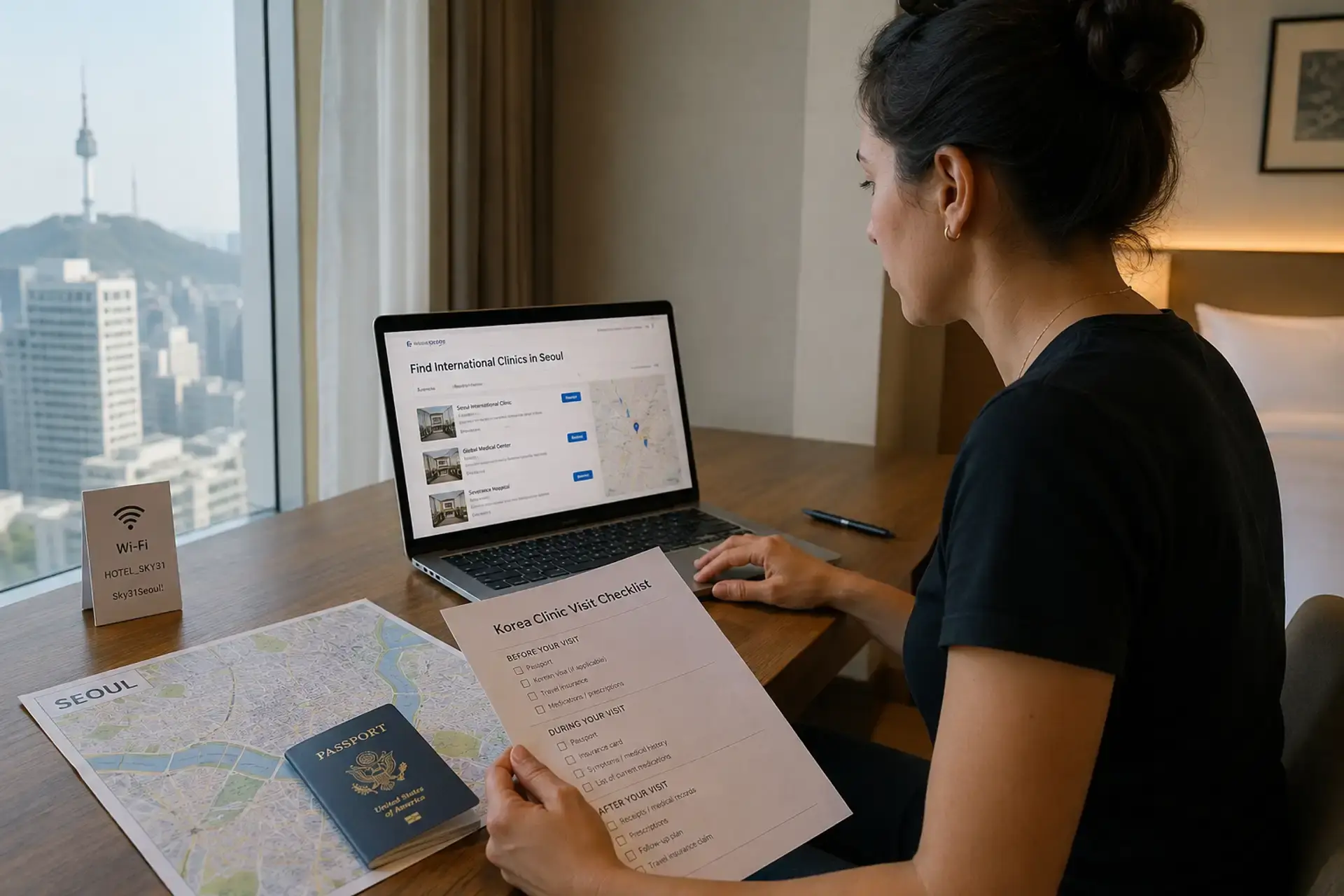
When you are researching from Dallas, Toronto, London, or Sydney, you may be comparing clinics late at night across several browser tabs. Save the Korean and English names of each clinic, the doctor’s full name, its address, and screenshots of the quoted service. English brand names can be similar, so these details help prevent confusion when you later confirm registration or directions.
Trust should come from information you can check—not from how expensive the website looks.
First, Understand What “Clinic” Means in Korea
Korea’s medical system includes several types of medical institutions.
A clinic, usually called an uiwon in Korean, is generally an outpatient-focused medical institution. Clinics commonly provide dermatology, dentistry, internal medicine, eye care, women’s health, Korean medicine, and other non-inpatient services.
Hospitals and general hospitals have inpatient facilities and broader departments. Tertiary hospitals are large referral institutions, often connected to universities, that manage more complex cases.

The word “clinic” does not automatically mean lower quality or limited experience. Many specialists work in independent outpatient institutions. A larger hospital is not always necessary for a straightforward consultation or outpatient procedure, while a clinic may not be appropriate for a complex condition that requires several departments or inpatient support.
The useful question is therefore not simply, “Is this a clinic or a hospital?”
Ask instead:
Is the institution appropriate for the type and complexity of care I need?
Who is the doctor responsible for my consultation or procedure?
What training and specialist credentials does that doctor hold?
Can the institution support an international visitor before and after the appointment?
For a broader comparison of location, language support, estimates, and clinic fit, read our guide to choosing the right Korean clinic.
What Government Registration Actually Proves
Under Korean law, medical institutions that actively attract international patients from abroad must complete a designated registration process. Registered foreign-patient facilitators—companies that coordinate or connect patients with providers—are registered separately.
Registration requirements include the required medical accident liability insurance or medical indemnity coverage. Depending on the type of institution and department, specialist staffing requirements may also apply. Registration is therefore a meaningful legal-status check.
International visitors can search the official Medical Korea registered hospitals directory and the separate registered facilitators directory. As of July 2026, Medical Korea provides separate searchable directories for registered medical institutions and registered foreign-patient facilitators.
What registration tells you
Registration helps confirm that an institution or facilitator is officially registered for international-patient attraction activities.
It is a useful first filter when a clinic or coordinating company is actively marketing to patients outside Korea.
What registration does not tell you
Registration is not a guarantee of treatment quality, a particular medical result, fluent English communication, or suitability for your individual case.
It does not automatically tell you:
How much experience a specific doctor has with your condition or procedure
Whether interpretation is available during the medical consultation
Whether the estimate includes medication, testing, follow-up, or additional procedures
How quickly the clinic responds to questions after you leave Korea
Whether the proposed treatment fits your travel schedule and health history
The registration check establishes a legal floor. You still need to evaluate the clinical and practical fit.
Registration is only one part of verification. Warning signs such as payment pressure, an unidentified doctor, vague pricing, or missing aftercare should also make you pause. For a detailed checklist, read our guide to Korean clinic red flags before booking.
Verify the Doctor, Not Just the Service Menu
A clinic’s website may advertise dermatology, dental implants, health screenings, eye care, pain treatment, or aesthetic procedures. A service menu alone does not prove that the doctor you will meet is a board-certified specialist in the most relevant field.
Korean rules allow recognized specialty information to appear in specified ways in a medical institution’s legal name when the person opening the institution holds the relevant specialist status. That can be a useful clue, but it should not replace direct verification of the individual doctor.

Ask the clinic or coordinator these three questions:
Is the doctor a Korean board-certified specialist, and in which specialty?
How frequently does this doctor evaluate or perform the service I am considering?
Who will actually perform each part of the consultation or procedure?
Not every clinic name includes a specialty, even when a specialist practices there, so the clinic name should be treated as a clue rather than final proof.
A clinic should be able to provide the doctor’s full name, role, specialty, and a clear explanation of who is responsible for care.
Be careful with vague answers such as “our medical team is highly experienced” when no individual doctor is identified.
Specialist status is not the only measure of a good physician, and it does not guarantee an outcome. It is simply one important fact to consider alongside experience, communication, facility type, and the needs of your case.
Red Flags You Can Spot Before Leaving Home
You do not need to speak Korean to notice common warning signs.
A guaranteed outcome
No responsible provider can guarantee an exact medical or aesthetic result. Outcomes depend on individual anatomy, health history, treatment response, and other factors.
Pressure to pay immediately
Limited promotions can be legitimate, but a countdown, repeated payment pressure, or a refusal to provide time for review should make you pause.
A medical decision should not depend on whether you transfer money before the end of the day.
No identifiable doctor
You should know who will assess you and who will perform the procedure. A clinic that presents rooms, equipment, and testimonials but does not identify its doctors is giving you incomplete information.
A quote with no scope
A low number is not useful unless you know what it includes.
Ask whether the estimate covers consultation, tests, medication, anesthesia, supplies, follow-up, interpretation, taxes where applicable, and any likely additional fees. Prices vary by clinic and individual plan—request a direct quote for accuracy.
No questions about your health
A provider should request relevant information before confirming that a service may be appropriate. Depending on the care involved, that may include medical history, medications, allergies, previous procedures, pregnancy status, or current symptoms.
No realistic aftercare plan
“Contact us anytime” is not an aftercare process.
Ask who receives post-visit questions, what communication channel is used, what symptoms require urgent local care, and whether records or instructions can be provided in English.

Use This Five-Step Clinic Verification Process
Here is the practical sequence I would use for a family member planning care in Korea.
1. Confirm the institution’s identity
Record the clinic’s full Korean name, English name, address, phone number, and website. Make sure the information on the estimate and payment request matches the institution you researched.
2. Check the official registration status
Search the Medical Korea directory when the institution is actively attracting international patients from overseas. When a facilitator or concierge is involved, check that business separately.
A listing is the beginning of the review—not the end.
3. Verify the individual doctor
Ask for the doctor’s full name, specialty, role, and relevant experience. Confirm who will provide the consultation and who will perform the procedure.
Do not assume that the doctor shown most prominently on social media will be the doctor treating you.
4. Request a written estimate and process outline
The estimate should identify the proposed service, likely inclusions, major exclusions, payment timing, and cancellation or refund terms.
Remember that a final medical plan may change after an in-person examination. The clinic should explain which parts are estimates and which charges are already fixed.
5. Confirm communication, records, and aftercare
Ask how you will communicate before the visit, during the medical consultation, and after returning home.
Confirm whether available records, results, prescriptions, receipts, and post-care instructions can be provided in English. Record availability and format depend on the provider and type of care, so ask before booking rather than at the airport.
For the next stage of planning, see our practical guide on how to book a clinic in Korea.
Why a Directory Alone May Not Be Enough
Directories are useful for confirming names, locations, and registration status. They do not automatically tell you which clinic is suitable for your particular goals, dates, communication needs, budget range, or follow-up situation.
That is where coordination can be useful.
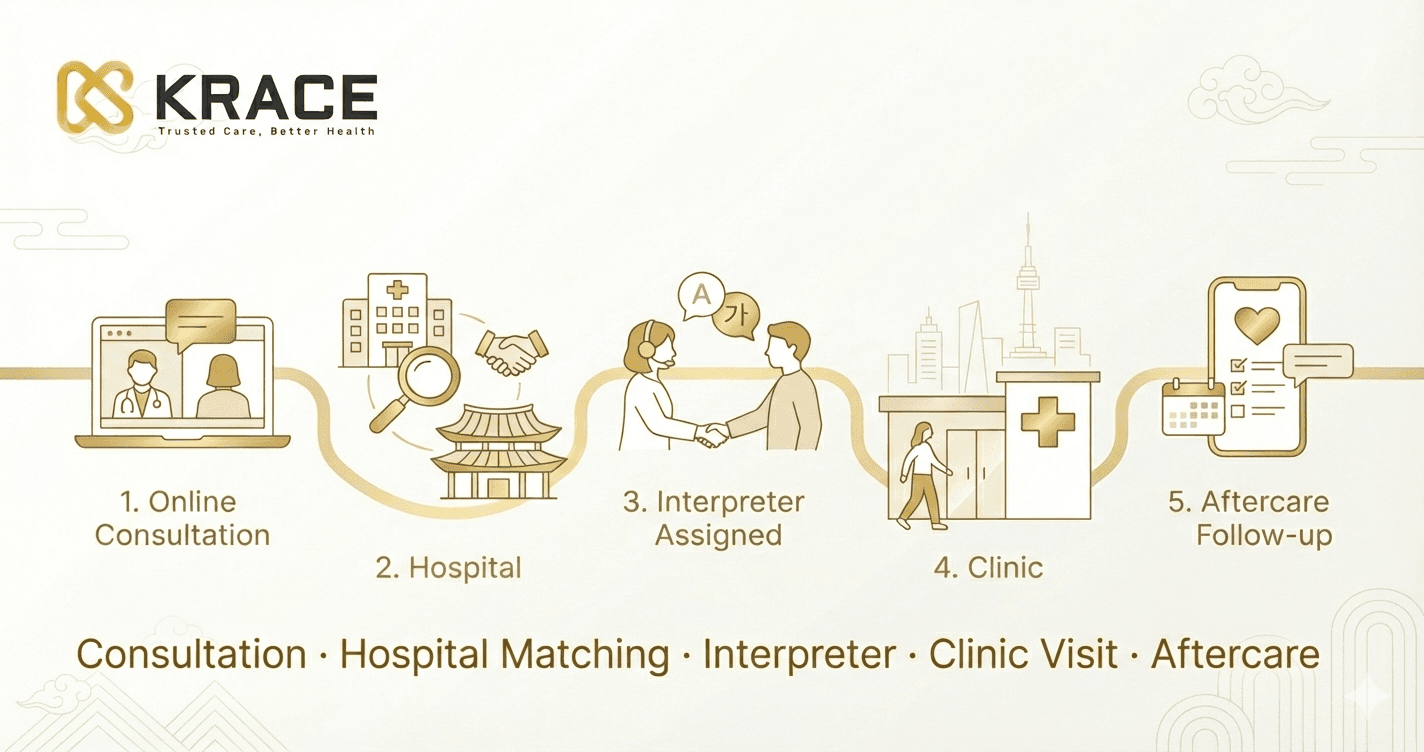
KRACE begins by understanding what you are looking for, your preferred dates, relevant health context, communication needs, and budget range. Where appropriate, KRACE may first share a de-identified summary of your request with potential providers.
Identifying or medical information is shared only when necessary for coordination and with the patient’s consent.
Potential providers can then clarify matters such as availability, the expected evaluation process, language support, estimated service scope, and aftercare arrangements. You remain free to review the information and decide whether to proceed.
KRACE supports clinic matching, booking, communication, and post-care coordination. KRACE does not diagnose, prescribe, recommend a specific medical treatment, or provide medical care. Medical evaluations, treatment recommendations, and medical services are provided by independent licensed healthcare providers licensed in Korea.
Plan for the Trip Home Before You Book
The most overlooked part of medical travel is not getting to the clinic. It is what happens after you leave.
Someone visiting from Texas may fly home ten days after treatment. A visitor from Canada, the UK, or Australia may also return to a healthcare system where the Korean provider cannot directly manage local emergency care or order routine follow-up in the same way.

Before confirming care, ask:
How long should I remain in Korea after the appointment or procedure?
Is an in-person follow-up required?
What symptoms should lead me to contact the clinic?
What symptoms require urgent care where I am staying?
Can the clinic communicate with me after I return home?
Which records and instructions will I receive?
Will I need a doctor back home for continued monitoring?
A responsible plan accounts for the fact that you do not live around the corner.
Start With Verification, Not a Booking
You do not need to identify one universally “best” clinic. You need a legitimate institution, an appropriate doctor, clear communication, and a plan that fits your health needs and travel situation.
Take the process in order:
Verify the institution.
Verify the doctor.
Clarify the estimate.
Confirm communication.
Plan the aftercare.

When those five areas are clear, the decision becomes less about trusting an unfamiliar website and more about comparing information you can understand.
Start with a free consultation →
Frequently Asked Questions
These answers explain how to verify a Korean clinic, check registration and doctor credentials, and prepare for communication and aftercare.
How can I verify a Korean clinic before booking?
Confirm the clinic’s full legal name, address, and contact information. Check its international-patient registration when applicable, identify the individual doctor, request the doctor’s specialty and role, and obtain a written estimate. You should also confirm language support, cancellation terms, medical-record availability, and how the clinic handles questions after you return home.
Does foreign-patient registration guarantee that a clinic is good?
No. Registration confirms that the institution has completed the applicable legal registration for attracting international patients and meets specified registration conditions. It does not guarantee treatment quality, English fluency, suitability for your case, or a particular result. Use registration as the first filter, then evaluate the individual doctor, communication, estimate, and aftercare plan.
How do I check whether a Korean doctor is a board-certified specialist?
Ask for the doctor’s full name, recognized specialty, role in your care, and relevant procedure or case experience. Do not rely only on the clinic’s service list or English brand name. A specialty appearing in a Korean legal clinic name can be a useful clue, but direct confirmation of the individual doctor’s credentials is still important.
Do I need a coordinator to book a Korean clinic?
No. International visitors can contact clinics directly. A registered coordinator may be helpful when you need assistance comparing providers, confirming communication support, organizing appointments, or planning follow-up from abroad. KRACE supports those coordination steps but does not diagnose, recommend a specific medical treatment, or provide medical care.
What should I confirm about aftercare before flying home?
Ask how long you should remain in Korea, whether an in-person follow-up is required, which symptoms require urgent local attention, and how to contact the clinic after departure. Confirm which records, results, prescriptions, receipts, and post-care instructions will be available in English and whether you may need continued monitoring from a provider back home.
You Might Also Like

How to Choose the Right Korean Clinic: A Practical Guide
Imagine this: back home, you wait weeks—sometimes months—for a specialist appointment, only to spend 10 minutes in the consultation room. Now imagine landing in Seoul and getting a full consultation, diagnostics, and a treatment plan within 24–48 hours. That’s not an exception. It’s the norm in Korea. But here’s the reality most guides skip: while Korea is fast and affordable, choosing the right clinic as a foreigner can feel overwhelming. Different systems, unclear pricing, and language gaps ca
blog.kracecare.com

How to Book a Clinic in Korea as a Foreigner
Imagine this: back home, you wait two to six weeks just to see a doctor—longer for anything specialized. Now picture landing in Seoul and getting a consultation, diagnosis, and treatment plan within a single day. That’s not a travel hack. It’s how the Korean medical system works. But here’s the catch: while care is fast and accessible, figuring out how to actually book a clinic in Korea as a foreigner isn’t always straightforward. Different systems, language gaps, and unclear pricing can make it
blog.kracecare.com

Why More Travelers Are Choosing Korea for Primary Care
Imagine needing a health checkup but facing a three-month wait back home. Now picture landing in Seoul, booking a clinic visit within days, completing lab tests the same morning, and getting results before the week ends. For many international visitors, that’s not hypothetical — it’s exactly how healthcare works in Korea, especially for those seeking primary care Korea. Across North America, Europe, and Australia, rising costs and long wait times are pushing travelers to look abroad for care. Ko
blog.kracecare.com