

“I have insurance, but I’m still afraid to use it.”
For many U.S. travelers, that feeling has become familiar. As ACA Marketplace premiums and deductibles rise, some people are keeping insurance but delaying routine care because the out-of-pocket cost still feels unpredictable. For U.S. travelers already considering a trip to Korea, this is changing how they think about planned, non-emergency medical care in Korea.
Instead of postponing preventive checkups, dermatology consultations, dental evaluations, or second opinions indefinitely, some visitors are starting to organize medical appointments before they travel.
That does not mean medical travel should replace health insurance. It should not. Emergency care, unstable conditions, and ongoing treatment needs should stay connected to local providers back home.
But for planned care that can be reviewed, scheduled, documented, and followed up carefully, Korea may be a practical option to consider before a trip.
Why U.S. Health Insurance Does Not Always Make Care Affordable
Health insurance is supposed to provide peace of mind. But having coverage does not always mean care feels accessible.
In the U.S., many people face a difficult trade-off. A lower monthly premium can come with a higher deductible. A plan may help protect against major emergencies, but routine care, lab work, imaging, specialist visits, dental care, or dermatology consultations may still feel expensive.
This is especially true when people move into lower-premium plans to manage monthly costs. Bronze plans can reduce the monthly bill, but they often come with higher deductibles and more cost-sharing when care is actually used.
Source note to include: According to KFF’s 2026 ACA Marketplace analysis, average deductibles rose sharply in 2026, driven in part by more people selecting Bronze plans.
The practical result is simple: people hesitate.
They wait to book an appointment. They delay blood work. They postpone a skin concern, dental issue, or recurring pain. They search online for alternatives because they are not sure what the final bill will be.
The problem is not that people are ignoring their health. Many are trying to make a responsible decision in a system where prices and coverage rules can be hard to understand.
That is why planning ahead matters.
On the Ground
Many international visitors do not come to Korea only for medical care. They are already visiting Seoul for food, culture, family, business, beauty, or a long-postponed vacation.
The medical part often becomes practical once they realize that certain appointments can be planned in advance. A health checkup, dental evaluation, dermatology consultation, or specialist visit may fit into a trip when the clinic, timing, language support, and follow-up process are confirmed before arrival.
The best experiences usually start before the flight. Visitors who prepare medical records, clarify their goals, and confirm communication support tend to feel more in control.
Why Higher ACA Premiums Are Changing Medical Travel Planning
For years, many ACA Marketplace enrollees received enhanced premium tax credits that helped lower monthly insurance costs. Those enhanced credits ended on December 31, 2025, which means some enrollees may face higher monthly premiums in 2026.
Source note to include: Covered California explains that enhanced premium tax credits ended on December 31, 2025, and monthly costs may be higher in 2026.
Even when financial help is still available, many consumers are being asked to carry more of the cost burden themselves.
This creates three common behaviors.
First, some people drop coverage when premiums become too high. That can leave them exposed if something serious happens.
Second, some people move to lower-premium plans with higher deductibles. This may help with the monthly bill but can make actual care feel expensive.
Third, some people keep insurance but delay using it. They avoid appointments because they are unsure what they will owe after the visit.
That third group is especially important. These are often people who want to take care of their health but feel stuck between rising costs and unclear billing.
For them, planning non-emergency care before travel can become part of a broader health strategy.
Medical Travel Is Not a Replacement for Health Insurance
Medical travel should not be presented as a replacement for health insurance. It is not appropriate for emergencies. It is not ideal for unstable medical conditions. It should not replace ongoing care for serious chronic disease.
If you have chest pain, stroke symptoms, severe infection, uncontrolled symptoms, or any urgent health concern, local medical care should come first.
Medical travel is more relevant for planned, non-emergency services.
That may include preventive health checkups, dermatology consultations, dental evaluations, second opinions, and selected specialist consultations. These services can often be reviewed in advance, scheduled around travel dates, and documented for follow-up.
But even planned care requires caution.
Before booking, travelers should ask:
What type of clinic or hospital is appropriate?
Is English support available before, during, and after the appointment?
What is included in the appointment or package?
What records should be prepared before travel?
How will results be delivered?
What happens if follow-up is needed after returning home?
These questions are not small details. They are what make medical travel safer and more realistic.
Why U.S. Travelers Are Considering Medical Care in Korea
Korea has become one of Asia’s major medical travel destinations, especially for visitors seeking planned care in cities like Seoul.
According to South Korea’s Ministry of Health and Welfare, Korea recorded 2,011,822 foreign patients treated at Korean medical institutions in 2025, surpassing 2 million for the first time since official statistics began in 2009.
Source note to include: Ministry of Health and Welfare / KHIDI, April 2026 foreign patient statistics.
This growth reflects Korea’s expanding medical travel infrastructure. But it does not mean every clinic is appropriate for every visitor.
For English-speaking travelers, the practical appeal is usually not just the medical service itself. It is the combination of dense clinic access, appointment-based services, health screening culture, modern diagnostic infrastructure, and travel convenience.
Many clinics and hospitals in Seoul are located near areas international visitors already know, including Gangnam, Seocho, central Seoul, and major transit routes. This can make it easier to combine planned appointments with a broader itinerary.
Still, clinic selection matters.
A polished website, viral video, or social media review is not enough. Travelers should check whether the provider is licensed, whether the facility is appropriate for the service, and whether communication support is clear.
What Medical Services Can U.S. Travelers Plan in Korea?

Not every service fits a short trip. The best fit is usually care that can be planned, reviewed, documented, and followed up without creating unnecessary risk.
1. Preventive health checkups
Korea is known for structured health screening programs. Depending on the clinic or hospital, a checkup may include blood work, imaging, digestive screening, women’s health options, cardiovascular markers, or lifestyle-related tests.
For travelers who have delayed routine care back home because of cost, scheduling, or uncertainty, a preventive checkup can help restart the conversation with their health.
The key is to choose a package based on age, risk factors, family history, and health goals. The longest or most expensive package is not always the best fit.
2. Dermatology consultations
Many visitors are interested in Korean dermatology for pigmentation, acne scarring, redness, texture, skin maintenance, or laser consultations.
A safe consultation should include skin assessment, expected downtime, possible side effects, aftercare instructions, and whether multiple sessions are needed.
Travelers should avoid making decisions based only on before-and-after photos or influencer content. A treatment plan should match skin type, timing, medical history, and travel schedule.
3. Dental evaluations
Dental care is another area where travelers often compare timelines and care options. A basic exam, cleaning, imaging, or second opinion may be easier to plan than complex treatment.
More involved dental work needs careful timing. Procedures such as implants, crowns, extractions, or surgical treatment may require multiple visits, healing time, or follow-up care.
Before committing, travelers should confirm the full treatment timeline, not just the first appointment.
4. Specialist consultations
For non-urgent concerns, a specialist consultation may help clarify next steps. This can be useful for reviewing previous test results, asking whether additional testing is appropriate, or getting a better understanding of a recurring issue.
However, overseas consultation should not replace ongoing care for serious or unstable conditions. It should support better decision-making, not create fragmented care.
Checklist Before Booking Medical Care in Korea

Before booking a clinic in Korea, start with the same questions you would ask back home.
Clarify your goal
Are you trying to get a routine checkup, investigate a symptom, compare treatment options, or receive a planned service?
A vague goal leads to vague recommendations. A clear goal helps match you with the right clinic, department, and appointment type.
Prepare your records
Bring relevant medical records, medication lists, allergies, past surgeries, imaging reports, and recent lab results if available.
Even basic information can help avoid repeated tests or misunderstandings.
Confirm English support
Do not assume that “English-friendly” means full support through every step.
A clinic may have English booking support but limited English during medical consultation, consent forms, payment explanation, aftercare, or follow-up messages.
Ask where English support is available.
Ask about pricing scope
Prices vary by clinic, package, doctor, test type, and follow-up needs. Request a direct quote for accuracy.
Instead of asking only, “How much is it?” ask what is included, what is optional, and what could create additional charges.
Review follow-up
This is one of the most important steps.
If results come out after you leave Korea, how will they be delivered? If you need more care, who explains the next step? If you return home, what information should you share with your local doctor?
Match your itinerary to the medical plan
Some appointments are easy to combine with sightseeing. Others may require fasting, rest, avoiding alcohol, avoiding sun exposure, or leaving time for results.
Your travel schedule should support your care plan, not work against it.
What to Avoid When Planning Medical Travel
Medical travel becomes risky when people rush decisions.
Avoid clinics that pressure you to book immediately, refuse to explain pricing clearly, offer one-size-fits-all treatment plans, or minimize recovery time.
Be cautious with services that promise guaranteed results or frame medical decisions as a limited-time deal.
Also avoid treating Korea as a place to “get everything done quickly.” Some care should not be rushed. Some symptoms require local follow-up. Some procedures may be better handled near home because continuity of care matters.
Source note to include: CDC advises medical travelers to plan for continuity of care and not delay treatment if complications occur during or after travel.
A responsible medical trip should feel organized, not impulsive.
How KRACE Helps International Visitors Plan More Safely
KRACE does not provide medical care, diagnose conditions, prescribe medication, or make treatment decisions. Medical services are provided by independent licensed clinics and hospitals in Korea.
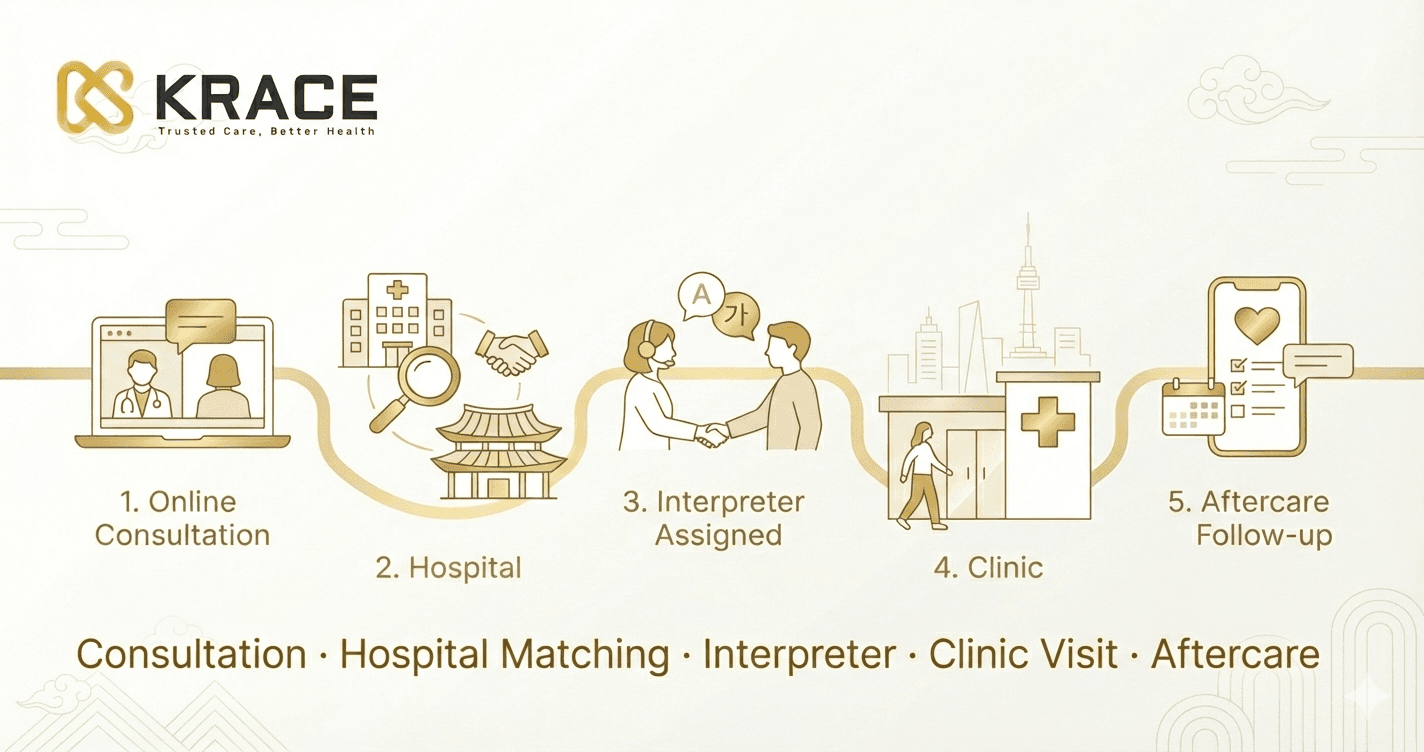
KRACE helps with the coordination layer that many international visitors struggle with.
That may include:
clinic matching based on goals, location, language needs, and service type,
appointment booking,
communication support,
interpretation coordination when available,
document and result guidance,
and post-visit follow-up support.
For someone already planning to visit Korea, this can reduce uncertainty before arrival. Instead of searching alone through scattered clinic websites, social media posts, and map reviews, visitors can prepare a clearer plan.
The goal is not to replace your doctor back home. The goal is to help you ask better questions, choose more carefully, and avoid delaying care simply because the system feels too expensive or confusing.
The Better Strategy: Plan Before You Need Urgent Care
Rising healthcare costs are forcing many people to rethink how they access care. But the answer should not be panic, avoidance, or last-minute decision-making.
A better approach is to separate urgent care from planned care.
Urgent care should stay local. Chronic conditions should remain connected to a regular provider. But preventive screenings, routine evaluations, dermatology consultations, dental assessments, and selected specialist consultations can sometimes be organized as part of a broader travel plan.
If you are already considering Korea, your trip can be more than restaurants, shopping, and sightseeing. It can also be a moment to catch up on the care you have been postponing.
Not because medical travel is perfect.
Because delaying care has a cost too.
Frequently Asked Questions
Frequently Asked Questions
These answers cover common questions about planning non-emergency medical care in Korea, especially for U.S. travelers comparing healthcare costs, timing, and clinic support before a trip.
Can I use medical travel instead of health insurance?
What medical services can travelers plan in Korea?
Should I book a Korean clinic before arriving?
Is medical care in Korea safe for international visitors?
Does KRACE provide medical advice?
You Might Also Like

Korean Health Checkups: Why Travelers Are Booking Screenings in Seoul
Imagine booking a full medical checkup and getting the results the same day—not after weeks of waiting. For many travelers visiting Korea, that’s exactly what happens. Health screenings in Seoul combine fast diagnostics, transparent pricing, and English-friendly clinics. Compared with long wait times and high costs in many countries, a Korean health checkup often feels less like a medical ordeal and more like a well-organized part of your trip. Why More Travelers Are Choosing Korea for Preventiv
blog.kracecare.com

How to Choose the Right Korean Clinic: A Practical Guide
Imagine this: back home, you wait weeks—sometimes months—for a specialist appointment, only to spend 10 minutes in the consultation room. Now imagine landing in Seoul and getting a full consultation, diagnostics, and a treatment plan within 24–48 hours. That’s not an exception. It’s the norm in Korea. But here’s the reality most guides skip: while Korea is fast and affordable, choosing the right clinic as a foreigner can feel overwhelming. Different systems, unclear pricing, and language gaps ca
blog.kracecare.com
Sources
KFF, June 2026: ACA Marketplace premiums, deductibles, and Bronze plan enrollment trends
Covered California, February 2026: Enhanced premium tax credits ended December 31, 2025
South Korea Ministry of Health and Welfare / KHIDI, April 2026: 2025 foreign patient statistics
CDC Yellow Book, April 2025: Medical tourism and continuity-of-care guidance