

What KRACE Does (and What We Don't)
Planning a clinic visit in Korea can involve more than finding an appointment. You may need to compare providers, ask about language support, understand when payment happens, and work out how to receive records after returning home. If you found KRACE through an ad, search result, or recommendation, this guide explains the service, its fees, its limits, and the steps you control.
KRACE in one sentence
KRACE is a healthcare coordination platform that helps international visitors explore Korean providers, request appointments, communicate across languages, and organize practical follow-up. Independent licensed providers deliver medical care and make clinical decisions. KRACE does not diagnose, decide which tests you need, recommend treatment, or interpret your results.
On the Ground — Before you choose a date: Ask the provider whether your visit requires preparation, how long to allow on-site, and when any documents can be issued. Language support and report formats vary. If a procedure may affect your travel plans, ask the treating provider about recovery and follow-up before arranging flights or other activities.
You can compare options and decide whether to request an appointment.
What KRACE actually does
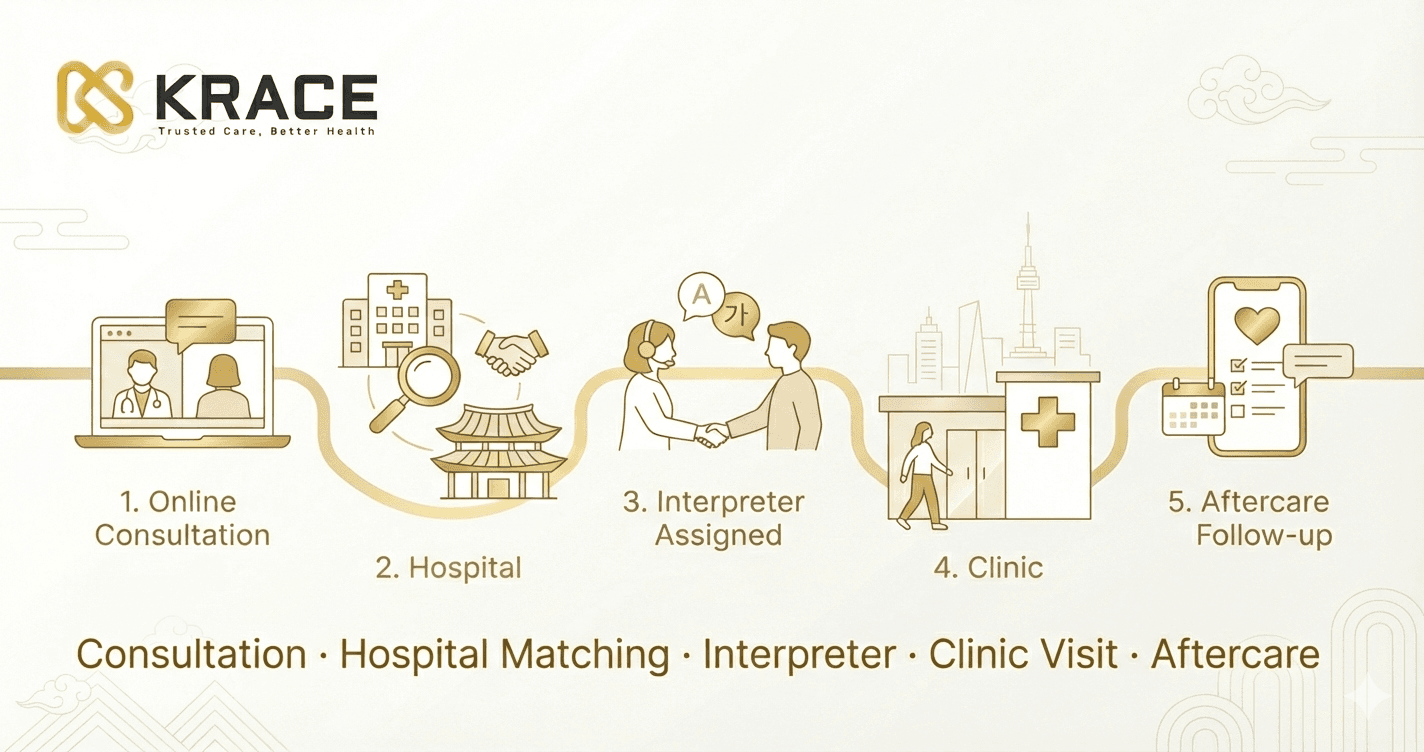
KRACE supports three practical tasks: getting oriented, arranging a visit, and handling follow-up logistics.
1. Start with questions, not a clinic name
Start with the visit category, dates, location, and language preference rather than a particular clinic name.
We use Care Map to describe that planning approach: looking at commonly discussed care categories, previous appointments you may have had, and practical time requirements. It is an informational framework, not an automated medical assessment or a personalized screening recommendation. It cannot tell you whether a test or procedure is clinically appropriate.
For a checkup, ask about package contents, preparation, and result timing. Only a clinician can determine whether tests are suitable.
For a closer look at the practical steps involved, see our guide to Korean health checkups. That article discusses the screening experience; this page explains what KRACE does around the visit.
2. Compare provider information and request an appointment
KRACE makes information about participating Korean providers available in English. Depending on the listing, that may include the provider's location, medical field, physician information, and stated language support. The platform may display options based on the practical preferences you share, such as area, dates, and type of visit.
A displayed option is not a medical endorsement. KRACE's provider review is an internal information review, not a government accreditation, a guarantee of clinical results, or a substitute for checking a physician's credentials. You choose the provider; it determines availability.
You can also read Doctor Perspectives, where participating Korean clinicians describe their professional approach or what patients may expect during a visit. These articles help you prepare questions, not select a treatment.

When you're ready, KRACE offers a free consultation to collect the information needed for a coordination request. You can describe what you are looking for without committing to treatment or paying a coordination fee at the inquiry stage. Account sign-in and question order may change as the platform is updated.
After reviewing provider information, you can request preferred appointment dates. A request is not a confirmed appointment. The provider must check its schedule and respond; KRACE helps pass along the request, status updates, and relevant logistical information in English. Availability, staffing, and language arrangements still need confirmation.
Our clinic booking guide explains the broader process.
3. Help with communication and documents after the visit
Before a visit, practical details can become scattered across messages. KRACE helps coordinate communication with the provider, including appointment details, language requests, and scheduling changes under the applicable rules. This is logistical support, not a promise that any schedule change will be approved.
Where interpretation is available, it can be requested for an appointment. Confirm the language, whether the interpreter will be on-site or remote, any additional charge, and which part of the visit is covered. An interpreter supports conversation; the clinician remains responsible for medical explanations and decisions.

Afterward, KRACE can help request or collect records that the provider is able to issue. These might include a visit summary, test results, or other documentation. The provider creates the records and controls the language, content, release requirements, and timing. Do not assume every provider issues an English version or that it will be ready before your flight.
This is particularly important if you will continue care back home. The U.S. Centers for Disease Control and Prevention advises people considering medical care abroad to arrange follow-up plans and obtain copies of relevant records. If your doctor back home needs a particular format, ask about it before you travel. Read the CDC's medical tourism guidance.
What KRACE does not do
Clear boundaries are part of a useful coordination service. We want you to know which questions we can handle and which must go to a clinician, insurer, or government authority.
KRACE is not a hospital or clinic. It does not examine patients, diagnose conditions, prescribe medication, choose treatments, or interpret laboratory and imaging results. All medical services are provided by independent licensed practitioners and institutions.
KRACE does not make medical recommendations. Showing providers that match the location, service category, or language you requested is not the same as deciding which clinic is medically appropriate. You make the provider choice, with any clinical advice coming from qualified medical professionals.
KRACE is not a personal medical concierge. Coordination may involve a support team and, when arranged, an interpreter, but the platform does not automatically assign someone to accompany you throughout your stay. Confirm any requested in-person assistance before booking.
KRACE does not book your vacation. It is not responsible for flight purchases, hotel bookings, or sightseeing itineraries. You may share travel dates so appointment requests can be coordinated around them, but travel arrangements remain yours.
KRACE is not an insurance company or discount marketplace. It cannot promise a lower medical bill, insurance reimbursement, or a particular medical outcome. The provider sets medical charges, and your insurer determines coverage under your policy.

What you pay: a free inquiry and a separate coordination fee
Exploring the site and starting a KRACE consultation are free. When you proceed with a booking through the platform, a flat Coordination Fee applies. Under KRACE's current published policy, that fee is the same regardless of the selected service provider. It is separate from, and is not deducted from, the medical fee you pay directly to the provider.
The Coordination Fee pays for booking coordination; the provider charges separately for medical services. Ask for an itemized estimate covering consultations, tests, medication, follow-up, taxes, and any language-related fees.
The usual payment flow is straightforward. For a booking that has not yet been confirmed, the platform places a card authorization, rather than completing a charge. The Coordination Fee is charged once the provider confirms. If the booking is already confirmed at the time of payment, the charge may occur immediately; an expiring authorization may also need to be released and reprocessed.
If the provider cannot confirm and no alternative is accepted, the policy provides for a release of the authorization or a refund where applicable. For a pending booking cancelled before provider confirmation, the authorization is released and the fee is not charged. Bank processing may make a released hold visible temporarily.
Once an appointment has been confirmed, different cancellation rules apply. KRACE's policy updated October 24, 2026, describes full refunds at least seven calendar days before the visit, a 50% Coordination Fee refund one to six days before, and no refund for same-day cancellation, subject to the policy's other provisions. Cancellation timestamps use Korea Standard Time. Always review the current Cancellation and Refund Policy before paying.
Commercial disclosure: Partner providers may also compensate KRACE for services provided to them. This is separate from the visitor's Coordination Fee. The fee is the same across providers under the current policy; that does not mean provider relationships are identical, or that KRACE makes an independent clinical recommendation.
Prices for medical care vary by clinic and package, so request a direct quote. This article does not publish a medical-price comparison or an unverified dollar amount for the Coordination Fee. The payable fee should be checked in the live booking flow before the transaction is authorized.
From first question to completed visit: an example
Imagine an international visitor staying in Seoul for several days who wants to ask about a routine checkup. This is an illustrative booking process, not a documented patient story, appointment guarantee, or recommendation for screening.
First, the visitor describes their preferred part of Seoul, travel dates, language preference, and the appointment category they want to explore. They read the available provider information and prepare questions about the package and possible report language. No clinical decision has been made.
Next, the visitor selects a provider and requests an appointment. KRACE helps communicate with the provider and shares the response. If the requested slot is unavailable, the visitor can consider another time or provider rather than assume the visit is booked.
Before confirming travel plans around the appointment, the visitor asks the provider about preparation instructions, total expected charges, follow-up requirements, and when results can be issued. For procedures involving sedation, recovery, or repeat care, they obtain instructions directly from the medical team. The provider—not KRACE—determines the clinical plan.
After the visit, any records requested are issued by the provider according to its process. KRACE may assist with the administrative request, while the visitor arranges any needed follow-up back home. A doctor at home may need to review the records or request additional information.
What about language support and a medical visa?
KRACE accepts English-language inquiries, but confirm which languages the provider supports and whether interpretation adds a cost.
Visa requirements are a separate matter. They depend on passport nationality, residence, travel purpose, intended stay, and current immigration rules. Some travelers may enter under a visa-free or other eligible entry arrangement; others may need to apply for an appropriate visa. KRACE cannot determine entry eligibility or guarantee an approval.
Where applicable, KRACE may help coordinate supporting documents from the provider or agency for a medical-visit application. This does not replace the traveler's application or the Korean authorities' decision. Requirements differ by embassy or consulate: for example, the Korean Embassy in Singapore publishes specific conditions for the C-3-3 medical tourism category. Check the official Korean embassy's C-3-3 information and the Korean mission responsible for your place of application.
How to make an informed choice before you book
A useful coordination service should make it easier to ask good questions—not remove your judgment. For provider registration checks, Korea's official Medical Korea site publishes a directory of registered medical institutions serving international patients. Government registration, KRACE's internal review, and any separate hospital accreditation are different things; none is a guarantee of treatment results.
Ask about the provider's correct name and location, who will conduct the consultation, which languages are supported, and what costs are included. If your appointment involves tests or a procedure, confirm the preparation requirements and any follow-up with the clinician. Keep copies of your booking terms, provider estimate, and records you receive.
A displayed option or estimate is neither a medical assessment nor a confirmed booking.
Where to start
Start with the care category you want to explore, the dates you expect to be in Korea, and any language or record needs. KRACE can help organize provider information and the booking conversation. You decide whether to proceed, and licensed providers make all medical decisions.

Start with a free consultation →
Frequently Asked Questions.
Is KRACE a hospital or a medical provider?
No. KRACE is a healthcare coordination platform, not a hospital or clinic. It helps international visitors explore provider information, communicate about bookings, and request follow-up documents. Doctors and licensed healthcare institutions provide examinations, medical advice, treatments, and results. A provider shown on KRACE is an option to review, not a clinical recommendation or a guarantee of the care you will receive.
How can I check whether a Korean clinic is registered for international patients?
Start with the clinic's full legal name and location. Korea's official Medical Korea directory lists medical institutions registered to serve international patients, and its information can help you check the institution you are considering. Registration is different from hospital accreditation or an individual doctor's credentials. Ask the provider to clarify any unclear names, branches, or registrations before making a booking or paying a fee.
Can I book a Korean clinic appointment if I do not speak Korean?
Yes, many visitors arrange appointments without speaking Korean, but language support differs by provider and service. Ask whether the consultation itself can be conducted in English, whether an interpreter must be booked separately, and whether there is an extra charge. Also confirm the language and delivery date of any written results. Do not assume that English booking messages mean every clinician or staff member is fluent in English.
What should I confirm before paying for a clinic booking in Korea?
Check whether the appointment is confirmed, who charges each fee, the estimated medical costs, the cancellation deadline, and the policy's time zone. Under KRACE's current policy, a pending request generally involves a card authorization rather than a completed Coordination Fee charge. A confirmed booking may be charged immediately, and later cancellations follow separate rules. Read the live terms and ask the provider about its own medical-service payment and refund rules.
Do I need a medical visa for an appointment in Korea?
Not necessarily. Entry requirements depend on your passport, residence, travel purpose, planned length of stay, and the rules in force when you travel. A medical tourism visa category exists, but it is not automatically required for every visitor seeking care. Consult the Korean embassy or consulate responsible for your application, and confirm which documents it requires. Only the Korean authorities can decide visa issuance and entry permission.
Note: This information is general guidance. Confirm booking terms with KRACE, medical questions with your provider, and entry rules with the relevant Korean authority.
You Might Also Like

How to Choose the Right Korean Clinic: A Practical Guide
Imagine this: back home, you wait weeks—sometimes months—for a specialist appointment, only to spend 10 minutes in the consultation room. Now imagine landing in Seoul and getting a full consultation, diagnostics, and a treatment plan within 24–48 hours. That’s not an exception. It’s the norm in Korea. But here’s the reality most guides skip: while Korea is fast and affordable, choosing the right clinic as a foreigner can feel overwhelming. Different systems, unclear pricing, and language gaps ca
blog.kracecare.com

Why More Travelers Are Choosing Korea for Primary Care
Imagine needing a health checkup but facing a three-month wait back home. Now picture landing in Seoul, booking a clinic visit within days, completing lab tests the same morning, and getting results before the week ends. For many international visitors, that’s not hypothetical — it’s exactly how healthcare works in Korea, especially for those seeking primary care Korea. Across North America, Europe, and Australia, rising costs and long wait times are pushing travelers to look abroad for care. Ko
blog.kracecare.com

Why Seoul Should Be on Your 2026 Travel List (And Why Smart Travelers Are Adding Healthcare to the Plan)
Most people plan a trip around food, culture, and places to explore. But what if your trip could also take care of something you’ve been putting off—without slowing you down? That’s exactly why Seoul is showing up on global “best cities” lists in 2026. Not just because it’s exciting—but because it’s one of the few places where daily life, infrastructure, and even healthcare feel seamlessly connected. And once you experience how the city works, you start to see why more travelers are quietly addi
blog.kracecare.com