

A trip to Seoul is no longer only about food, shopping, skincare, or sightseeing. Some American travelers are adding something more personal to their itinerary: a comprehensive health checkup that can combine bloodwork, imaging, women’s health screening, and physician review within one coordinated visit.
Some Korean screening centers coordinate bloodwork, imaging, women’s health tests, and physician review within one structured visit. Publicly listed programs range from under $500 to more than $2,000, depending on the hospital and included tests. This guide explains the real costs, one-day screening process, clinic verification, English reports, and follow-up planning for international visitors.
The appeal is not simply finding cheaper care abroad. Many visitors are looking for something that can feel surprisingly difficult to arrange back home—time, coordination, and a clearer understanding of their health.
Key Takeaways
Some Korean screening centers coordinate bloodwork, imaging, women’s health tests, and physician review within one structured visit.
Publicly listed health checkup programs range from under $500 to more than $2,000, depending on the hospital and included examinations.
Package names such as “comprehensive,” “executive,” and “premium” are not standardized, so compare the actual test list rather than the package name.
English reports, physician consultations, sedation, pathology, and follow-up appointments may not be included in the quoted price.
Schedule your health checkup early in your Seoul trip in case additional imaging, repeat testing, or a results consultation is needed.
Prices, test inclusions, appointment duration, and report delivery vary by institution and individual circumstances.
What Is a Comprehensive Health Checkup in Korea?
A comprehensive health checkup is a bundled preventive-screening program. Instead of arranging each test through a separate clinic or specialist, a screening center organizes multiple examinations under one appointment plan.
The exact tests depend on the institution, package, age, sex, medical history, symptoms, and risk factors. A basic program at one center may be very different from a package carrying the same name somewhere else.
A Korean health screening may include:
Blood and urine testing
Blood pressure, height, weight, and body-composition measurements
Cholesterol, glucose, liver, kidney, and thyroid testing
Chest X-ray and electrocardiogram
Abdominal or thyroid ultrasound
Mammography or breast ultrasound
Pelvic ultrasound and cervical screening
Vision and hearing tests
Gastroscopy or colonoscopy
CT, MRI, or cardiovascular imaging in higher-tier programs
A physician consultation or later results review
“Comprehensive,” “executive,” and “premium” are not standardized medical package names. The itemized test list matters more than the marketing label.
Before booking, ask whether the quoted price includes sedation, pathology, additional imaging, physician interpretation, an English report, and a follow-up consultation.
Compare common Korean health checkup packages, included tests, and booking considerations in our detailed Korean health checkups guide.

Why Korea’s Coordinated Screening Model Appeals to American Travelers
Recent reporting has highlighted American women traveling to South Korea for comprehensive screening, gynecology, thyroid evaluations, cardiovascular tests, and dermatology. Their reasons are not limited to price. Many visitors are also looking for a healthcare experience that feels more coordinated, easier to plan, and more respectful of their limited time in Seoul.
A note on the original reporting: The Guardian article focused on Black American women who described racial bias, delayed attention, and concerns about whether their symptoms were being taken seriously in the United States. Their experiences should not be generalized or separated from that context. This guide addresses the broader logistical questions international visitors may have about coordinated health screening in Korea.
Several Tests in One Structured Visit
At some Korean screening centers, bloodwork, physical measurements, ultrasound, imaging, women’s health examinations, and a physician consultation may be arranged within one appointment plan.
This can reduce the need to schedule several separate clinics or specialist visits. However, the exact sequence and number of tests depend on the institution, selected package, medical history, symptoms, age, sex, and individual risk factors.
Clearer Package-Based Pricing
Many screening centers present examinations as packaged programs. This can make it easier for international visitors to compare an initial price before booking.
Package names alone can be misleading, however. A “comprehensive” program at one hospital may include very different examinations from a package with the same name at another institution.
Always request an itemized test list and confirm whether the quoted price includes sedation, pathology, additional imaging, physician interpretation, an English report, and follow-up consultation.
English-Language Coordination
Some hospitals and clinics have international-patient teams that assist with appointment scheduling, registration, payment instructions, and communication.
English-language support varies significantly. Visitors should confirm whether interpretation is available during testing, whether a physician can explain the results in English, and whether the final medical report will be issued in English.
Translation support should not be treated as a substitute for medical interpretation by a licensed physician.
Time Efficiency During a Seoul Trip
Several examinations may be completed during one structured visit, which can be practical for travelers with limited time in Korea.
Some primary screening programs may take approximately three hours, while broader programs involving endoscopy or advanced imaging may require most of the day.
A one-day screening does not mean every result will be available immediately. Laboratory analysis, pathology, radiology interpretation, and specialist follow-up may take additional time.
Follow-Up Options When Additional Testing Is Needed
When a screening identifies an abnormal or unclear finding, additional imaging, repeat testing, or a specialist consultation may sometimes be arranged during the same trip.
For this reason, visitors should schedule their health checkup early in their Seoul itinerary rather than on the final day.
Before booking, ask who will explain the results, how quickly reports and imaging files will be released, and what support is available if another appointment is recommended.
The real value is not simply “cheaper care.”
For many international visitors, the appeal is access to care that feels coordinated, understandable, and respectful of their time. The right option still depends on the patient’s medical needs, travel schedule, budget, risk factors, and access to follow-up care after returning home.
A note on the original reporting: The Guardian article focused on Black American women who described racial bias, delayed attention, and concerns about whether their symptoms were being taken seriously in the United States. Their experiences should not be generalized or separated from that context. This guide addresses the broader logistical questions international visitors may have about coordinated health screening in Korea.
What to Expect During a One-Day Health Checkup
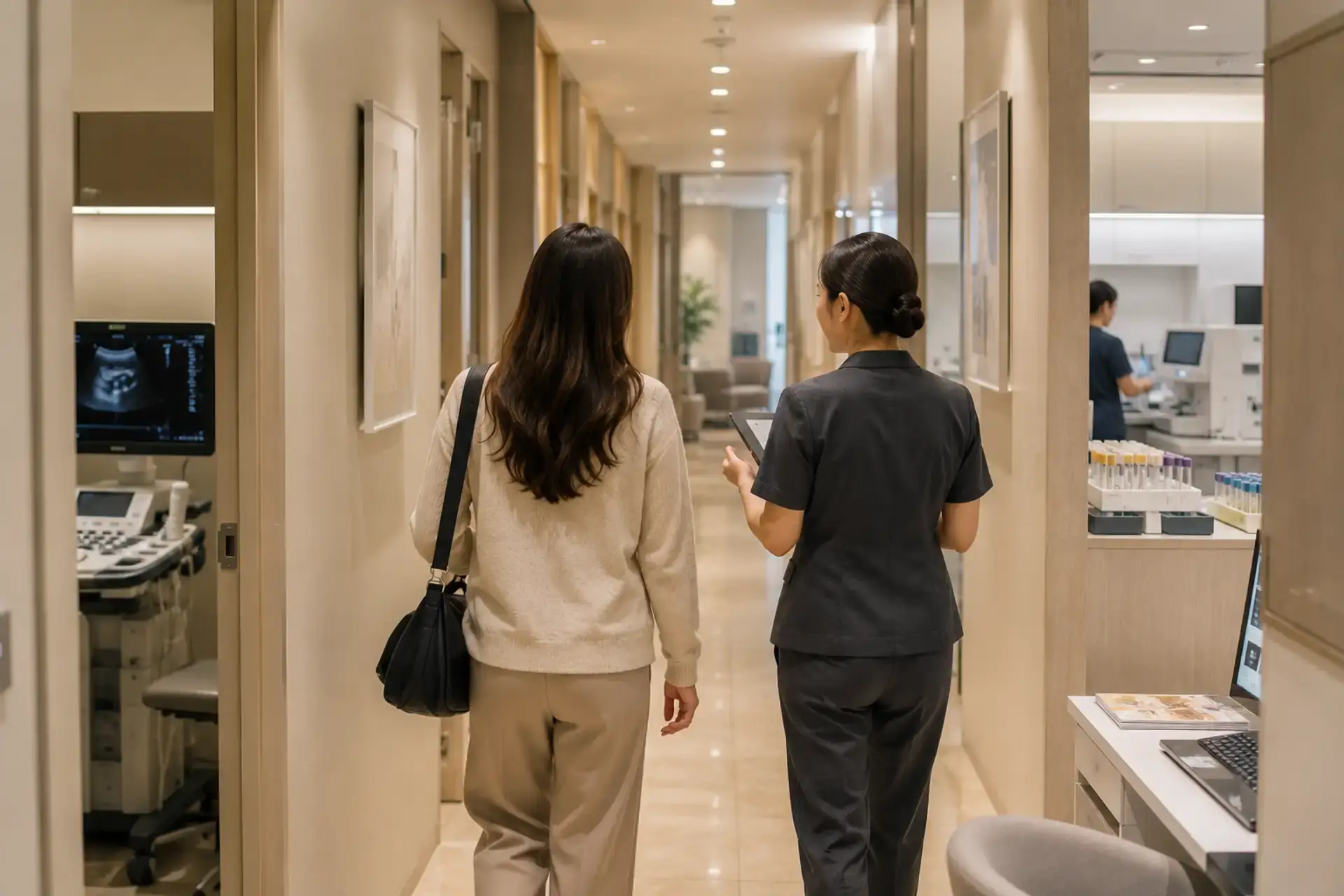
A Korean health checkup is usually not a longer version of a routine annual physical. At a dedicated screening center, patients may change into clinic clothing and move through laboratory testing, physical measurements, ultrasound, imaging, endoscopy, and consultations in a planned sequence.
The following timeline is an illustration only. The actual order, duration, and result timing vary by hospital, selected package, patient information, and whether sedation or additional imaging is included.
Approximate time | What may happen |
|---|---|
7:30–8:00 AM | Registration, passport verification, consent forms, payment, and confirmation of fasting instructions |
8:00–9:30 AM | Blood and urine testing, blood pressure, body measurements, vision, hearing, and other basic examinations |
9:30–11:30 AM | Ultrasound, X-ray, mammography, endoscopy, CT, or other selected imaging and examinations |
11:30 AM–12:30 PM | Initial physician consultation, preliminary explanation, or instructions about when results will be available |
Later that day or on a later date | Final laboratory analysis, radiology review, pathology results, English report, or detailed results consultation |
Allow several hours inside the center and avoid scheduling an intensive sightseeing itinerary immediately afterward.
Sedated gastroscopy or colonoscopy may require an escort. Patients may also be advised not to drive, drink alcohol, make important decisions, or follow a demanding schedule after sedation.
Not every result will be available on the same day. Confirm the expected report date and whether the results consultation will take place in person, by phone, by video call, or through a written report.
How Much Does a Health Checkup in Korea Cost?
Current publicly listed health checkup options for international visitors show a wide price range. Basic or one-day programs may start at approximately $335–$525, while more comprehensive or specialized packages are often listed at approximately $615–$820.
Advanced screening at a major university hospital can cost considerably more, particularly when MRI, PET-CT, colonoscopy, or extensive cardiovascular testing is included.
Package level | Approx. price, USD | Typical scope | |
|---|---|---|---|
Basic or one-day screening | Under $500 | Blood and urine tests, physical measurements, chest X-ray, abdominal ultrasound, ECG, and selected gastrointestinal screening | |
Comprehensive or specialized | $500–$820 | Additional ultrasound, CT, endoscopy, cardiovascular, digestive, or cancer-focused screening depending on the program | |
Advanced university-hospital program | $1,275–$2,420+ | Broader specialist-led screening, endoscopy, CT, echocardiography, and additional women’s or men’s health tests |
Recent public listings include a one-day screening program starting at KRW 490,000 and a comprehensive program at Hanyang University Seoul Hospital starting at KRW 770,000. KMI also lists specialized foreign-patient packages from KRW 900,000 to KRW 1,200,000.
Major tertiary hospitals may charge substantially more. For example, Samsung Medical Center currently lists primary and executive programs from KRW 1,874,000 to KRW 3,550,000. Its highest-priced programs include advanced imaging such as MRI and PET-CT and should not be treated as the typical cost of a Korean health checkup.
Prices vary by clinic, selected tests, age, sex, sedation, imaging, and international-patient support. Request an itemized written quote before booking.
Korea’s International Patient Market Is Growing
Korea recorded approximately 2.01 million international patients from 201 countries in 2025, up from about 610,000 in 2023 and 1.17 million in 2024. It was the first time the annual number had exceeded two million since official reporting began in 2009.
The United States was Korea’s fourth-largest international patient market. Approximately 173,000 patients from the United States visited Korea in 2025, representing a 70.4% increase from the previous year.
The data also show that American patient demand extends beyond plastic surgery. Among patients from the United States, dermatology accounted for 44.3% of visits, the combined internal-medicine category for 13.2%, and plastic surgery for 9.3%.
These figures show that Korea’s international healthcare market—and its American patient segment—is expanding. They do not, however, prove that most American patients are traveling specifically for comprehensive health checkups. Screening centers accounted for approximately 3.1% of all international patients in 2025, so the growth of preventive screening should be presented as an emerging trend rather than the dominant reason for medical travel.
How to Check Whether a Korean Clinic Is Legitimate
Start by confirming whether the institution is registered to serve international patients.
Korea has operated a Foreign Patient Attraction Institution Registration System since 2009. Registered medical institutions have also been required to subscribe to medical-malpractice liability insurance since 2016.
Travelers can search the official Medical Korea registered-hospital database. The database listed 4,160 registered hospitals and clinics as of July 2026.
Registration is an important baseline check, but it does not prove that a specific package is medically appropriate or that every visitor will receive the same experience.
Before booking, ask:
Which physician or department reviews the results?
Will I receive the complete itemized test list?
Which tests involve radiation, contrast, or sedation?
What findings may require another visit?
Is the final report available in English?
Will a physician explain the results?
How quickly will imaging and laboratory files be released?
What happens if a serious abnormality is found?
Are additional charges approved before testing?
Can the records be shared with my doctor back home?
Use the guide to choosing a Korean clinic for a more detailed verification process.

Plan the Medical Visit Before the Vacation
Schedule the health checkup early in your Seoul trip rather than on your final day.
This leaves time for a results consultation, repeat examination, or additional imaging when a physician considers it necessary. It does not mean that every unexpected result should be treated during the same trip.
Bring:
A current medication and supplement list
Allergy information
Previous surgeries and diagnoses
Recent laboratory reports
Previous ultrasound, CT, or MRI reports
Relevant family medical history
Menstrual and pregnancy information when applicable
Contact information for your doctor back home
Ask the clinic how long to fast and whether regular medications should be taken on the morning of the appointment. Do not stop prescribed medication unless a licensed healthcare professional gives you specific instructions.
Sedated gastroscopy or colonoscopy may require an escort. Patients may also be advised not to drive, drink alcohol, make important decisions, or follow a demanding itinerary afterward.
The CDC South Korea traveler page provides current general travel-health guidance, including vaccination and preparation information.

Seoul Logistics That Are Easy to Underestimate
A clinic may be close to a subway station but still take time to find inside a large commercial or medical building.
In KRACE’s coordination experience, Naver Map often provides more precise building entrances and local navigation than international map services. Save the Korean clinic name, address, floor number, and phone number before leaving the hotel.
Arrive at least 15 to 20 minutes early unless the clinic gives different instructions. Registration, passport verification, clothing changes, consent forms, and payment can add time before testing begins.
Also confirm:
Whether passport identification is required
Whether payment is due before testing
Whether international credit cards are accepted
Whether the center provides lockers
Whether an escort can wait inside
Whether food is provided after fasting
Whether transportation support is available
The Seoul Medical Tour Help Desk also provides general information and assistance for international medical visitors.
What Happens After the Checkup?
A screening visit is not complete when the final test is finished.
Ask when the report will be issued, whether it will be translated into English, and whether a licensed physician will explain the significant findings. Translation support is not the same as medical interpretation.
When an abnormal result is identified, request:
Original laboratory results with reference ranges
Radiology reports
Imaging files in DICOM or another usable format
Pathology reports when applicable
The physician’s written assessment
Recommended follow-up timing
The medical-record department’s contact information
Take the records to an appropriate licensed clinician back home. Medical terminology, reference ranges, screening guidelines, and treatment pathways may differ between countries.
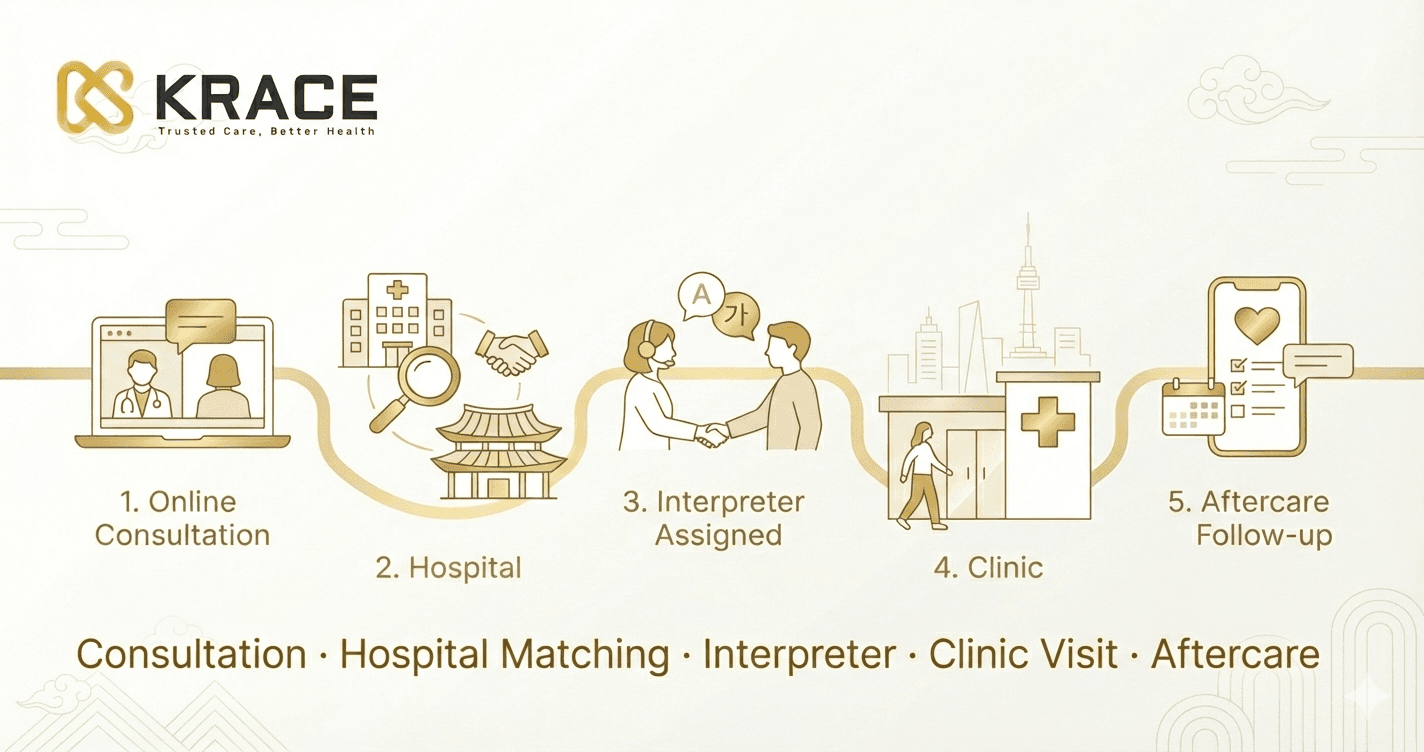
KRACE can support clinic matching, appointment coordination, communication, and post-visit medical-record requests. KRACE does not interpret results, determine which tests a patient needs, or recommend a medical treatment.
Is Korea the Better Choice?
Not automatically.
Traveling to another country for preventive care requires airfare, accommodation, time away from work, and the ability to pay medical expenses upfront. It also creates practical challenges when follow-up care is needed after returning home.
A Korean health checkup should therefore not be presented as a cure for problems in the American healthcare system or as a guaranteed way to detect disease.
The real value is choice.
For some travelers, Korea’s concentrated screening infrastructure may make it easier to complete several examinations during one visit. For others, arranging testing with an established doctor back home may offer better continuity and insurance coverage.
The right decision depends on the patient’s medical needs, travel schedule, budget, risk factors, and access to follow-up care.
The Real Hook Is Not “Cheaper Care”
The strongest reason to pay attention to Korea’s health-checkup trend is not a dramatic comparison between two countries.
It is the growing demand for care that feels coordinated, understandable, and respectful of the patient’s time.
International visitors should approach Korea with informed expectations: verify the provider, compare actual test lists, ask who reviews the results, understand the total cost, and prepare a plan for follow-up after returning home.

Need Help Comparing Korea Health Checkup Options?
KRACE helps international visitors compare registered clinics, coordinate appointments, communicate logistical needs, and organize post-visit documents.
Start with a free consultation →
Free Checklist
15 Questions to Ask Before Booking a Health Checkup in Korea
Use this practical checklist to compare included tests, total cost, English-language support, report delivery, and follow-up procedures before confirming your appointment.
View the 15-Question Checklist
Clinic and Package
- Is the hospital or clinic registered to serve international patients in Korea?
- Will I receive a complete itemized list of the tests included in the package?
- Which physician or medical department will review the results?
- Which tests involve radiation, contrast material, or sedation?
- Does the quoted price include sedation, pathology, physician interpretation, and additional imaging?
- Will the clinic obtain my approval before adding any extra tests or charges?
English Support and Results
- Is English interpretation available during registration, testing, and consultation?
- Will the final medical report be provided in English?
- Will a licensed physician explain the significant findings?
- When will the laboratory, radiology, and pathology results be available?
- Can I receive original imaging files in DICOM or another usable format?
- Can the records be shared with my doctor after I return home?
Appointment and Follow-Up Planning
- How long should I fast, and what instructions apply to my regular medication?
- Will I need an escort after sedated gastroscopy or colonoscopy?
- What happens if an abnormal result requires another examination or specialist appointment during my trip?
This checklist is intended for appointment planning and comparison. It does not determine which tests are medically appropriate. Screening decisions should be made with an independent licensed healthcare provider.
No email required.
Need Help Comparing Health Checkup Options?
KRACE helps international visitors compare registered clinics, request itemized package information, coordinate appointments, and organize practical communication and post-visit medical records.
Compare Health Checkup OptionsKRACE does not determine which tests a patient needs or provide medical advice. Medical decisions are made by independent licensed healthcare providers.
You Might Also Like

Korean Health Checkups: Why Travelers Are Booking Screenings in Seoul
Imagine booking a full medical checkup and getting the results the same day—not after weeks of waiting. For many travelers visiting Korea, that’s exactly what happens. Health screenings in Seoul combine fast diagnostics, transparent pricing, and English-friendly clinics. Compared with long wait times and high costs in many countries, a Korean health checkup often feels less like a medical ordeal and more like a well-organized part of your trip. Why More Travelers Are Choosing Korea for Preventiv
blog.kracecare.com

How to Choose the Right Korean Clinic: A Practical Guide
Imagine this: back home, you wait weeks—sometimes months—for a specialist appointment, only to spend 10 minutes in the consultation room. Now imagine landing in Seoul and getting a full consultation, diagnostics, and a treatment plan within 24–48 hours. That’s not an exception. It’s the norm in Korea. But here’s the reality most guides skip: while Korea is fast and affordable, choosing the right clinic as a foreigner can feel overwhelming. Different systems, unclear pricing, and language gaps ca
blog.kracecare.com
Frequently Asked Questions
These answers explain Korea health checkup prices, one-day screening, clinic verification, English reports, and KRACE’s role for international visitors.
How much does a comprehensive health checkup cost in Korea?
Publicly listed Korea health checkup programs for international visitors typically start under $500 for basic screening. More comprehensive packages are often priced at approximately $500–$820, while advanced university-hospital programs involving endoscopy, CT, MRI, PET-CT, or cardiovascular testing may cost approximately $1,275–$2,420 or more. Because package names are not standardized, compare the actual test list and request a current itemized quote before booking.
Can I complete a Korean health checkup in one day?
Yes. Many Korean screening centers can complete most scheduled tests—such as bloodwork, physical measurements, ultrasound, imaging, and selected consultations—during one structured visit. However, final laboratory, pathology, or radiology reports may be issued later, and an abnormal finding may require another examination or specialist appointment. Schedule the checkup early in your Seoul trip in case follow-up is needed.
How can I verify a Korean clinic before booking?
Start by searching the institution in Medical Korea’s official database of medical institutions registered to serve international patients. Registration is an important baseline check, but it does not guarantee that a particular package is appropriate for every patient. Also confirm the physician or department reviewing the results, the complete test list, English-language support, total price, sedation requirements, report delivery, and the process for handling abnormal findings and follow-up care.
Will I receive my health checkup report in English?
Not always. Some Korean hospitals and clinics provide English reports, English-speaking staff, or coordinator support, but availability varies. Before booking, confirm the report language, expected delivery date, whether a licensed physician will explain the findings, and whether original imaging files—such as DICOM files—can be provided. Translation or coordinator support should not be confused with medical interpretation by a licensed healthcare professional.
Can KRACE recommend which medical tests I should take?
No. KRACE can help international visitors compare registered clinics, coordinate appointments, communicate logistical needs, and request post-visit medical records. Decisions about appropriate tests, diagnosis, medical results, and treatment must be made by independent licensed healthcare providers based on the patient’s medical history, symptoms, risk factors, and clinical assessment.