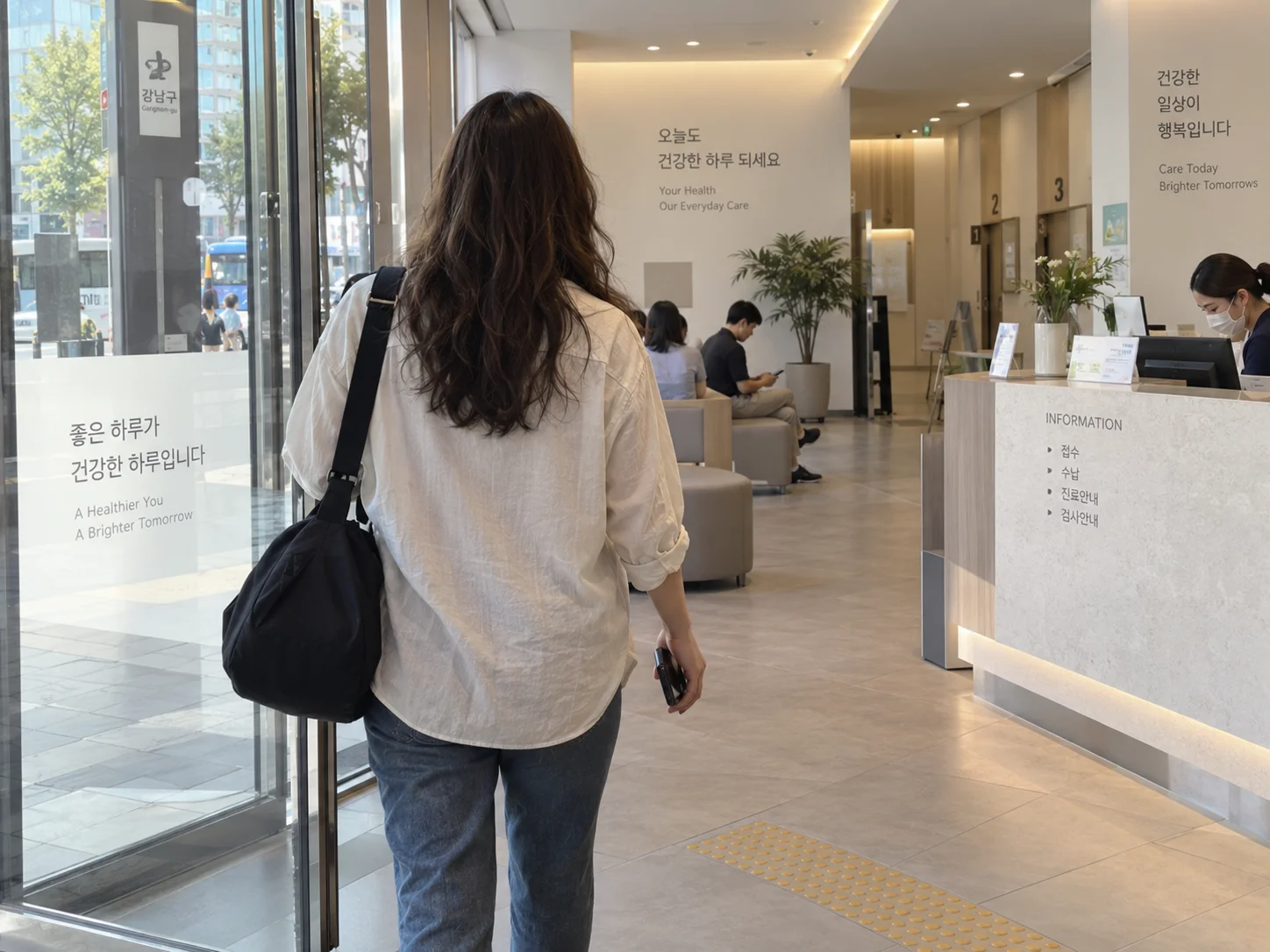


The first surprise at a Korean clinic may not be a futuristic machine or a dramatic price difference. It may be the rhythm: check in, meet the doctor, complete available tests, and discuss the next step without moving between several disconnected offices.
That pace can feel refreshingly practical, but it is not automatic. The best Korean clinic experience begins before you arrive—with the right provider, a clear appointment scope, and realistic expectations about what can happen during one trip.
Why the Korean Clinic Experience Can Feel Different

Healthcare back home can involve separate referrals, insurance authorization, laboratory appointments, imaging centers, and follow-up visits. In Korea, some outpatient clinics and health screening centers organize several of those steps within one institution or coordinated appointment.
That does not mean every visitor receives an immediate diagnosis or same-day treatment. Appointment availability, test complexity, fasting requirements, medical history, and the doctor’s judgment all affect the timeline. Medical Korea identifies relatively short waiting times as one reason international patients consider Korea, but individual providers still set their own schedules and clinical processes.
Interest in Korean healthcare has also expanded beyond cosmetic procedures. According to Korea’s Ministry of Health and Welfare, approximately 2.01 million international patients from 201 countries received care in Korea in 2025. About 173,000 came from the United States, and their most frequently used categories included dermatology, integrated internal medicine, and plastic surgery.
The same report shows that 87.7% of international patients visited clinic-level institutions rather than large general or tertiary hospitals. This matters because the everyday Korean clinic experience is often built around independent outpatient providers, not only major university hospitals.
On the Ground
Seoul accounted for 87.2% of Korea’s international patient visits in 2025, so many clinics serving visitors are concentrated in relatively compact urban districts. Still, two clinics described as being “in Gangnam” may be 30–45 minutes apart in real traffic. Check the exact branch, building floor, subway exit, and appointment time before choosing your hotel.
Before You Fly: Define What the Appointment Is For

A common booking mistake is asking for a “full checkup” or “skin treatment” without defining the actual objective. Those phrases can describe dozens of different appointments.
Before contacting a clinic, prepare a short non-diagnostic summary containing:
The service or medical specialty you are looking for
Your main questions for the doctor
Relevant previous records, images, or laboratory reports
Current medication and allergy information
Your available dates in Korea
Whether you need English communication support
Whether you want consultation only or may consider treatment
For a general health screening, confirm whether the package requires fasting, includes sedation, or expects you to return for a separate results consultation. The Korean health checkups guide explains how screening packages can differ even when their names sound similar.
For dermatology, dental, eye, women’s health, or musculoskeletal appointments, ask whether the first visit is assessment-only. A clinic should not assume that you have agreed to treatment simply because a consultation has been booked.
International travelers should also review routine travel health preparations separately from the planned clinic visit. The CDC recommends checking destination-specific vaccines and medicines and consulting a healthcare professional at least one month before travel when possible.
What Actually Happens at a Korean Clinic
The experience varies by specialty, but most planned outpatient visits follow a recognizable sequence.
1. Registration and identity check
The clinic may request your passport, date of birth, contact details, and a local or international phone number. You may also be asked to complete medical history and consent forms.
Do not rely on live translation apps for consent documents involving sedation, invasive procedures, significant risks, or complex financial terms. Confirm in advance whether the clinic can explain those documents in English or provide qualified interpretation support.
2. Initial measurements or pre-consultation questions
Depending on the appointment, staff may record basic measurements, take standardized photographs, conduct a preliminary scan, or confirm your main concerns.
This stage is not the medical decision. Staff or coordinators may help collect information, but diagnosis, interpretation, treatment recommendations, and medical consent should remain with the licensed provider.
3. Consultation with the doctor
The doctor reviews your history, examines you, and decides whether further testing is appropriate. Bring a concise list of questions because consultations can move quickly, especially at busy outpatient clinics.
Useful questions include:
What is the purpose of each proposed test or procedure?
Are there reasonable alternatives?
What should I decide today, and what can wait?
Who will perform the procedure?
What follow-up would be needed after I return home?
The guide to choosing a Korean clinic provides a more detailed provider-verification framework.
4. Tests or imaging, when available
Some clinics can complete blood collection, ultrasound, X-rays, skin imaging, dental imaging, or other tests during the same visit. Others send patients to a separate department or facility.
“Same day” can refer only to completing the test—not necessarily receiving a final specialist interpretation or translated report. Ask when preliminary and final results will be available and how they will be delivered.
5. Treatment decision
A clinic may offer treatment after the consultation when the doctor considers it appropriate and the schedule allows. You are not required to make a same-day decision merely because treatment is available.
Ask for the proposed plan, total cost, major exclusions, cancellation terms, expected follow-up, and the name of the treating doctor before paying. For elective care, build enough time into your itinerary to review the information without pressure.
6. Records and follow-up
Before leaving, confirm what documentation you will receive. Depending on the service, this may include receipts, prescriptions, images, laboratory reports, procedure details, or a brief medical record.
Also confirm:
The expected language and file format
When final reports will be ready
How medical questions are handled after departure
Whether the clinic communicates directly with your provider back home
What requires an in-person follow-up in Korea
How Fast Is Medical Care in Korea?
The honest answer is that Korea can be highly efficient, but the timeline depends on the service.
May be possible in one visit | Usually needs confirmation | Should never be assumed |
|---|---|---|
Consultation and basic clinic-based assessment | Specialist availability | A definitive diagnosis |
Routine blood collection | Final laboratory reporting time | Same-day treatment |
Clinic-based imaging | English-translated records | Fitness to fly afterward |
Consultation and written estimate | Sedation or fasting requirements | No need for follow-up |
Some outpatient procedures | Pathology or outside imaging review | A guaranteed result |
A preventive screening center may be designed around several tests in one organized session. A dental, eye, orthopedic, or women’s health concern may require imaging and a second appointment. Pathology, cultures, complex scans, and consultations involving more than one specialist can take longer.
The practical advantage is not always “everything in one day.” It is often the ability to arrange a clearer sequence before the trip and reduce unnecessary gaps between stages.
For the booking process itself, see how international visitors can book a Korean clinic.

What Does a Korean Clinic Visit Cost?
Prices vary by clinic and package — request a direct quote for accuracy.
A basic consultation, a hospital international center appointment, a sedated health screening, and a multi-device dermatology package are not comparable products.
Instead, request an itemized quote from two or three suitable providers. Each quote should state:
Consultation fee
Tests and imaging included
Doctor or procedure fee
Medication, anesthesia, or consumable charges
Interpretation or coordination charges
Taxes, when applicable
Follow-up visits
Record translation or document fees
Deposit and cancellation conditions
Ask whether the quote is fixed, preliminary, or subject to change after examination. A lower advertised price may exclude the doctor consultation, specific device, treatment area, medication, or follow-up that you actually need.
Value should be assessed through total trip cost, not the clinic invoice alone. Include flights, hotel nights, local transportation, recovery time, companion expenses, possible itinerary changes, and follow-up after returning home.
How to Check Safety and Legitimacy
Korea operates a government registration system for medical institutions that attract international patients. Medical Korea states that registered institutions are required to carry medical malpractice liability insurance, and visitors can search its registered-provider database.
Registration is an important first check, but it is not the same as a guarantee of clinical quality or a guaranteed outcome.
KAHF—the Korean evaluation and certification program for institutions serving international patients—is a separate, voluntary evaluation framework. It covers areas such as international patient management, interpretation, patient safety, medication management, infection control, and facilities. Hospital-level applicants must also meet applicable KOIHA requirements.
Before booking, verify:
The exact legal name and branch of the clinic
Whether the institution is currently registered to attract international patients
The doctor who will examine or treat you
Who performs each part of the procedure
What equipment or materials are included
The total written estimate and refund terms
The clinic’s after-hours and complication contact process
How records will be provided after the visit
Treat urgency as a warning sign when it comes from sales pressure rather than medical necessity. Claims such as “risk-free,” “guaranteed,” “permanent,” or “only available today” should prompt further questions.
English Support: Available, but Not Universal
Some Korean hospitals have international healthcare centers, and some outpatient clinics employ English-speaking coordinators. Medical Korea’s provider search allows users to filter institutions by interpretation language, including English.
However, “English support” can mean several things:
An English-speaking receptionist
A bilingual coordinator
A doctor who consults in English
A professional interpreter
Translated consent forms
English medical records
Confirm exactly which type is available during the doctor consultation, consent process, procedure, and follow-up. A clinic may handle booking messages in English while providing limited English support inside the treatment room.
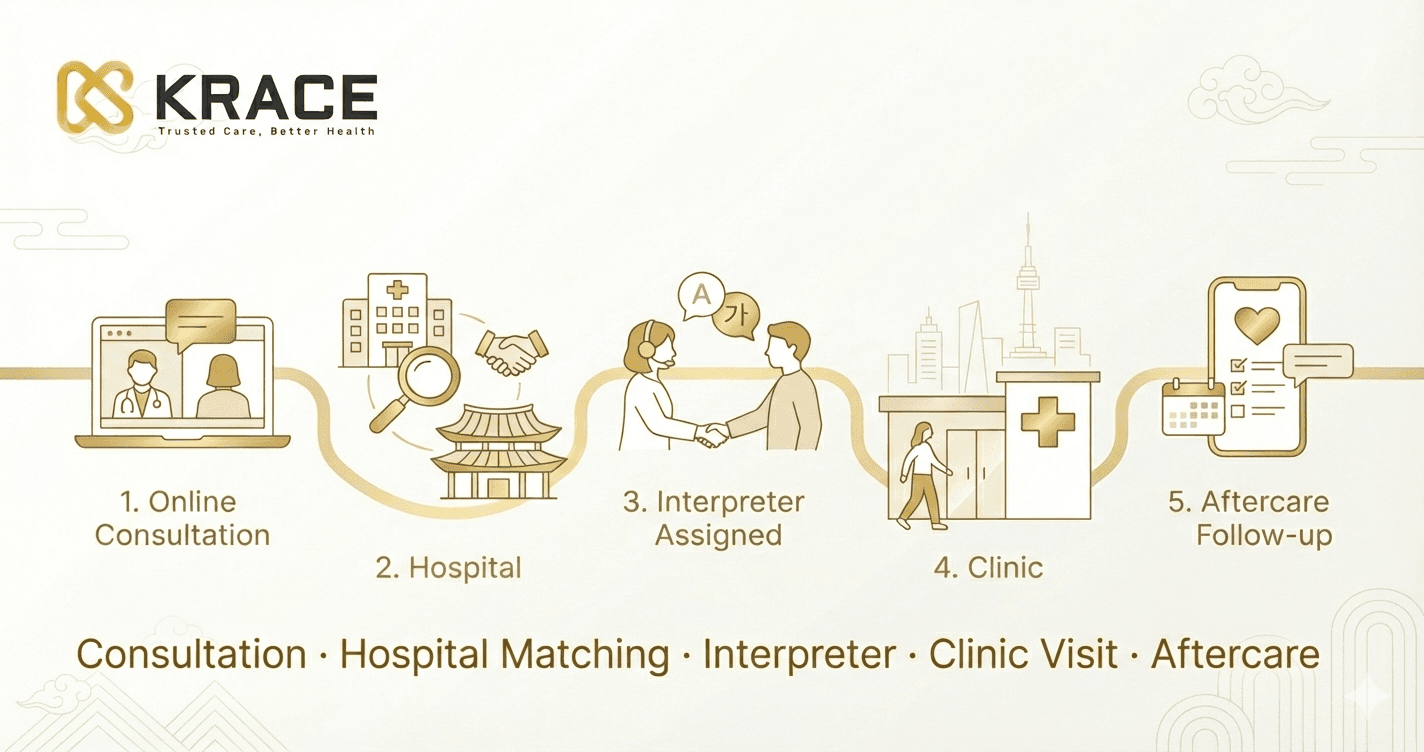
KRACE may support matching, booking, communication, logistics, and post-care coordination. The treating provider remains responsible for medical explanations, diagnosis, recommendations, informed consent, treatment, and interpretation of results.

Getting Around Seoul on Appointment Day
NAVER Map is generally more useful than international map apps for Korean building entrances, local routes, and transit details. Its visitor-facing service supports English, Japanese, and Chinese, and provides routes and expected transportation fares.
Save the clinic name in Korean as well as English. Many medical buildings contain several clinics, pharmacies, cafés, and offices, so the floor and suite number can be as important as the street address.
Seoul’s subway connects the city with parts of Incheon and Gyeonggi Province, and official traveler information is available in several languages. Still, avoid scheduling appointments immediately after landing. Immigration, baggage collection, airport transfers, traffic, and fatigue can make a seemingly generous window disappear.
For procedures involving sedation, restricted movement, temporary blurred vision, or medication, ask the clinic whether you need a companion and when it is appropriate to use public transportation. The medical provider—not a travel itinerary—should determine post-procedure restrictions.
Who May Benefit From This Type of Trip?
A planned Korean clinic visit may suit travelers who already intend to visit Korea and want to organize a defined outpatient service, such as:
A preventive health screening
A consultation about an existing concern
Dermatology or aesthetic assessment
Dental examination and planning
Eye or vision consultation
Primary care or specialist evaluation
Follow-up that can be coordinated with care back home
It is less suitable when the condition is unstable, urgent, likely to require prolonged monitoring, or dependent on records that cannot be obtained in time. Emergencies should be handled through appropriate emergency medical services rather than a medical-travel booking process.
The most useful question is not “Can Korea do this fast?” It is:
Can the correct provider safely complete the necessary steps during my available dates, explain them clearly, and support an appropriate follow-up plan?
The Korean Clinic Experience, Without the Hype
Korean clinics can feel fast because many outpatient services are concentrated, digitally organized, and accustomed to high patient volumes. But speed alone does not make a clinic appropriate.
A strong experience comes from the less glamorous details: confirming the doctor, understanding the appointment scope, receiving an itemized quote, protecting time to make a decision, and leaving Korea with usable records and a follow-up plan.
Plan the care first. Build the trip around what the independent medical provider says is clinically appropriate—not the other way around.
You Might Also Like

Korean Health Checkups: Why Travelers Are Booking Screenings in Seoul
Imagine booking a full medical checkup and getting the results the same day—not after weeks of waiting. For many travelers visiting Korea, that’s exactly what happens. Health screenings in Seoul combine fast diagnostics, transparent pricing, and English-friendly clinics. Compared with long wait times and high costs in many countries, a Korean health checkup often feels less like a medical ordeal and more like a well-organized part of your trip. Why More Travelers Are Choosing Korea for Preventiv
blog.kracecare.com

How to Choose the Right Korean Clinic: A Practical Guide
Imagine this: back home, you wait weeks—sometimes months—for a specialist appointment, only to spend 10 minutes in the consultation room. Now imagine landing in Seoul and getting a full consultation, diagnostics, and a treatment plan within 24–48 hours. That’s not an exception. It’s the norm in Korea. But here’s the reality most guides skip: while Korea is fast and affordable, choosing the right clinic as a foreigner can feel overwhelming. Different systems, unclear pricing, and language gaps ca
blog.kracecare.com

Why More Travelers Are Choosing Korea for Primary Care (And What It’s Really Like)
Imagine needing a health checkup but facing a three-month wait back home. Now picture landing in Seoul, booking a clinic visit within days, completing lab tests the same morning, and getting results before the week ends. For many international visitors, that’s not hypothetical — it’s exactly how healthcare works in Korea, especially for those seeking primary care Korea. Across North America, Europe, and Australia, rising costs and long wait times are pushing travelers to look abroad for care. Ko
blog.kracecare.com
Ready to Plan Without Guesswork?
KRACE supports clinic matching, booking, communication, logistics, and post-care coordination for international visitors seeking care from independent licensed Korean providers.
Start with a free consultation →
Author: KRACE Content and Medical Coordination Team
Editorial Review: KRACE Operations and Data Protection Team
Last updated: July 2026
Disclaimer: KRACE supports clinic matching, booking, communication, and post-care coordination. KRACE does not diagnose, recommend treatment, interpret results, or provide care. Medical services come from independent licensed providers. Informational only, not medical advice.
View All 10 Questions to Ask Before Booking
- What is included in the first appointment?
- Will I meet the treating doctor before making a decision?
- Is this consultation-only, or has treatment time been reserved?
- Which tests require fasting, preparation, or a companion?
- When will preliminary and final results be available?
- What English support is available during medical explanations?
- Can I receive an itemized written estimate before payment?
- What records will I receive before returning home?
- What follow-up may be required after I leave Korea?
- Who should I contact if I have a concern after the appointment?
Frequently Asked Questions
These answers cover common questions about booking, timing, costs, registration, and English support during a Korean clinic visit.
What should I confirm before booking a Korean clinic?
Before booking, confirm the exact clinic branch, treating doctor, purpose of the first appointment, preparation requirements, English support, expected costs, and when records or results will be available. Also ask whether the appointment is consultation-only or whether testing or treatment time has been reserved. Requirements vary by specialty, provider, and medical concern.
Can I receive tests and results on the same day?
Sometimes, but it should not be assumed. A clinic may complete blood collection, imaging, or a basic assessment during one visit while issuing final reports later. Timing depends on the test, fasting or sedation requirements, laboratory processing, specialist review, and translation. Ask separately when the test can be performed and when the final interpreted result will be available.
How much does a Korean clinic visit cost?
Prices vary by clinic and package, so request a direct itemized quote for accuracy. Confirm the consultation, tests, imaging, doctor or procedure fees, medication, anesthesia, interpretation, taxes, records, and follow-up. Also ask whether the quote is fixed or preliminary. Broad online comparisons may exclude important components or compare services with very different clinical scopes.
How can I verify a clinic for international patients?
Search the institution’s exact legal name and branch through Medical Korea’s registered-provider system. Registration and additional accreditation are different checks, so review each separately. Confirm the treating doctor, who performs the procedure, the written estimate, liability and cancellation terms, record delivery, and the contact process for concerns after you leave Korea.
Is English support available at every Korean clinic?
No. Some hospitals and international-facing clinics provide English-speaking doctors, coordinators, interpreters, or translated documents, while others offer only basic booking assistance. Confirm who will support communication during the doctor consultation, consent process, procedure, payment, and follow-up. Reception-level English support should not be treated as equivalent to medical interpretation.